
Styling Butterfly Domes in Modern Home Decor
Last Updated: November 7, 2026
Quick Summary
Style butterfly domes by treating each one as a small sculpture with breathing room: build a vignette in threes with books and one organic element, match the base to your room's palette and materials, and keep the piece out of direct sun and away from heaters. Match dome size to the surface, roughly one third of its width.
- Build coffee table vignettes in threes: one dome, one book stack and one organic element.
- Keep lamps at least 20 cm from the glass so heat does not build up.
- Aim for the butterfly to fill roughly half to two-thirds of the visible dome height.
- Dust the outside weekly with a dry microfibre cloth and never spray cleaner onto the dome.
- Check that sellers name the species and country of origin before buying.
Table of Contents
- Why Butterfly Domes Suit Modern Interiors
- Butterfly Dome Decor Ideas for Every Room
- How to Display a Butterfly Dome: Scale, Proportion and Placement
- Matching Colour Palettes and Materials to Your Decor
- Butterfly Dome Care and Cleaning
- Ethical, Non-Taxidermy Materials and What to Check Before You Buy
- Choosing Your First Butterfly Dome
- Frequently Asked Questions
Why Butterfly Domes Suit Modern Interiors
A butterfly dome is a preserved butterfly displayed under a clear glass cloche on a base, and it solves a problem modern interiors keep running into: how to add warmth and texture without clutter. At Newman Art Designs, we have been preserving and mounting specimens since 1996.
The appeal is simple. A dome is a self-contained object. It has a footprint smaller than a dinner plate and a silhouette that reads as sculpture, not ornament. In a room built on clean lines and neutral walls, one dome adds a focal point without adding noise.
There is also a practical angle. Glass domes keep dust off delicate wings. A sealed display keeps dust off delicate wings.
Below, we will show you exactly how to style, place and care for butterfly domes so they look intentional rather than accidental.
Butterfly Dome Decor Ideas for Every Room
Good butterfly dome decor ideas start with one rule: give the piece breathing room. A dome crowded by three other objects loses its impact. Treat it like a small sculpture and it will behave like one. The gap most guides leave is cohesion, how the dome relates to the books, plants, art and lighting already in the room. Below is a room-by-room approach that builds a vignette rather than placing an isolated ornament.
Living Room and Coffee Table Vignettes
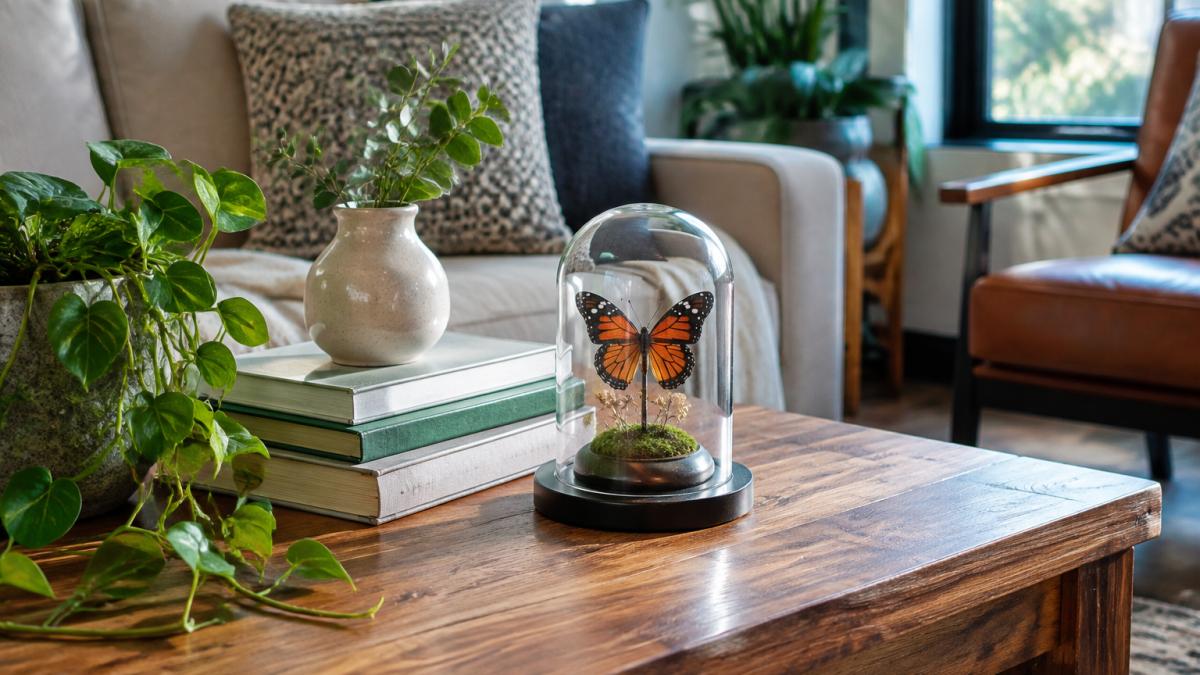
The coffee table is the classic spot, and for good reason. A dome sits at eye level when guests are seated, so the detail inside gets noticed. Build a vignette in threes: one dome as the hero piece, one stack of two or three books laid flat, and one organic element such as a small vase, a bowl or a single stem.
For a modern living room, pair a small dome with a low ceramic bowl and a single dried stem in a matte vase. Avoid glossy lacquer trays or mirrored coasters directly beneath the dome, the reflections compete with the glass and make the specimen harder to read.
Bedside, Shelf and Hallway Displays
Smaller domes suit small surfaces. A bedside table, a hallway console or a floating shelf all work if you respect height. Measure the clear space above the surface before you buy, leave at least a hand's width of empty space around the dome, and on shelves place the dome at eye level rather than on the bottom tier.
A bedside vignette works best with a small dome, a low lamp and one book, no more. Keep the lamp at least 20 cm from the glass so heat does not build up. On a floating shelf, centre the dome and pair it with a single small object offset to one side; a row of three or more objects flattens the display. A hallway console with one dome and a small lamp creates a stopping point. Guests pause. That is the whole point.
Dining, Study and Cabinet-Top Vignettes
On a dining sideboard or study desk, the dome should sit off-centre and slightly back from the working edge. Pair it with a stack of two art books and a small stone or ceramic object; the stone adds weight and stops the arrangement looking floaty.
A common pattern in modern interiors is to repeat a material rather than a shape: if the room already has brass hardware, choose a brass-toned base; if it has black metal legs, choose a black base. That single repeat makes the dome look commissioned for the room rather than bought separately.
Keep domes out of direct sun and away from heaters, as heat and UV can fade the specimen over time.
How to Display a Butterfly Dome: Scale, Proportion and Placement
How to display a butterfly dome comes down to three numbers: height, width and sightline. Get those right and the rest follows. The practical gap in most guides is the relationship between the dome and the butterfly inside it, a large dome with a small specimen looks empty, and a small dome with a wide-winged specimen looks cramped.
Scale is about the room, not the object. A small dome on a large empty wall looks lost. A large dome on a narrow shelf looks cramped. Match the dome to the surface it sits on, roughly one third of the surface width.
Proportion is about neighbours and about the specimen. If everything around the dome is tall and vertical, the dome reads as a low, calm shape. That contrast is useful. If everything is low and horizontal, the dome disappears.
Placement is about light and traffic:
- Keep domes out of direct sun, which can fade colours over time
- Avoid spots where doors swing or elbows land
- Set the base on a felt pad to protect timber surfaces
- Check the sightline from the main seating position: the butterfly should be visible without crouching or standing on tiptoe
For a fuller walkthrough of placement and proportion, see our guide on how to style glass domes.
A quick reference:
| Surface | Dome Size | Spacing Rule | Watch For |
|---|---|---|---|
| Coffee table | Small to medium | One third of table width | Crowding with books |
| Bedside table | Small | Hand's width clearance | Lamp heat and glare |
| Floating shelf | Small | Centred, eye level | Shelf weight limits |
| Hallway console | Small to medium | Offset, not centred | Door swing |
| Cabinet top | Medium to large | Pair with one object | Direct sunlight |
Watch out: on a floating shelf, check the manufacturer's weight limit before placing a medium or large dome, because glass and a solid timber base can be heavier than they look and a sagging shelf ruins the sightline.
Matching Colour Palettes and Materials to Your Decor
The fastest way to make a dome look out of place is to ignore the room's palette. The second fastest is to ignore its materials.
Modern interiors tend to run on three palettes:
- Warm neutral: oak, cream, linen, brass. Pair with gold-tone or natural wood bases.
- Cool minimal: white, grey, black, glass. Pair with black finish bases and clear domes.
- Earthy: terracotta, olive, walnut. Pair with dark wood bases and moss or stone styling inside.
Material pairing matters just as much. Glass and timber sit well together. Glass and high-gloss lacquer compete. If your furniture is matte, keep the dome's base matte too.
One insider tip: the base does more work than the butterfly. A contrasting base, black against pale timber for example, gives the piece a deliberate look. A base that blends into the shelf makes the whole thing vanish.
Butterfly Dome Care and Cleaning
Butterfly dome care and cleaning is mostly about restraint. Glass scratches. Wings are fragile. Strong cleaners do more harm than dust.
Follow this routine:
- Dust the outside of the dome weekly with a dry microfibre cloth
- Wipe glass with a barely damp cloth and a mild soap solution
- Dry immediately with a second, dry cloth to avoid streaks
- Never spray cleaner directly onto the dome
- Keep the piece out of direct sun and away from heaters
- Lift by the base, never by the glass
- Check the base fitting every few months for looseness
Watch out: never open the dome to "air it out" or dust inside. Preserved specimens are sealed for a reason, and opening the display exposes delicate wings to moisture and physical damage.
For step-by-step instructions, our guide on how to clean glass dome displays covers the full process.
Ethical, Non-Taxidermy Materials and What to Check Before You Buy
When shopping for butterfly domes, it is worth checking how the specimens were sourced before you buy.
Here is what to look for:
- Species disclosure: the seller names the species and country of origin
- Sourcing statement: farmed, sustainably collected, or captive-bred
- Preservation method: how the specimen was dried and mounted
- Materials list: glass versus acrylic, timber versus composite base
If a seller cannot name the species, that is a red flag. Reputable sellers publish it.
If you want to understand what cruelty-free claims actually mean in this category, read our breakdown of what cruelty free nature decor really means for buyers.
Choosing Your First Butterfly Dome
Start with size and species, then work outward to styling. A first dome should be small enough to place easily and striking enough to justify the shelf space.
Three good starting points from our range:
- Japanese Emperor butterfly in a dome ($99.95): a multicoloured species and the national butterfly of Japan, mounted on a wooden base approximately 9-11 cm wide and 11-13 cm high.
- Dotted Glory butterfly in a dome ($99.95): a South American species with a distinctive spotted pattern and strong warm-cool contrast. Same compact size.
- Blue Morpho Didius butterfly in a dome ($129.95): a larger dome on a wooden base, made in Australia.
If you are still deciding on a style, browse the full range of domes to compare sizes and species side by side. For a deeper primer on the format itself, our article on butterfly in a dome display art explains how the pieces are built.
A common mistake is buying the biggest dome first. Start small. You can always add a second piece once you know how the first one sits in your space.
Styling a preserved specimen well takes a little patience, but the payoff is a piece that starts conversations for years. If you want museum-quality preservation, Newman Art Designs has been mounting specimens since 1996, with free shipping across Australia.
Frequently Asked Questions
Where should you place a butterfly dome in a modern home?
Put it where the detail can actually be seen and the light is indirect. A coffee table, side table, shelf or hallway console works well because the dome sits at eye level when you are seated or standing nearby. Keep it out of direct sun, which fades the wings over time, and away from steamy bathrooms and hot kitchens. Small domes, approximately 9-11 cm wide and 11-13 cm high, fit neatly on a desk or narrow shelf without crowding the space.
How do you make a butterfly dome display look contemporary rather than old-fashioned?
Lean on restraint. Use one dome as the focal point instead of clustering several, pair it with a plain wooden or black base, and keep the surrounding objects to two or three pieces at most. Modern interiors respond to negative space, so a single clear glass cloche on an empty stretch of shelf reads as sculptural. Grouping a large dome with a smaller one at different heights also works, provided the colours tie together and the surfaces stay uncluttered.
How do you clean a glass butterfly dome safely?
Dust the outside of the glass with a microfibre cloth, then wipe with a barely damp cloth and dry immediately to avoid streaks. Never spray cleaner directly onto the dome or the specimen, and never lift the glass to clean inside unless the base is designed for it. Keep the dome out of direct sunlight and away from heat sources, and handle it by the base rather than the glass. A light dusting every few weeks is enough to keep a butterfly dome looking sharp.
Are butterfly domes ethically sourced and do they last?
Ask the seller where the specimens come from and how they were preserved before you buy. Keep the piece out of direct sun and away from damp. Newman Art Designs has been established since 1996 and offers free shipping in Australia. Store the dome away from windows and heat, and it will stay a display piece rather than a short-lived one.
Prices of butterfly domes

