What Cruelty Free Nature Decor Really Means for Buyers
Last Updated: November 2, 2026
Quick Summary
Cruelty free nature decor is home decoration built from materials that did not require harming or killing an animal for the purpose of making the piece. The phrase is not defined in law and sellers use it loosely, so treat it as a claim to verify rather than a guarantee.
- Cruelty-free means no animal was harmed for the item; vegan means no animal-derived materials at all.
- No regulator defines or polices cruelty-free in the decor market, so any seller can print the phrase.
- For preserved insect art, ask whether specimens were farmed or wild-caught and confirm the species is not threatened.
- Conventional silk production kills the pupae, so look for ahimsa silk or peace silk if the claim is no harm.
- Ask sellers about adhesives and finishes, since animal-derived glue or casein treatments rarely appear on labels.
Table of Contents
- What Cruelty Free Nature Decor Actually Means
- Where the Phrase Comes From
- Why It Is Not a Regulated Term
- Cruelty-Free vs Vegan: The Distinction That Trips Buyers Up
- Animal Testing, Ingredient Testing and What Labels Leave Out
- The Ethics Behind Preserved Insect Art
- How to Identify Ethically Sourced Insect Specimens
- Building Cruelty-Free Home Decor Beyond the Beauty Aisle
- How to Verify a Cruelty-Free Claim Before You Buy
- Choosing a Piece That Matches Your Values
- Frequently Asked Questions
What Cruelty Free Nature Decor Actually Means
Cruelty free nature decor is home decoration built from materials that did not require harming or killing an animal for the purpose of making the piece. The phrase borrows its language from cosmetics, where it has a settled meaning, and applies it to objects: framed specimens, dried botanicals, beeswax candles, wool textiles and leather goods. This guide unpacks what the term can and cannot promise, because the wording is not defined in law and sellers use it loosely.
The confusion is understandable. A shopper who has spent years reading "not tested on animals" on shampoo bottles meets the same phrase on a wall hanging and assumes the same rules apply. They don't. There is no equivalent of the cosmetics testing regime for a framed butterfly, which is why you have to do the verifying yourself.
Below, we break down where the phrase came from, how it differs from vegan, and the specific checks that separate a genuine ethical claim from a decorative one.
Where the Phrase Comes From
The term grew out of the animal rights movement's campaign against product testing, then migrated into retail as a marketing signal. Cosmetic and personal care brands adopted it first, and consumers learned to scan for it on packaging. Home decor sellers borrowed it because it signals the same values to the same buyers.
That migration is where precision got lost. A cosmetics company claiming cruelty-free status is making a statement about a testing process. A decor seller using the phrase is usually making a statement about sourcing, which is a different claim entirely. When you see cruelty free nature decor on a product page, the seller is telling you the materials were obtained without animal harm, not that a laboratory was involved.
Why It Is Not a Regulated Term
No regulator defines or polices "cruelty-free" in the decor market. In cosmetics, the Therapeutic Goods Administration's guidance on cosmetic claims sets expectations around advertising accuracy, and the Australian Competition and Consumer Commission enforces consumer law against misleading representations. Neither body publishes a standard for what cruelty-free means on a picture frame.
The practical consequence: any seller can print the phrase on a label. The claim is only as trustworthy as the evidence behind it. That is not a reason to dismiss it, but it is a reason to ask what the seller means before you pay a premium for it.
Cruelty-Free vs Vegan: The Distinction That Trips Buyers Up
These two labels answer different questions, and conflating them is the most common mistake we see. Cruelty-free means no animal was harmed or killed to produce the item. Vegan means the item contains no animal-derived ingredients or materials at all.
A wool blanket can be cruelty-free, if the sheep were treated well and not slaughtered for the fleece, while remaining non-vegan because wool comes from an animal. A beeswax candle is the same story: no bee was killed to harvest the wax, but the wax is an animal product. Conversely, a synthetic piece can be vegan and still be produced in ways an ethical buyer would object to.
| Label | What it addresses | Example |
|---|---|---|
| Cruelty-free | Animal harm in production | Wool from a well-treated flock |
| Vegan | Animal ingredients or materials | Plant-based resin frame |
| Natural | Origin of materials | Untreated timber |
| Organic | Farming method | Certified organic cotton |
Neither term is regulated for decor, so treat both as claims to verify rather than guarantees.
Animal Testing, Ingredient Testing and What Labels Leave Out
In cosmetics, the cruelty-free conversation splits into two questions: was the finished product tested on animals, and were individual ingredients tested on animals? A brand can avoid finished-product testing while still buying ingredients that were tested earlier in the supply chain.
That same supply-chain blindness applies to decor. A frame assembled without animal testing tells you nothing about the adhesives, finishes or treatments used on the materials inside it. Most guides skip this. The label on the box rarely covers the inputs the seller never sees.
Watch out: a seller who answers only "we don't test on animals" has answered a cosmetics question about a decor product. Ask instead where the materials came from and how the animal component was obtained.
The Ethics Behind Preserved Insect Art
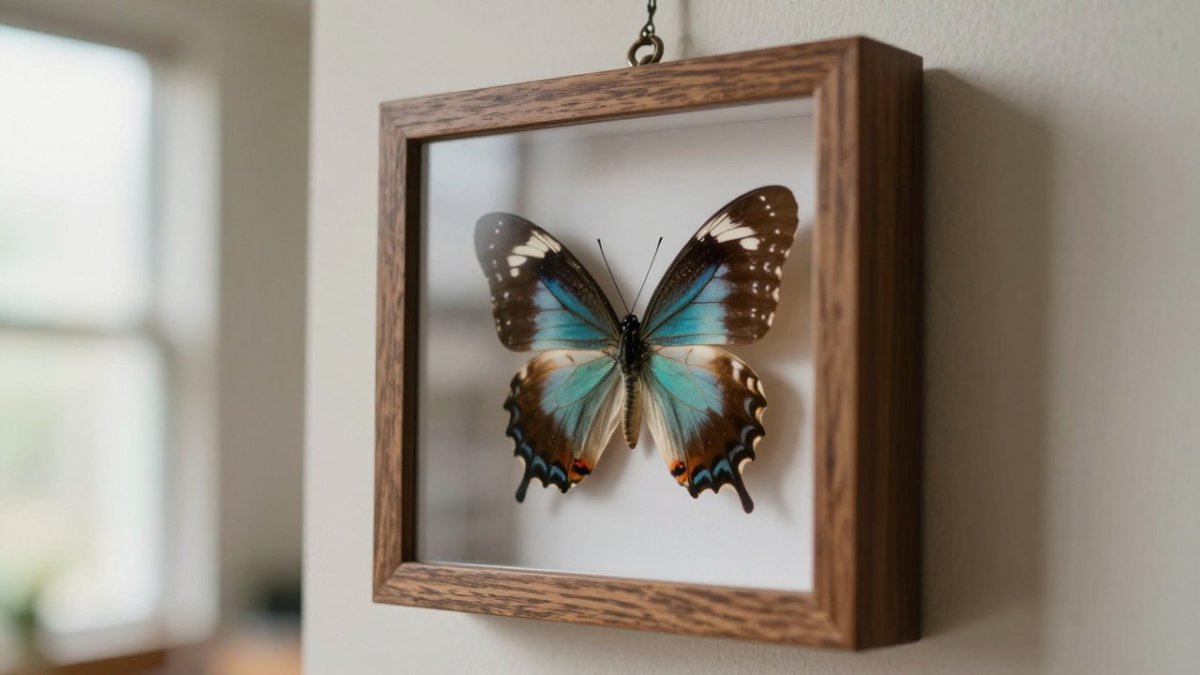
Preserved insect art sits at the centre of this debate because it involves a dead animal by design. The ethical question is not whether the insect died, but how and why. Specimens sourced from sustainable farms sit in a different category from wild-caught specimens taken from declining populations.
Buyers often want to know the insect wasn't taken from the wild and wasn't an endangered species. A responsible seller can answer both, and should be able to explain the difference between farmed and wild-caught stock without hesitation.
How to Identify Ethically Sourced Insect Specimens
Start with documentation. A seller making an ethical claim should be able to tell you the country of origin, whether the specimen was farmed or wild-caught, and how the population is managed. Vague assurances are a red flag; specific answers are the signal.
Guides on ethically sourced butterfly wall art and ethical sourcing standards for insect specimens walk through the verification steps in more detail. In practice, the checks come down to a short list:
- Country of origin stated clearly
- Farmed versus wild-caught disclosed
- Species not listed as threatened
- Seller can explain the sourcing relationship
- Preservation method described
If a seller cannot clear all five, the ethical claim is decoration, not documentation.
Building Cruelty-Free Home Decor Beyond the Beauty Aisle
The phrase 'cruelty free nature decor' does not map neatly onto furnishings, because decor involves animal materials that cosmetics rarely do. Understanding how each material behaves under a cruelty-free claim is the part most guides skip.
Wool and other animal fibres. A wool throw or upholstery fabric can be cruelty-free if the sheep were not harmed for the fleece, but the claim depends on husbandry, shearing practice, and what happens at end of life.
Leather and hides. Leather is almost always a by-product of the meat industry, which means the animal was killed for another purpose.
Feathers and down. Feathers used in decor or cushions may be a by-product of poultry, or may be live-plucked. The latter is the welfare concern, and it is not visible in the finished product.
Beeswax and other insect products. A beeswax candle involves harvesting a product from a colony.
Adhesives, finishes and treatments. This is the blind spot. A frame assembled with animal-derived glue, or a textile finished with a casein-based treatment, carries an animal input the label rarely mentions.
Preserved specimens. Framed insects, taxidermy and dried botanicals each raise the question of how the animal or plant was obtained. For insects, farmed versus wild-caught is the central distinction, and a responsible seller will disclose it.
For readers thinking about the wider room, the principle is consistent across a space. How to choose sustainable luxury art for eco-conscious homes extends the cruelty-free mindset into decor purchases.
How to Verify a Cruelty-Free Claim Before You Buy
Here is the concrete version of what to check.
Start with the claim's scope. A cruelty-free claim on decor can refer to the animal-derived material (the wool, the leather, the silk, the feathers), the adhesives and finishes, the testing regime, or all three. Ask the seller which one they mean.
Check for named third-party schemes. In the absence of a decor-specific standard, the credible signals are schemes built for adjacent categories. Choose Cruelty Free accredits brands that meet its animal-testing criteria, and Leaping Bunny runs an internationally recognised programme with supply-chain auditing.
Interrogate the supply chain, not the slogan. A common pattern is a brand that avoids finished-product testing but buys components from suppliers who do not. Ask where the animal component was sourced, who processed it, and whether the seller has visited or audited that supplier.
Use the regulator as a backstop. Under ACCC guidance on country of origin and product claims, a seller must not make a representation that is misleading or deceptive, and 'cruelty-free' is a representation like any other. If a claim collapses under a direct question, you have grounds to walk away and, in clear cases, to complain.
Watch out: a seller who answers only 'we don't test on animals' has answered a cosmetics question about a decor product. Redirect them to the material and the supply chain.
A short verification checklist:
- Claim scope stated (material, testing, or both)
- Named scheme or audit referenced, not just a logo
- Animal component's origin disclosed
- Supplier or processing method described
- Seller responds to follow-up questions with specifics
The same logic applies to specimens, where the sourcing questions are sharper because the animal is the object.
Choosing a Piece That Matches Your Values
Values-driven buying is not about finding a perfect label. It is about understanding what you are bringing into your home and being comfortable with the answer. A preserved specimen from a documented, sustainable source can sit comfortably alongside a plant-based frame and a wool throw, because you know the story behind each.
If you want to act on that, browse the collection and see how documentation is presented for each piece.
Frequently Asked Questions
What does cruelty-free mean for nature decor?
For nature decor, cruelty-free usually means the piece was made without harming animals for the purpose of production. In practice, that covers how materials were sourced, whether any animal testing was involved in finishes or treatments, and whether specimens were collected ethically rather than farmed or taken from the wild for profit. The term is not regulated in Australia, so it functions as a claim rather than a guarantee. Ask the seller what it means for their specific products before you rely on it.
Is preserved insect art cruelty-free?
It can be, but it depends entirely on how the specimens were obtained. Ethically sourced insect specimens typically come from conservation projects, sustainable farms, or natural lifespan endings rather than being collected from the wild in volume. Reputable sellers can explain the origin of each specimen and how it was preserved. If a seller cannot tell you where the insects came from, treat the cruelty-free claim with caution, regardless of how the piece is labelled.
Does cruelty-free mean the same as vegan?
No. Cruelty-free refers to animal testing and harm during production. Vegan means the product contains no animal-derived ingredients or materials at all. A preserved butterfly specimen is cruelty-free if ethically sourced, but it is not vegan because it contains an animal. Similarly, a candle made with beeswax is not vegan, though it may be cruelty-free. The two labels answer different questions, and a product can carry one without the other.
How can I tell whether an insect specimen was ethically sourced?
Ask the seller directly about provenance: where the specimen came from, whether it was farmed or wild-caught, and how it was obtained. Look for sellers who can name their supply chain and explain their sourcing policy in plain language. Third-party certification is rare for insect art, so transparency is the strongest signal. A seller who answers specific questions with specific answers is more trustworthy than one who repeats a generic ethical claim.
The gap between a cruelty-free claim and a cruelty-free product comes down to evidence. We built Newman Art Designs around museum-quality preservation, a documented sourcing approach and free shipping across Australia, so the answer to "where did this come from" is never a shrug. Get started with Newman Art Designs and choose a piece you can explain to every guest who asks about it.

