
How to Choose Sustainable Luxury Art for Eco-Conscious Homes
Last Updated: October 24, 2026
Quick Summary
Sustainable luxury art combines museum-quality craftsmanship with ethical sourcing and environmental responsibility, allowing you to beautify your home while honouring the natural world. Choose pieces based on material provenance, specimen legality, production transparency, packaging practices, and end-of-life repairability to ensure genuine sustainability over eco-marketing.
- Ask sellers five key questions: material provenance, specimen legality, production transparency, packaging type, and repair options.
- Premium pieces lasting 50 years have lower environmental impact per year than cheap art replaced every two years.
- Archival-grade adhesives and acid-free backing allow art to last decades rather than deteriorate within five years.
- Secondhand and estate pieces often have the lowest environmental impact because their material and shipping footprint is already sunk.
- Stable room temperature (18-22°C), indirect light, and monthly dusting preserve specimens and extend collection lifespan.
Table of Contents
- Understanding Sustainable Luxury Art for Your Home
- Evaluating Sustainable Art Materials and Ethical Production
- Selecting Nature-Inspired Wall Art That Reflects Your Values
- Biophilic Interior Design: Bringing Natural Elements Indoors
- Styling Nature Art in the Home: Placement and Display
- Balancing Luxury, Durability, and Environmental Impact
- Caring for and Preserving Your Sustainable Art Collection
- Building Your Sustainable Art Collection with Newman Art Designs
- Frequently Asked Questions
Understanding Sustainable Luxury Art for Your Home
Sustainable luxury art combines museum-quality craftsmanship with ethical sourcing and environmental responsibility, pieces that beautify your home while honouring the natural world.
At Newman Art Designs, we curate nature-inspired art that meets this standard, including responsibly sourced Papilio maackii and Monarch specimens mounted using museum-preservation techniques.
The advantage is living with it guilt-free: no fast-fashion decor waste, no unethical collection practices, and an investment that will outlive you.
Evaluating Sustainable Art Materials and Ethical Production
Choosing sustainable luxury art starts with asking the right questions about how it's made and where it comes from. Here's a practical framework for any piece.
A five-point sustainability checklist for any artwork
- Material provenance. Ask what the frame, backing, mount, and adhesives are made from, and where the raw materials originate. Look for Forest Stewardship Council (FSC) or Programme for the Endorsement of Forest Certification (PEFC) chain-of-custody claims on timber frames, and ask whether backing boards are acid-free and lignin-free.
- Specimen or source legality. For preserved specimens, ask whether the material is captive-bred, museum-surplus, or legally wild-collected. In Australia, wildlife trade is regulated under the Environment Protection and Biodiversity Conservation Act 1999 (EPBC Act) and CITES as implemented domestically. A seller who cannot explain their permit position is a red flag.
- Production transparency. Ask who made the piece and where. "Handcrafted" is meaningless without a location and a named workshop.
- Packaging and shipping. Ask what the piece ships in. Recyclable cardboard, paper tape, and moulded pulp inserts beat expanded polystyrene, PVC blister packs, and single-use plastic film. Ask about consolidated shipping or carbon-offset options.
- End-of-life plan. Ask what happens when the frame is damaged or the piece is no longer wanted. Can it be repaired? Are components separable for recycling? Is there a take-back service?
The lifecycle impact of materials, framing, and shipping
True sustainability looks beyond the specimen: frame, mounting materials, packaging, and shipping all carry environmental weight, and the biggest gains come from longevity.
Framing. A shadowbox frame in sustainably sourced timber with archival-grade materials and low-VOC adhesives protects your art while minimising harm. Cheap plastic or composite frames degrade, off-gas VOCs, and end up in landfill within years.
Mounting materials. Archival-grade adhesives and acid-free backing prevent yellowing and deterioration, the difference between art that lasts five years and art that lasts fifty. Reversible mounting is the gold standard because it allows repair or reframing rather than replacement.
Packaging and shipping. Responsible suppliers use recyclable or compostable packaging and consolidate orders.
Checking provenance and artist compensation
Ethical sourcing means specimens were collected legally and sustainably, not poached from endangered populations or fragile ecosystems.
Ask the seller directly: where do specimens originate, captive-bred populations, museum donations, or sustainable wild collection?
Artist compensation matters too. Handcrafted framing is skilled work, and fair-trade art means the people doing it earn decent wages.
Look for transparency: established businesses publish their sourcing practices.
How to verify a claim without specialist knowledge
You don't need a materials science degree to separate substance from spin. Three habits do most of the work:
- Ask for the paper trail. Certificates, permits, and supplier declarations should be available on request. Verbal assurances alone carry little weight.
- Prefer specificity over adjectives. "FSC-certified oak frame, acid-free mount board, water-based finish" is verifiable. "Eco-luxury materials" is not.
- Check consistency across the range. A genuinely committed seller applies the same standards across every product, not just the ones marketed as green.
Selecting Nature-Inspired Wall Art That Reflects Your Values
Nature-inspired wall art comes in many forms: botanical prints, landscape paintings, abstract compositions, and preserved specimens. The best choice depends on your space, aesthetic, and values.
Botanical prints bring organic softness to bedrooms, studies, and living areas. Abstract nature art suits modern spaces. Preserved specimens like framed butterflies and beetles offer something unique: genuine connection to the natural world, not a reproduction.
When selecting pieces, ask: does this reflect my values, fit my space, and will I still love it in five years? The best sustainable luxury art passes all three tests. A large statement piece works as a focal point; smaller frames create interest through grouping. The key is intentional placement.
Biophilic Interior Design: Bringing Natural Elements Indoors
Biophilic design incorporates natural elements into interiors to improve wellbeing and connection with nature; research shows such spaces reduce stress and improve focus.
Biophilic design works best when intentional, not cluttered: a few well-chosen pieces create more impact than many scattered ones. Greens, blues, and earth tones create calm; warm woods and natural textures add warmth. Layer framed art with living plants and warm lighting.
Styling Nature Art in the Home: Placement and Display
Where you hang your art matters as much as what you choose.
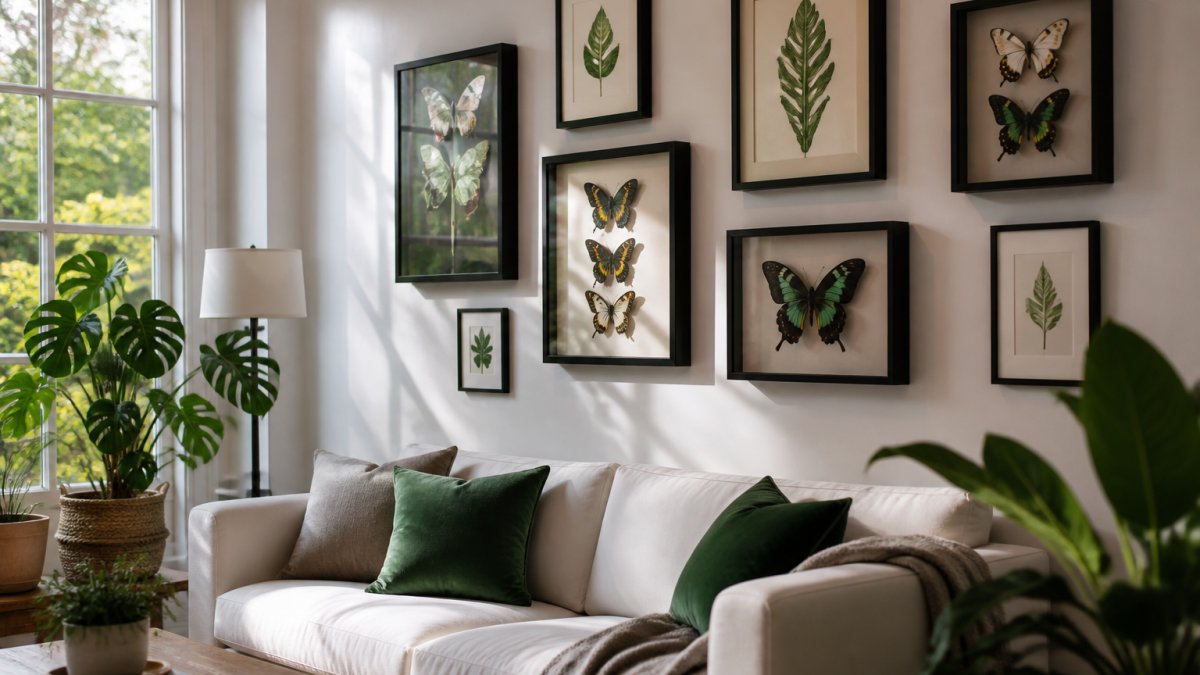
Wall height and grouping: Hang art at eye level (roughly 1.5 metres from the floor). For grouped pieces, arrange them in a cohesive pattern, salon style (organic clustering) or grid style (structured alignment).
Lighting: Natural light is ideal, but avoid direct sunlight, which fades colours. Soft, indirect light showcases detail without damage; add subtle picture lighting if needed. Best Lighting Techniques for Luxury Nature Wall Displays shows how lighting transforms how your art looks and feels in your home.
Room-by-room placement:
Danaus plexippus, Monarch Butterfly, in a Frame →
- Bedrooms: Calming pieces like soft botanical prints or gentle landscape art
- Living areas: Statement pieces that spark conversation, like striking preserved specimens
- Studies: Focused, detailed art that inspires concentration
Scale and spacing: In a small apartment, one well-chosen piece beats several cramped together. In larger rooms, grouping multiple pieces creates visual weight.
Interior design principles for nature-inspired spaces recommend balancing art with negative space. Overcrowding a wall feels chaotic. Leave breathing room.
Balancing Luxury, Durability, and Environmental Impact
Well-made objects can be the greener choice, so a decision framework is more useful than either celebrating luxury or pushing minimalism.
When premium craftsmanship is the greener choice
Luxury doesn't have to mean wasteful. A framed butterfly specimen that lasts 50 years has far lower impact per year than cheap wall art replaced every two years. The case for premium pieces rests on four factors:
- Durability. Museum-preservation techniques protect your art from fading, deterioration, and damage. Archival materials cost more upfront but eliminate replacement cycles.
- Repairability. A well-made frame can be re-glazed, re-backed, or re-finished; a bonded composite frame usually cannot. Ask whether the piece can be repaired rather than replaced, and whether spare parts are available.
- Material efficiency. Premium pieces are designed to last, not to be disposable. A solid timber frame uses more timber per unit than a thin composite one, but across a 50-year life the material intensity per year is usually lower.
- Resale and provenance value. Named makers, documented provenance, and limited production runs support resale. A piece that can be resold or passed on has a second life built in, the most effective end-of-life strategy for art.
A decision framework: when does the premium justify itself?
Use these four questions to decide whether a higher-priced piece is the more sustainable purchase.
- Will I still want this in ten years? If uncertain, a print or smaller piece is the lower-risk choice. If confident, the premium is more likely to pay off environmentally and financially.
- Can it be repaired or reframed? Repairability is the strongest predictor of long-term environmental performance. A piece that can be maintained won't be replaced.
- Is the provenance documented? Documented sourcing and maker details support resale and give you a paper trail to verify claims.
Cost per year, and the Australian consumer-law backdrop
Sustainable luxury art costs more than mass-produced alternatives because it's built to last and sourced responsibly. The Australian Consumer Law, enforced by the ACCC, includes consumer guarantees that goods must be of acceptable quality, fit for purpose, and durable for a reasonable period given their price and description.
Think of cost per year. A $150 frame lasting 30 years costs $5 per year; a $30 frame lasting 2 years costs $15 per year. Quality saves money and reduces waste.
Buying options across originals, prints, and secondhand pieces
Eco-conscious luxury doesn't require buying new or overspending. A practical hierarchy:
- Secondhand and estate pieces. Often the lowest-impact option because the materials and shipping footprint are already sunk. Inspect frames for damage and ask about provenance; reframing can extend its life considerably.
- Originals from named makers. Highest upfront cost, but usually the strongest combination of durability, repairability, and resale value.
- Limited-edition prints on archival paper. A middle path. Ask about paper stock (acid-free and lignin-free is the baseline), ink type (pigment inks generally outlast dye inks), and whether the print is signed and numbered.
Whichever route you take, apply the same test: will this piece still be on my wall in a decade, and can it be repaired? If yes, the environmental case is strong regardless of price.
Caring for and Preserving Your Sustainable Art Collection
Cleaning: Dust glass domes and frames gently with a soft, dry cloth. For shadowbox frames, avoid touching the specimen directly.
Light exposure: Keep pieces away from direct sunlight.
Temperature and humidity: Stable conditions preserve specimens. Avoid extreme temperature swings and high humidity, which promote mould and deterioration.
Handling: When moving or adjusting pieces, support the frame, not the specimen. Avoid touching preserved insects directly; skin oils can damage delicate structures. How to Clean Glass Dome Displays: A Step-by-Step Guide provides practical maintenance instructions to preserve your pieces for decades.
Long-term storage: Wrap stored pieces in acid-free paper and keep them in a cool, dry place.
| Care Task | Frequency | Impact |
|---|---|---|
| Gentle dusting | Monthly | Prevents dust buildup, maintains clarity |
| Light assessment | Quarterly | Prevents fading, protects colours |
| Humidity check | Seasonally | Prevents mould, preserves specimen |
| Deep inspection | Annually | Catches damage early, extends life |
Building Your Sustainable Art Collection with Newman Art Designs
Starting a sustainable art collection doesn't require buying everything at once. Build thoughtfully over time.
Begin with a statement piece. Choose one artwork that genuinely speaks to you. Our Ethical Butterfly Specimen Review: What to Check guide helps you evaluate what makes a specimen truly sustainable and ethically sourced.
Understand the investment. Why Preserved Specimens Cost More explains the real factors behind pricing, museum-preservation techniques, ethical sourcing, skilled framing, and durability. Why Preserved Specimens Cost More explains the real factors behind pricing, museum-preservation techniques, ethical sourcing, skilled framing, and durability.
Choose pieces that complement your space. Consider colour, scale, and mood. A striking Monarch butterfly in a frame works as a focal point.
Maintain your collection. How to Clean Glass Dome Displays: A Step-by-Step Guide provides practical maintenance instructions to preserve your pieces for decades.
Frequently Asked Questions
How can I tell whether sustainable luxury art is ethically sourced?
Reputable sellers provide clear provenance information about where specimens originate and how they were sourced. Ask whether pieces come from established breeding programs, museum deaccessions, or ethical collection practices rather than wild capture. Look for sellers who document their supply chain and support conservation efforts. Museum-quality preservation techniques also indicate commitment to craftsmanship and longevity. Newman Art Designs, for example, has operated since 1996 with a focus on museum-preserved specimens, offering transparency about their curation and quality standards.
What sustainable art materials should I prioritise when choosing pieces?
Prioritise natural, responsibly sourced framing materials like sustainably harvested timber, recycled metals, and glass. Avoid synthetic or plastic frames when possible. For artwork itself, seek pieces created with non-toxic, archival-quality materials that won't fade or deteriorate. Consider the full lifecycle: low-impact packaging, minimal shipping waste, and frames designed to last decades. Museum-preserved specimens in shadowbox frames or glass domes represent durable options that maintain their beauty over time, reducing the need for replacement and minimising environmental impact.
Can preserved specimen art like butterflies and insects be considered sustainable?
Yes, when sourced ethically and preserved with museum-quality techniques. Preserved specimens represent a sustainable alternative to fast-moving nature decor because they last indefinitely without fading or deterioration. They support conservation awareness and appreciation for biodiversity. The key is verifying ethical sourcing: specimens should come from established breeding programs, museum collections, or responsible suppliers rather than wild capture of endangered species. Handcrafted framing and display add to their durability and longevity, making them a long-term investment rather than disposable decor.
How do I balance paying premium prices for sustainable luxury art with environmental responsibility?
Higher prices for sustainable luxury art reflect genuine costs: ethical sourcing, museum-quality preservation, handcrafted framing, and responsible production practices. These pieces last decades or longer, spreading their environmental cost over time. Compare the lifecycle impact of one $69.95 to $99.95 framed butterfly specimen versus buying multiple cheaper nature prints that fade or require replacement. Quality craftsmanship means less waste, longer enjoyment, and greater value. Investing in fewer, well-chosen pieces from established makers like Newman Art Designs supports skilled artisans and sustainable practices rather than fast-fashion decor.

