
Ethical Butterfly Specimen Review: What to Check
Table of Contents
- What an Ethical Butterfly Specimen Review Should Actually Check
- The Range in One Table: Butterfly Taxidermy Price vs Specimen Quality
- How to Tell Whether Butterfly Specimens Are Ethically Sourced
- Reading Butterfly Specimen Shop Reviews Without Getting Fooled
- Wing Condition, Colour and Framing: Judging Specimen Quality
- Packaging, Delivery and Buyer Protections on Delicate Specimens
- What to Look For in a Butterfly Specimen Shop
- Frequently Asked Questions
Last Updated: October 8, 2026
What an Ethical Butterfly Specimen Review Should Actually Check
An ethical butterfly specimen review assesses how a preserved butterfly was sourced, prepared and mounted, and whether the seller can prove both. At Newman Art Designs, buyers still focus on how a piece looks in photos.
Buying a butterfly specimen online is a leap of faith: you cannot turn the dome over or ask where the insect came from.
Here is what to check before you pay, and where most listings fall short.
The Five Checks That Decide Value
Every butterfly specimen purchase comes down to five questions. Get clear answers to all five and you are buying well.
- Provenance: Can the seller name the species, the country of origin, and how it was obtained?
- Condition: Are the wings intact, the colour vivid, and the body complete with legs and antennae?
- Mounting: Is the specimen properly set, pinned, and sealed against moisture and pests?
- Display: Does the frame or dome suit the size and shape of the butterfly?
- Protection: What happens if it arrives damaged, and what is the return policy?
Most disappointing purchases fail on one of these five. A stunning photo hides a chipped wing. A cheap price hides a wild-caught specimen with no paperwork.
Australian Border Force guidance on importing wildlife specimens sets out the permits and declarations that apply to bringing preserved wildlife into the country, which is why a seller who can document origin matters.
The Range in One Table: Butterfly Taxidermy Price vs Specimen Quality
Butterfly taxidermy price reflects three things: the species, the size of the display, and the mounting work. A common species in a small frame costs far less than a large swallowtail in a hand-carved dome.
Here is how our own range breaks down.
| Piece | Display | Price | Best For |
|---|---|---|---|
| Monarch Butterfly | 10 x 15 cm shadow box frame | $69.95 | First purchase, small walls |
| Papilio maackii | 15 x 15 cm shadow box frame | $69.95 | Symmetrical gallery walls |
| Monarch Butterfly | 9 cm base x 11 cm dome | $99.95 | Desks and shelves |
| Japanese emperor | 9 cm base x 11 cm dome | $99.95 | Gifting, national butterfly appeal |
| Alpine black swallowtail | 18 cm diameter dome | $109.95 | Statement pieces, 360 degree viewing |
Why a Dome Costs More Than a Frame
A dome is not just a fancier frame. It is a different build: glass cut and seated on a base, the specimen mounted to read well from every angle.

With a frame, the specimen sits flat against a backing board. With a dome, we mount the butterfly in the round, which means more positioning work and more material. The Alpine black swallowtail sits in an 18 cm dome on a base carved to fit the pair, so you can walk around it and see the iridescent green from any side.
How to Tell Whether Butterfly Specimens Are Ethically Sourced
Ethically sourced butterfly specimens come from captive-reared stock or licensed rearing projects, not wild collection of vulnerable populations. The seller should name the species, where it was reared, and how the supply chain is documented.
The gap most buyers never close is verification. A claim is not evidence. What separates a documented specimen from a vague one is a paper trail naming the species, the rearing facility or licensed supplier, the country of origin, and the year of preparation.
What Documented Provenance Actually Looks Like
A documented specimen usually comes with some combination of the following. Ask which the seller can provide before you pay:
- Scientific species name, not just a common name like "Monarch" or "swallowtail"
- Country and, where relevant, region of origin, for example, a captive-reared Papilio maackii from a licensed East Asian rearing project reads very differently from an unlabelled swallowtail
- Rearing method, captive-reared, farm-sourced, or wild-collected, stated plainly
If a seller can name the species, origin and rearing method in one reply, that is a strong signal. If the answer is "ethically sourced, don't worry," that is a marketing phrase, not a claim you can check.
Captive-Reared, Farm-Sourced and Wild-Collected Are Not the Same
The trade often treats every non-wild source as equivalent. They are not.
- Captive-reared specimens come from controlled breeding, usually of common or non-threatened species. Supply is predictable and pressure on wild populations is minimal.
- Farm-sourced specimens come from rearing operations that may also supply museums and educational collections. Quality varies with the facility.
- Wild-collected specimens are taken from natural populations. This is where conservation risk concentrates, and where documentation matters most.
None of these categories is automatically unethical. What matters is whether the species is protected, whether collection was licensed, and whether the seller can show the chain.
Questions Worth Asking Before You Pay
Send these before you buy. The answers tell you more than any product photo.
- What is the exact species name, not just the common name?
- Which country was the specimen reared or collected in?
- Was it captive-reared, farm-sourced, or wild-collected?
A seller who answers all three without hesitation is worth buying from. One who dodges the sourcing question is not.
The Legal Layer You Cannot Ignore
Australia regulates the movement of wildlife and wildlife products, and the rules are not optional. The Department of Climate Change, Energy, the Environment and the Water wildlife trade framework explains how permits and declarations work for protected species, and Australian Border Force guidance on importing wildlife specimens sets out the permits and declarations that apply to bringing preserved wildlife into the country.
Reading Butterfly Specimen Shop Reviews Without Getting Fooled
Butterfly specimen shop reviews are useful only if you read them for the right signals. Star ratings tell you almost nothing. What you want is detail about packaging, condition on arrival, and how the seller handled a problem.
Danaus plexippus, Monarch Butterfly, in a Dome →
Look for reviews that mention:
- How the piece was packed and whether it arrived intact
- Whether the colours matched the listing photos
- How quickly the seller responded to a question or complaint
Ignore reviews that only say "beautiful" with no specifics. They tell you nothing about how the seller behaves when something goes wrong, which is the only time a review really counts.
Wing Condition, Colour and Framing: Judging Specimen Quality
Specimen quality comes down to the wings, the body and the mount. A well-prepared butterfly has intact wing edges, strong colour, complete legs and antennae, and a body that sits straight. What most guides skip is how to check those things from a listing photo, and how to spot alterations that make a cheap specimen look better than it is.
A Practical Condition Checklist
Work through these in order. Each is visible in a good listing photo or can be requested as a close-up.
- Wing edges: Run your eye around the full outline. Chips, tears and missing wing tips are the most common defects. A clean edge all the way around is the mark of careful handling.
- Wing symmetry: Both forewings should mirror each other. A lopsided mount or a wing set at the wrong angle looks wrong from across the room, even if you cannot name why.
- Colour vibrancy: Faded patches suggest age or light exposure before mounting. Compare the listing photo against a known reference image of the species.
Spotting Alterations and Fakes
A specimen can be genuine and still be misleading. These are the alterations worth checking for:
- Repainted or touched-up wings. Look for colour that stops abruptly at a vein, or a patch that does not match the surrounding sheen. Repainting is used to hide fading or damage.
- Grafted wings. A wing from one specimen attached to the body of another. Check that the wing bases meet the thorax cleanly and that scale patterns line up across the join.
- Replaced antennae or legs. These are often glued on. Look for a visible seam, a mismatched colour, or a leg that sits at an unnatural angle.
Species Identification as a Quality Check
Species identification matters here too. A Monarch butterfly is recognisable by its black and orange pattern with dark wing borders. The Japanese emperor carries a multicoloured pattern and is the national butterfly of Japan. The Alpine black swallowtail is covered in iridescent green or blue scales that form neon-like waves. If a listing cannot name the species, it cannot promise the colour you are paying for, and cannot be checked against a reference.

Framing and Display Quality
Framing is where a good specimen is either protected or exposed. A shadow box frame should hold the specimen flat against a backing, with the glass clear of the wings. A dome should be mounted so the specimen reads well from every angle.
Packaging, Delivery and Buyer Protections on Delicate Specimens
Delicate specimens need packaging that absorbs shock and keeps the glass away from the insect.
What good packaging looks like:
- The frame or dome wrapped in soft material, then boxed with padding on all sides
- The glass protected so it cannot flex against the specimen
- The box marked fragile and, where possible, sent with tracking
Buyer protections matter just as much. Ask about the return policy before you buy, not after something goes wrong.
ACCC guidance on consumer guarantees sets out the rights you have when goods arrive faulty or damaged. Knowing those rights before you buy makes the conversation with any seller much simpler.
What to Look For in a Butterfly Specimen Shop
A good butterfly specimen shop does four things well: it names its species, documents its sourcing, mounts with care, and stands behind what it ships.
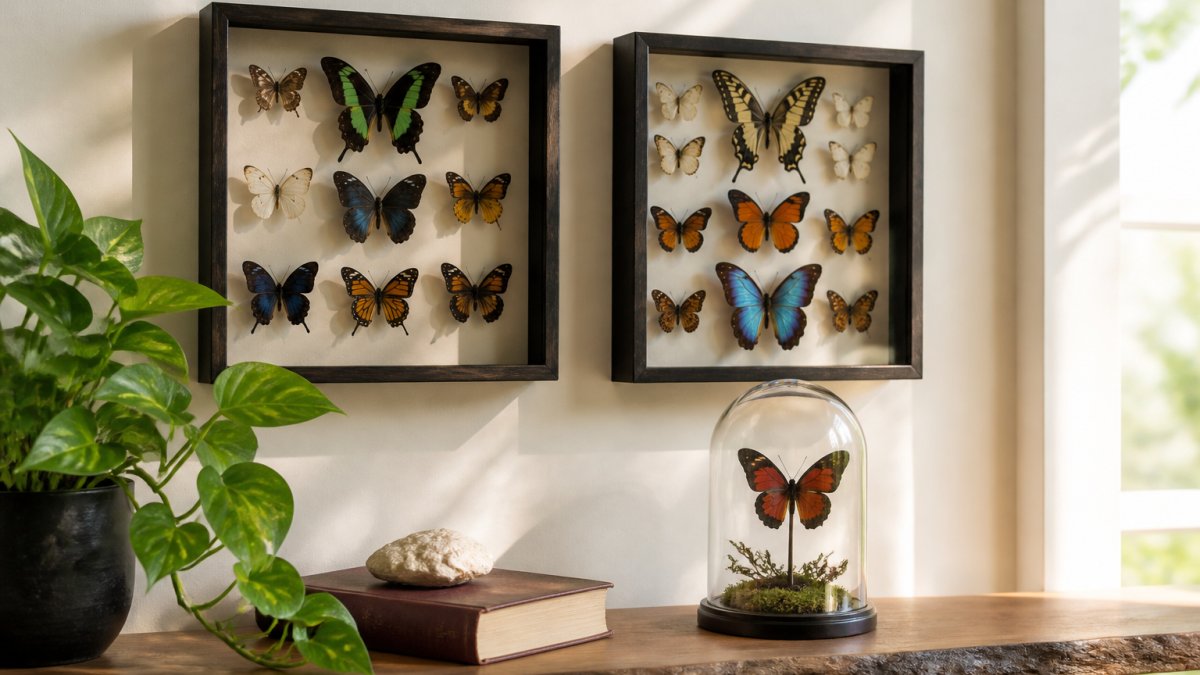
Here is the shortlist we would use to judge any shop, including our own.
- Species named on every listing, with common and scientific names
- Origin stated, not left vague
- Clear photos of the wings, body, and mount from more than one angle
We have been making these pieces since 1996, and our buyers come back for the same reason: the specimen arrives the way it looked online.
Choosing a preserved butterfly is a small act of trust.
Frequently Asked Questions
Is butterfly taxidermy ethical?
It depends entirely on where the butterfly came from. Ethical butterfly taxidermy uses captive-reared stock from rearing projects rather than wild-caught insects, so no pressure is placed on wild populations. Ask the seller for the species name, the country of origin and whether the specimen was captive-reared. A shop that can answer those three questions without hesitating is usually working to a genuine standard. If the answer is vague, treat the ethical claim as unproven.
How can I tell whether a butterfly specimen is ethically sourced?
Look for a named species, a stated origin and a clear statement that the insect was captive-reared. Ethical sourcing also means the seller avoids species listed under CITES, the international agreement that controls trade in protected wildlife. In Australia, the Environment Protection and Biodiversity Conservation Act 1999 governs the import and trade of protected species, so a seller who understands those rules is a better bet than one who has never heard of them.
How much does a taxidermy butterfly cost?
Expect roughly $70 to $110 for a single preserved butterfly from a specialist maker. A framed Monarch butterfly in a 10 x 15 cm black shadow box is around $69.95, while dome pieces with a carved wooden base and a crystal mount start near $99.95 and reach $109.95 for larger swallowtail pairs. Price tracks the species, the mount and the display format rather than the size of the insect alone.
How long does a preserved butterfly specimen last?
A properly dried specimen kept out of direct sunlight will hold its colour and shape for many years. The two things that shorten display life are ultraviolet light, which fades wing pigments, and humidity, which can encourage mould or loosen the mount. Keep the frame or dome away from windows, bathroom steam and kitchen heat, and dust the outside of the glass only. Never open the enclosure to clean the insect itself.
Will a butterfly specimen arrive damaged in the post?
It should not, if the seller packs properly. Good practice means the frame or dome sits in a padded box with the glass protected and the specimen unable to shift. Ask about the packaging before you buy, and check the parcel within the first day or two so any damage is reported while the seller's return window is still open. Keep the original box until you have inspected the piece.
