
Critters and Oddities: A Guide to Curious Home Decor
Table of Contents
- Critters and Oddities: An Introduction to Curious Collecting
- Framed Insects: The Art of Displaying Nature's Details
- How to Preserve Insects for Long-Lasting Displays
- Insect Collecting Equipment for Beginners: A Starter Kit
- Ethical and Sustainable Sourcing: What to Look For
- Nature-Inspired Home Décor: Styling Your Specimens
- Caring for Your Curiosities: Display and Preservation
- Frequently Asked Questions
Last Updated: October 9, 2026
Critters and Oddities: An Introduction to Curious Collecting
Critters and oddities is the term collectors use for preserved natural-history specimens displayed as art: framed butterflies, pinned beetles, skeletal mounts, and wet specimens kept under glass. At Newman Art Designs, we have been sourcing and framing these pieces since 1996. This guide covers what to buy, how to care for it, and how to tell ethical sourcing from greenwashing.
The appeal is easy to understand once you see a good piece in person. A shadowbox frame turns a single specimen into a focal point, and unlike a print or a poster, no two are identical.
A note on language before we go further: "curiosities" and "curious oddities" get used interchangeably with critters and oddities, but they cover different ground. Curiosities usually means the broader category of unusual objects. Critters and oddities specifically refers to animal specimens, which brings sourcing and care questions that a vintage typewriter does not.
Framed Insects: The Art of Displaying Nature's Details
Framed insects are the entry point for most collectors, and for good reason. Butterflies and moths offer the widest colour range, beetles bring structural detail that photographs rarely capture, and both sit flat in a frame without the depth a skeleton mount needs.
The quality difference between a cheap frame and a properly built one comes down to three things: how the specimen was dried, what the mount is fixed to, and whether the enclosure is sealed against humidity and pests.
Shadowbox Frames vs. Glass Domes
Shadowbox frames suit wall display and flat-bodied specimens. Glass domes suit three-dimensional mounts and anything you want to sit on a shelf or sideboard.
| Feature | Shadowbox Frame | Glass Dome |
|---|---|---|
| Best for | Butterflies, moths, flat beetle mounts | Skeletons, scorpions, multi-specimen scenes |
| Display position | Wall-mounted | Shelf, mantel, sideboard |
| Space needed | Wall area only | Surface footprint |
| Protection | Sealed behind glass | Enclosed under dome |
| Small-space fit | Excellent | Good, if you have shelf depth |
How to Preserve Insects for Long-Lasting Displays
Preserving insects means drying the specimen thoroughly, pinning it into its final pose while the body is still pliable, and then sealing it into an enclosure that blocks moisture, light, and pests. Get the drying stage wrong and nothing later will fix it.
Drying and Pinning Basics
A specimen needs to dry slowly in a controlled position, not quickly on a windowsill. Heat and direct sun bleach colour out of wings and make brittle bodies crack.
The practical sequence looks like this:
- Set the specimen on a pinning board within a few hours of collection or receipt
- Position wings, legs, and antennae while the body is still flexible
- Leave it to dry in a cool, dark, well-ventilated space away from direct sun
- Check that the body is fully rigid before moving it into a frame or dome
- Label the specimen with species and origin before it goes behind glass
If you would rather skip the pinning entirely, buying a finished piece is the sensible route. Our Duttaphrynus melanostictus toad skeleton arrives already mounted in a 5" x 7" black shadow box, so there is nothing to dry, pin, or risk.

Insect Collecting Equipment for Beginners: A Starter Kit
Insect collecting equipment for beginners does not need to be extensive, but the small differences in what you buy determine whether your first specimens survive. A pinning board, a set of entomological pins in two or three sizes, fine tweezers, a soft brush, and a storage box will cover most of what a new collector does in the first year. What most guides skip is which version of each item to buy and why it matters.
What Each Item Actually Does
Pinning board.
Entomological pins. These are not sewing pins. They are stainless, they come in numbered gauges, and the number refers to thickness, not length. A common beginner mistake is using one gauge for everything. Small beetles and moths need a finer pin than a large hawkmoth, because a thick pin splits a small thorax.
Fine tweezers. Straight, fine-tipped tweezers let you position a leg or antenna without crushing it. Curved tips help with awkward angles. Avoid household tweezers with serrated grips, which mark wing scales.
Soft brush. A dry, soft artist's brush lifts dust and loose scale without dragging it across the wing. Never use a cloth on an unpinned specimen.
Storage box. This is the item beginners underrate. Specimens waiting to be framed need to sit somewhere dark, dry, and sealed, or they will attract pests while they wait. A simple airtight container with a few silica packets does the job.
A Note on Handling
Handle a dried specimen by the pin or the mount, never by the body. Oils from skin dull wing scales and can soften a dried thorax over time. Work over a tray so that if a leg or antenna detaches, you can find it rather than lose it to the carpet.
When Equipment Is the Wrong Answer
For anyone who wants the look without the hobby, a finished piece removes the equipment question entirely. Our Asian bat skeleton in a dome is a non-CITES listed species mounted on a wooden base under a 7" acrylic dome, made here in Australia. There is no drying, pinning, or storage stage to get wrong, and no equipment to buy and then abandon after one season.
Duttaphrynus melanostictus,Toad Skeleton →

Ethical and Sustainable Sourcing: What to Look For
Ethical sourcing is a common question, and it deserves a straight answer. A responsibly sourced specimen comes with a clear species name, a stated country of origin, and confirmation that the species is not CITES-listed or otherwise restricted.
Australia's border rules add a layer most overseas guides ignore. The Australian Border Force guidance on importing wildlife products sets out what can and cannot cross the border, and the Department of Climate Change, Energy, the Environment and Water information on wildlife trade explains how CITES permits work for listed species. If a seller cannot tell you the species name and origin, that is your answer.
Sustainable sourcing also means the supply does not rely on removing animals from vulnerable populations. Farmed and non-listed species are the norm for reputable sellers.
Nature-Inspired Home Décor: Styling Your Specimens
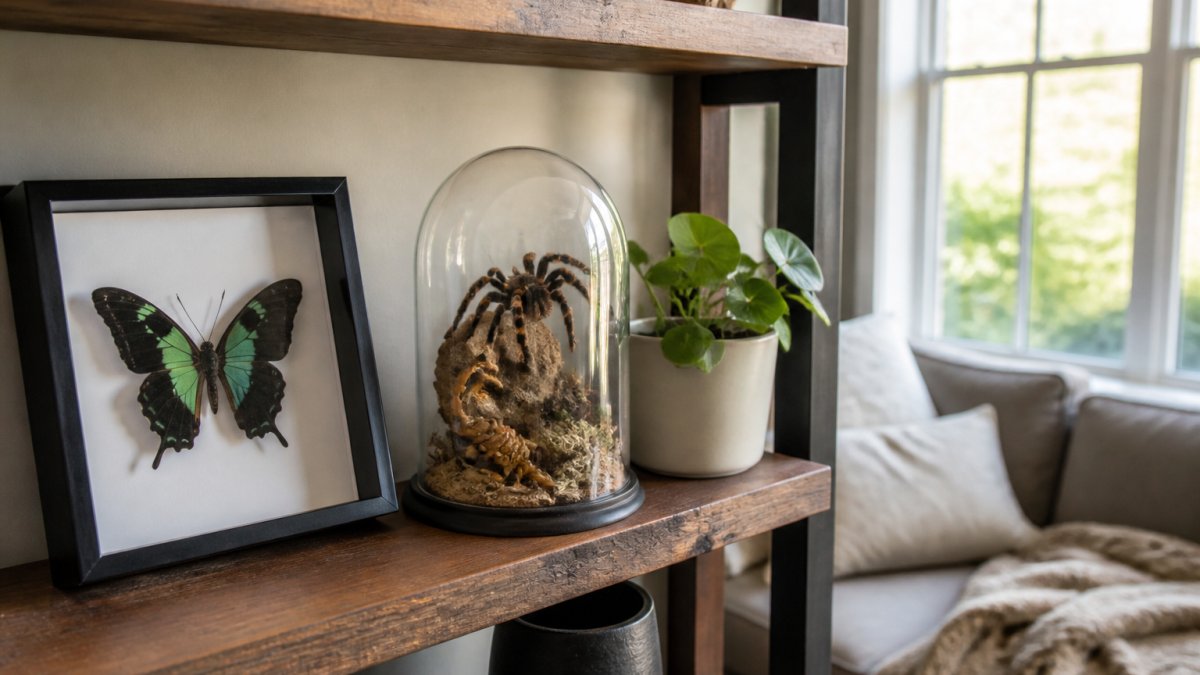
Nature-inspired home décor works best when the specimen is treated as one object among several, not as the entire scheme. A single framed butterfly above a desk reads as considered. Six frames in a grid reads as a collection display, which is a different look and a harder one to pull off in a living room.
Scale and Placement
The single most common styling mistake is buying a piece that is the wrong size for the wall. A 5" x 7" frame on a large blank wall disappears. The same frame on a narrow strip beside a doorway or above a small desk looks deliberate. Before you buy, measure the wall space and decide whether you want the piece to be the focal point or a supporting detail.
A dome is different. It takes up shelf depth rather than wall area, so it suits renters who cannot drill and anyone with more surface than wall.
Grouping by Material and Tone
Group by material and tone rather than by species. A black shadowbox frame next to dark timber and a matte ceramic pot will look deliberate. The same frame next to bright plastic and chrome will look like it wandered in from somewhere else. If you are building a shelf arrangement, pick two or three materials and repeat them: timber, ceramic, glass, or matte black metal. The specimens then read as part of a considered scheme rather than as a collection on display.
Small Spaces, Big Impact
Small apartments are where a single well-chosen piece outperforms a wall of them. A dome takes up shelf depth rather than wall area, which suits renters who cannot drill. A compact frame suits a narrow wall strip beside a doorway. If you are renting, a dome on a sideboard or a frame hung from a removable adhesive hook gives you the look without permanent fixings.
Our Tarantula vs Scorpion dome is a good example: a 7" wooden base with an acrylic dome, holding two specimens in a single scene. One object, one footprint, plenty of conversation.
Light and Longevity
Where you place a piece affects how long it lasts as much as how it looks. Direct sun bleaches wing colour and can make a sealed frame's interior heat up and cool down repeatedly, which stresses the mount. A spot that gets bright, indirect light for part of the day is the safest choice. Avoid placing a specimen directly above a heater, air conditioner, or open window, where temperature and humidity swing fastest.
Caring for Your Curiosities: Display and Preservation
Caring for a preserved specimen comes down to three enemies: direct sunlight, humidity, and physical knocks. Keep the piece out of direct sun, keep it in a room with stable humidity, and keep it somewhere it will not be knocked off a shelf.
A few habits that extend the life of a piece considerably:
- Dust the outside of the glass or dome with a dry microfibre cloth, never a wet one
- Keep pieces away from kitchen and bathroom humidity
- Avoid mounting directly above a heater, air conditioner, or open window
- Check sealed frames once a year for any sign of looseness at the backing
- Handle domes by the base, never the dome itself
For a larger mount, the Dendrelaphis pictus snake skeleton in a 12" x 14.5" black shadow box is built to sit on a wall for the long term, provided it stays out of direct light.

Frequently Asked Questions
What does “critters and oddities” refer to?
Critters and oddities covers a broad range of curious natural-history objects, including framed insects, taxidermy, wet specimens, and skeletal displays. These pieces blend science and art, turning preserved creatures into conversation-starting decor. Collectors often seek out ethically sourced butterflies, beetles, spiders, and small skeletons mounted in shadowbox frames or glass domes. The term also embraces gothic and Victorian-inspired curiosities that add a unique, nature-focused touch to a home.
How are insects preserved for display?
Preservation typically involves rehydrating dried specimens, pinning them into position, and allowing them to dry fully before mounting. For long-term display, specimens are sealed inside shadowbox frames or glass domes to keep out dust, moisture, and pests.
How should you care for a framed insect specimen?
Keep framed insects out of direct sunlight and away from damp areas like bathrooms or kitchens. UV light fades colours over time, and humidity can cause mould or warping. Dust the outside of the frame or dome with a soft, dry cloth; never open the enclosure. If you need to move the piece, hold it by the frame edges and avoid pressing on the glass. With proper care, a well-preserved specimen can last for decades.
What should beginners know before collecting insects?
Before you start, check local regulations and protected species lists. In Australia, some insects and their habitats are protected, so collecting may require permits. Begin with common, non-threatened species and learn ethical collection methods that avoid overharvesting. Always record the date and location of your catch for scientific value.
Building a collection of critters and oddities is a long game, and the pieces that last are the ones sourced and mounted properly from the start. Newman Art Designs has been framing museum-quality specimens since 1996, with free shipping across Australia and a range that covers butterflies, beetles, spiders, scorpions, and snake skeletons. Every piece is made here and built to hold up on a wall for years. Shop the collection and find the piece that fits your space.
