
7 Resin vs Glass Dome Taxidermy Display Differences
Last Updated: November 7, 2026
Quick Summary
Glass domes offer the clearest view of taxidermy displays but are heavier and can crack or shatter if knocked. Resin domes are lighter, resist impact and suit high-traffic surfaces, gifts and posted pieces. Choose glass for protected cabinets where clarity matters, and resin for displays that must survive real life.
- Clear resin sits between glass and acrylic, reading slightly warmer with a faint tint depending on the batch.
- Dust domes with a soft microfibre cloth and never spray cleaner directly onto resin or glass.
- Small domes around 8-10 centimetres across suit desks and shelves, while 18-centimetre domes work as centrepieces.
- Newman Art Designs domes range from $89.95 to $154.95 across both materials.
- Resin is the practical choice for gifts because it is lighter and less likely to arrive broken.
Table of Contents
- Resin vs Glass: What Actually Changes for Your Display
- Side-by-Side Comparison Table: Resin vs Glass Domes
- When a Glass Dome Taxidermy Display Is the Right Choice
- When a Resin Dome for Taxidermy Suits Your Specimen Better
- How to Care for Specimen Domes So They Stay Clear
- Matching Dome Size and Style to Your Specimen and Room
- Cost and Ownership Over Time
- Choosing Your Dome Display from Newman Art Designs
- Frequently Asked Questions
Resin vs Glass: What Actually Changes for Your Display
Choosing between resin and glass for taxidermy displays comes down to one trade-off: clarity versus resilience. Glass gives you the truest view of a specimen. Resin gives you a dome you can handle without holding your breath. At Newman Art Designs, the material question is the one buyers ask about most.
Both materials protect what is inside. What changes is how much detail you can see, how the piece survives daily life, and how it ages over a decade of ownership. Below, we break down seven differences that matter, with a comparison table and a clear recommendation for each type of specimen.
Clarity and How Much Detail You Can See
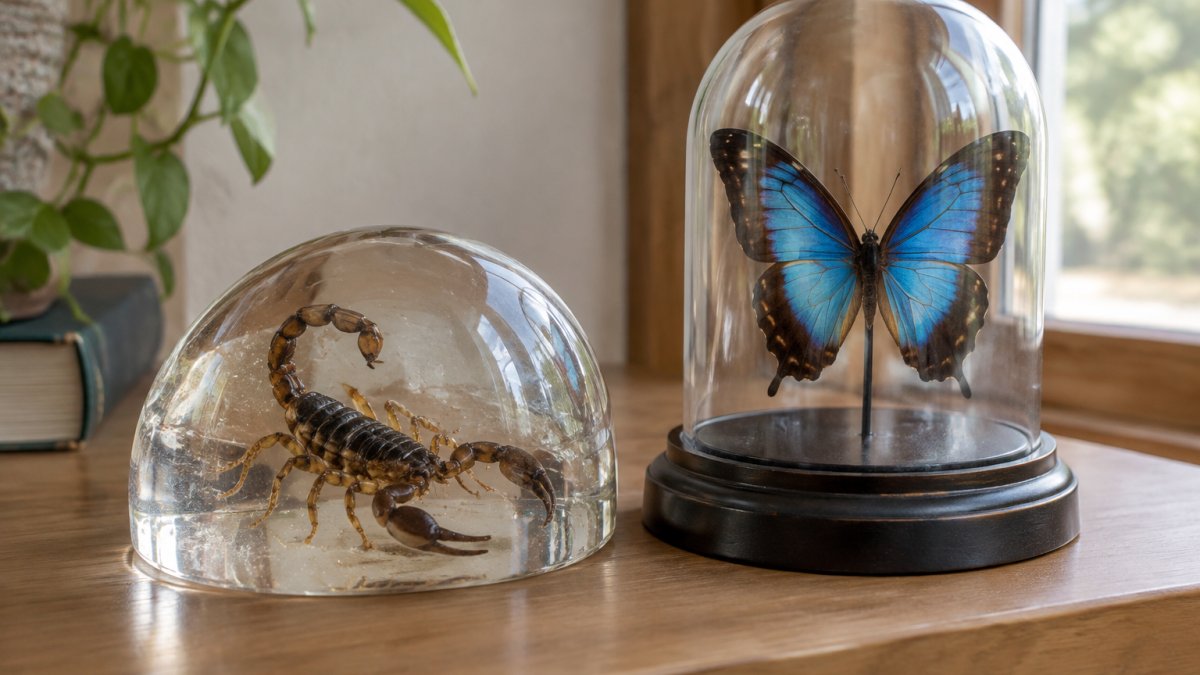
Glass wins on pure optical clarity. A clean glass dome is transparent with virtually no distortion, so fine details stay sharp: the wing veins on a butterfly, the pitting on a scorpion's carapace, the individual bones of a snake skeleton.
Clear resin, often called lucite, is also transparent, but it sits somewhere between glass and acrylic. It reads slightly warmer and can pick up a faint tint depending on the batch. For a specimen you plan to study up close, glass shows more. For a piece viewed from a metre away on a shelf, most people cannot tell the difference.
Weight, Breakage Risk and Everyday Handling
Here is where the two materials part company. Glass is heavier and brittle. A knock off a coffee table can crack or shatter it. Resin is lighter and generally more forgiving of everyday knocks.
If the display will sit on a high-traffic surface or get handled often, resin is the safer bet. If it lives behind glass in a cabinet and rarely moves, glass is fine.
Side-by-Side Comparison Table: Resin vs Glass Domes
| Feature | Glass Dome | Resin Dome |
|---|---|---|
| Clarity | Excellent, minimal distortion | Very good, slight warmth |
| Weight | Heavier | Lighter |
| Breakage risk | High if dropped or knocked | Low, resists impact |
| Scratch resistance | Moderate | High |
| Dust protection | Excellent seal | Excellent seal |
| Best for | Cabinet and shelf display | High-traffic surfaces, gifts |
| Typical price | Mid to high | Mid range |
When a Glass Dome Taxidermy Display Is the Right Choice
A glass dome taxidermy display is the right call when clarity is the priority and the piece will be treated gently. Think of a butterfly dome on a study desk, a scorpion on a bedside cabinet, or a specimen kept inside a display cabinet away from daily knocks.
Glass suits collectors who want a crisp, clear view of the specimen. If you are leaning toward a glass dome, our guide to butterfly in a dome display art walks through how preserved specimens are mounted and presented.
When a Resin Dome for Taxidermy Suits Your Specimen Better
A resin dome for taxidermy makes more sense when the piece has to survive real life. Resin is a practical option for gifts and for displays that move between rooms.
The trade-off is a slightly softer look. The Black Scorpion in a Glow in the Dark Resin Hemisphere is a resin option in our range.

How to Care for Specimen Domes So They Stay Clear
Knowing how to care for specimen domes is mostly about two things: keeping dust off and keeping light manageable. Neither material needs special products, but glass and resin fail in different ways, so the care routine should match the material.
- Dust the outside with a soft microfibre cloth, dry or very slightly damp.
- Never spray cleaner directly onto resin or glass; apply to the cloth first.
- Keep displays out of direct sunlight, which fades specimens over time.
- Handle the dome by its base, not the cover.
- Keep the seal tight so insects cannot get in.
Dust, Infestation and Long-Term Preservation
Both glass and resin seal well, which is the first line of defence against dust and infestation. For a deeper look at protecting colour and clarity over the years, see our notes on preventing fading in shadowbox display cases.
Where the materials diverge is in how they age and how they respond to the same conditions. Glass is generally stable and does not yellow. Its failure mode is mechanical: a chip, a crack, or a shatter. Resin is a polymer.
Humidity and ventilation matter more than most buyers expect. A sealed dome is not a vacuum. Moisture trapped at the base can encourage mould on organic mounts, feathers, and dried plant material.
Scratching is the other long-term difference. Resin can scratch more readily than glass, so dust it gently.
Watch out: avoid harsh cleaners on either material.
Matching Dome Size and Style to Your Specimen and Room
Size is where most buyers get it wrong. A dome that is too small crowds the specimen; one that is too large makes it look lost. Measure the specimen's wingspan or body length, then allow room for the mounting base and a little breathing space.
Style matters too. A Victorian-style display with a wooden base and moss reads as antique and warm. A simple acrylic or glass dome reads as clean and modern. Match the base to your furniture, and let the specimen carry the drama. Small domes, around 8-10 centimetres across, suit desks and shelves. Larger 18-centimetre domes suit a sideboard or coffee table as a centrepiece.
Cost and Ownership Over Time
Resin and glass sit in a similar price band at the point of sale, but the real cost is ownership. A dropped glass dome means replacing the dome, and sometimes the specimen inside. Resin survives the accidents that end a glass display's life, so over years of ownership it often works out cheaper in practice.
Our domes range from $89.95 to $154.95. What swings it is how carefully the piece will be treated and what sits inside it. A glass dome over a delicate butterfly is a different financial risk from a glass dome over a strong scorpion mount, because the specimen replacement cost sits on top of the dome replacement cost. If you want to understand why preserved specimens cost what they do before committing, our article on why preserved specimens cost more explains the work behind each piece.
A Lifecycle View of Both Materials
It helps to think in three cost layers rather than one sticker price.
- Initial cost. Glass and resin domes overlap in price. Resin is lighter, which usually means lower postage and lower packing cost, a difference that matters if you are sending a display as a gift.
- Replacement risk. Glass fails by breaking; resin fails by scratching or, over a long period, by yellowing. A broken glass dome is an unplanned replacement. A scratched resin dome is usually a cosmetic annoyance rather than a replacement trigger. Over a decade, the expected replacement cost is higher for glass in a high-traffic home and close to zero for resin in the same setting.
- Maintenance cost. Neither material needs specialist products, so maintenance cost is mostly time. Glass needs occasional polishing to stay optically clear. Resin needs gentler dusting to avoid scratches. Neither requires a professional unless a glass dome chips at the rim.
A small glass dome on a protected shelf is not a high-risk purchase. A large glass dome in a busy hallway is.
Matching the Material to the Specimen and the Setting
The cost question is really a decision question. Use the specimen and the room to choose the material, then let the price follow.
- Delicate specimens in a protected spot. A butterfly, a feathered mount, or a skeleton with fine bones belongs under glass if the display sits in a cabinet or on a quiet shelf. The clarity is worth the fragility because the piece is not being handled.
- Strong specimens in high-traffic areas. A scorpion mount, a beetle, or a resin-encased piece suits resin when the display sits on a coffee table, in a child's room, or anywhere it will be dusted and moved. The lower breakage risk outweighs the slight loss of optical clarity.
- Gifts and posted displays. Resin is the practical choice when the piece has to survive transit. It is lighter, less likely to arrive broken, and less likely to be broken by the recipient.
- Museum-look collections. Glass is the right call when the display is part of a curated collection behind cabinet doors and the owner wants the classic cloche silhouette and the crispest possible view.
Watch out: do not choose glass purely because it looks better in a product photo. The photo does not show the shelf it will sit on, the sunlight it will receive, or the household it will live in, and those are the factors that decide whether the material choice holds up over time.
Choosing Your Dome Display from Newman Art Designs
The decision is simpler than it looks. Choose glass for a protected spot where clarity is everything. Choose resin for a piece that has to live in the real world. If you are ready to browse actual dome displays to buy, our collection of domes covers both materials across butterflies, scorpions, and mounted scenes.
Whichever you pick, buy for how the piece will actually be used, not how it looks in a photo. That single shift prevents most of the disappointment buyers bring to us after a display has been knocked over or tucked away out of fear.
The hardest part is not choosing a material. It is finding a display that holds up to daily life without losing the detail that made you fall in love with the specimen.
Frequently Asked Questions
Is glass or resin better for a taxidermy dome?
It depends on the specimen and where you plan to display it. Glass domes offer the clearest view and suit feathered or detailed specimens where every texture matters, but they are heavier and can break. Resin domes are lighter and more forgiving around children or busy surfaces. For a small desk piece like the Japanese emperor butterfly in a dome at $99.95, either works well; for a larger centrepiece, weigh up weight and handling first.
Do resin domes become cloudy or yellow over time?
Resin clarity depends on the grade and how much direct sun it receives. Clear Lucite resin, like the material used in the Black Scorpion in a Glow in the Dark Resin Hemisphere, is chosen for transparency, but long-term exposure to strong UV light is the main risk for any resin. Keep resin pieces out of direct afternoon sun and away from heat sources to slow any change. Glass does not yellow, which is why some collectors prefer it for long-term display.
How do you clean a glass dome taxidermy display?
Use a soft microfibre cloth with a light mist of water or a gentle glass cleaner, applied to the cloth rather than sprayed onto the dome. Wipe the outside in gentle circles and avoid pressing on the dome where it meets the wooden base. Never lift the dome off to clean inside unless the specimen is fully secured, as disturbed specimens can lose antennae or wing scales. Dust the base with a dry brush.
How should you care for specimen domes to prevent damage?
Keep displays out of direct sunlight, which fades colours in butterflies and other specimens, and away from humid rooms like bathrooms. A stable indoor spot with moderate temperature suits both glass and resin. Check the seal between dome and base every few months, and handle the piece by the base rather than the dome. For feathered or delicate specimens, avoid opening the dome at all; the enclosed space is what protects against dust and infestation.

