
7 Things to Look for in Authentic Insect Art
Last Updated: October 31, 2026
Quick Summary
To identify authentic insect art, check for visible wing scales, natural wear and a textured body that replicas rarely reproduce. Confirm ethical sourcing, sealed framing, written provenance and good condition, and buy only from sellers who answer sourcing questions directly.
- Ask for a side-angle photo or short video, since straight-on photos hide replica giveaways.
- Ethical sellers name a country of origin and never claim a regulated species was found dead.
- A credible provenance record lists scientific name, country of origin, sourcing method and preparer.
- Keep frames out of direct sunlight and away from kitchens and bathrooms to prevent fading and warping.
- Framed pieces start at $69.95, with free shipping across Australia.
Table of Contents
- Why Authentic Insect Art Deserves a Closer Look
- How to Identify Real Butterfly Specimens
- What Ethical Insect Art Looks Like in Practice
- Materials, Mounting and Workmanship to Inspect
- Provenance, Labels and Verifying a Seller
- Condition, Preservation and Signs of Deterioration
- Planning Your Insect Specimen Display
- Choosing Your First Authentic Insect Art Piece
- Frequently Asked Questions
Why Authentic Insect Art Deserves a Closer Look
Authentic insect art is artwork built around real, preserved insect specimens, mounted and framed so the creature's true colours, scales and structure can be seen up close.
Most buyers never ask. They see a beautiful framed butterfly, assume it is real, and pay accordingly.
That is where things go wrong. Replicas are everywhere, and some are very good.
Below, we show you exactly what separates a museum-quality piece from a print in a nice frame.
How to Identify Real Butterfly Specimens
Real butterfly specimens show visible scales, natural wing wear and a body that was once a living insect. Replicas rarely reproduce all three. Start with the wings, then work outward.
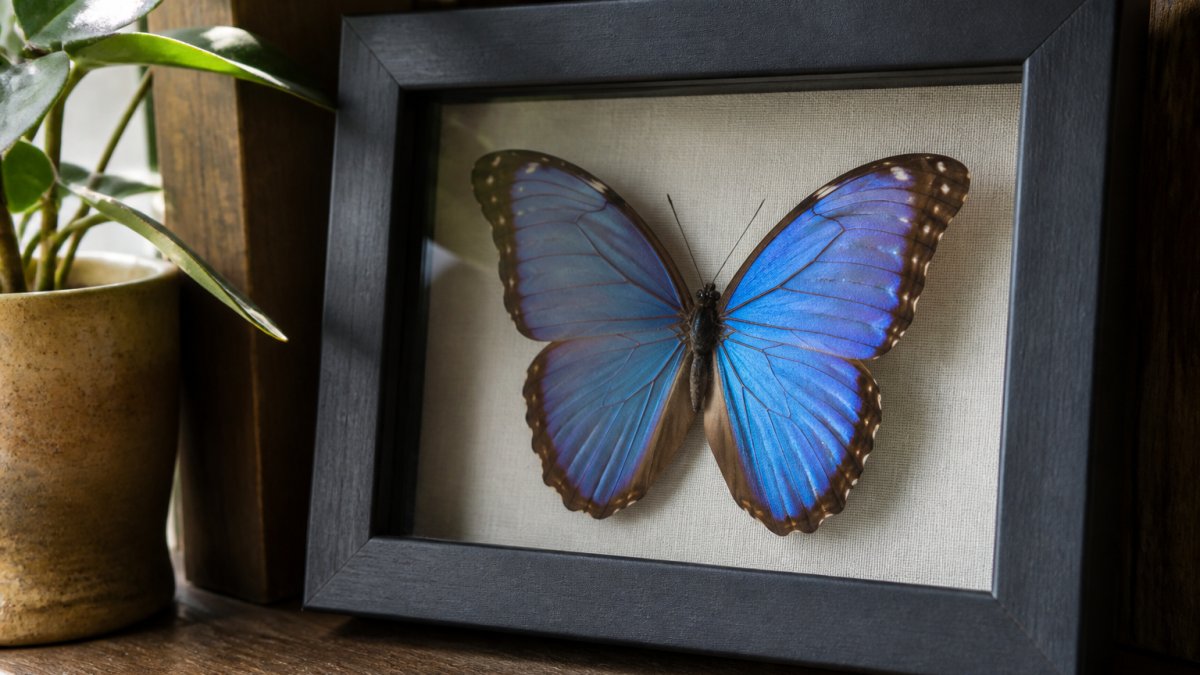
Wings, Scales and the Details Replicas Miss
Butterfly wings are covered in thousands of tiny scales. Under angled light they shift and shimmer. Prints cannot copy that depth, and resin casts flatten it.
A common mistake is judging a specimen from a straight-on photo. Ask for a side-angle shot or a short video instead.
Look for these signs of a real specimen:
- Individual scales visible along the wing edge
- Slight natural wear on wing tips
- Antennae with fine segments, not thick moulded lines
Real Specimens vs Prints, Resin and Synthetic Replicas
Prints sit flat. Real specimens have depth because the body lifts off the mounting board.
Resin blocks trap a specimen in clear plastic.
Synthetic replicas often use printed wings on a moulded body. The giveaway is symmetry that looks too perfect.
Watch out: a seller who will not send a close-up photo of the wing surface is usually hiding something.
What Ethical Insect Art Looks Like in Practice
Ethical insect art uses farmed or sustainably collected specimens, never endangered species taken from the wild. Reputable sellers can explain where each specimen came from.
Ask directly. A good seller answers without hesitation.
For a fuller explanation of what ethical sourcing means, our ethically sourced insect specimens guide walks through the standards we apply.
Here is what to check:
- A named country of origin for each species
- Species that are common and not protected
- Clear answers about how specimens were obtained
If a seller dodges the question, walk away. Ethical insect art starts with a seller who is happy to talk about sourcing.
Materials, Mounting and Workmanship to Inspect
Good framing protects a specimen for decades. Poor framing slowly destroys it. The materials matter as much as the insect.
Check these points:
- A sealed shadowbox frame with glass
- Specimens pinned or mounted securely, not loose
- Clean, straight joints on the frame
Workmanship shows in the small things. Look at how the antennae are positioned and whether the legs sit naturally. Careful mounting takes time, and it shows. Our guide to which materials are truly acid-free for insect mounting explains what to look for.
Provenance, Labels and Verifying a Seller
Provenance is the documented history of a specimen: what species it is, where it came from, how it was obtained and who prepared it. A seller who provides it is telling you they have nothing to hide. A seller who cannot is asking you to take their word for it.
Most listings you will see online give you a common name and a photo. That is not provenance. It is a caption.
What a Credible Provenance Record Contains
A genuine provenance trail does not need to be elaborate, but it should answer four questions without you having to chase the seller:
- Species identification, the scientific name (genus and species), not just "blue butterfly". Scientific names are the only reliable way to confirm a specimen is common, farmed or protected.
- Country of origin, where the specimen was collected or bred. "Asia" is too vague; a country is the minimum.
- Sourcing method, captive-bred, farmed, sustainably collected, or legally imported. Each has different implications for ethics and legality.
A specimen label pinned inside the frame or fixed to the backing board is the strongest form. Traditional entomology labels are small rectangles of acid-free paper carrying the species name, collection locality, collector and date. You will not always see a full scientific label in decorative frames, but a reputable seller should be able to supply the equivalent in writing.
Maackii butterfly in a frame (Spring Species) →
How to Verify the Claims Yourself
You do not need specialist training to run basic checks. These take a few minutes each:
- Search the scientific name in a general search engine and cross-check it against a recognised biodiversity database. If the species does not appear, or appears only on sales sites, treat the identification as unconfirmed.
- Check protected status, confirm the species is not listed under the Convention on International Trade in Endangered Species (CITES), which Australia implements through the Environment Protection and Biodiversity Conservation Act 1999. A seller offering a CITES-listed species without paperwork is a red flag.
- Check the seller's trading history, an Australian Business Number (ABN) lookup confirms the business is registered. Reviews that mention damage, misdescription or slow responses are more useful than five-star ratings.
Our ethical butterfly specimen review checklist sets out the full list of what to verify in a listing, including the questions worth asking before you commit.
Reading the Seller's Answers
A good seller answers sourcing questions directly and in specific terms. A weak one replies with vague reassurance ("all our specimens are ethically sourced") or changes the subject to the frame or the price.
One of our own customers put it simply: "Highly recommend seller, you would not be disappointed."
Condition, Preservation and Signs of Deterioration
A well-preserved specimen holds its colour for years. A poorly preserved one fades, warps or attracts pests. The frame is your first clue, but you need to know what you are looking at.
Condition is not just about whether the insect looks intact today. It is about whether the materials and mounting will keep it intact over the next decade.
What Causes Deterioration
Most damage comes from four sources, and each leaves a different signature:
- Ultraviolet light, breaks down the pigments in wing scales, causing colours to fade or shift. Blues and greens are usually the first to go. A frame hung in direct sun will fade faster than one in a shaded hallway.
- Humidity, swings in moisture cause wings to curl, mounting boards to warp and mould to establish. Kitchens, bathrooms and uninsulated walls are the usual culprits.
- Pests, museum beetles (also called carpet beetles) and clothes moths will feed on dried insect specimens. Their presence shows as fine dust, frass or hollowed bodies inside the frame.
Understanding the cause matters because it tells you whether a problem is stable or ongoing. A faded wing is permanent. A slightly warped board in a sealed frame may be stable. Condensation on the inside of the glass means moisture is still getting in.
How to Inspect a Framed Specimen Before You Buy
Ask for photos taken at an angle and in natural light, not just a straight-on shot. Then work through these checks:
- Wing colour, compare the specimen against a reference photo of the same species. Significant dulling or bleaching suggests UV exposure.
- Wing position, wings that have curled upward or drooped away from the mounting board indicate humidity damage.
- Body integrity, antennae, legs and thorax should be intact. Missing parts are common in older specimens but should be disclosed.
If you are wondering whether colours fade over time, our article on whether insect displays fade explains what causes it and how to slow it down.
Preservation and Long-Term Care
Once a piece is yours, a few habits extend its life considerably:
- Keep frames out of direct sunlight and away from heat sources.
- Avoid rooms with high humidity swings, such as kitchens and bathrooms.
- Dust the outside of the glass with a dry microfibre cloth rather than spraying cleaner near the frame.
A frame sealed with tape rather than proper backing lets moisture in. That shortens the life of any specimen, no matter how good it looked on arrival.
Planning Your Insect Specimen Display
An insect specimen display works best when it is planned around the space, not bought on impulse. Size and light matter more than most buyers expect.
Small shadowbox frames suit narrow walls, shelves and hallway nooks. Glass domes work well on sideboards and mantels.
Keep these rules in mind:
- Hang frames away from direct sunlight
- Avoid kitchens and bathrooms, where humidity swings
- Mount at eye level so the detail is visible
For a small apartment, a single well-chosen piece beats a crowded wall. Our Maackii butterfly in a frame is a 5" x 7" shadowbox frame, small enough for a tight space but detailed enough to hold attention.
Choosing Your First Authentic Insect Art Piece
Start with one piece you love, from a seller who answers your questions. That is the short version.
Here is a simple way to decide:
| If you want... | Choose | Why |
|---|---|---|
| An affordable first piece | Single butterfly frame, $69.95 | Low entry price, strong detail |
| A talking point for a shelf | Violin beetle frame, $69.95 | Unusual shape, compact size |
| A statement for a larger wall | Triple stag beetles, $119.95 | Three specimens, bolder presence |
| A gift for a nature lover | Any framed butterfly | Broad appeal, easy to display |
Before you commit, run the seven checks in this guide: wing detail, replica warning signs, ethical sourcing, materials, provenance, condition and display fit.
If a piece passes all seven, you are buying real authentic insect art, not a decoration that will disappoint you in a year.
Frequently Asked Questions
How can you tell if insect art is authentic?
Look at the specimen itself first: real butterflies and moths show overlapping wing scales, visible veins and intact antennae, which prints and resin casts rarely reproduce. Check that the insect sits on a proper mounting board, that the frame is a sealed shadowbox with glass, and that a species label names the insect and its origin. A seller who answers questions about sourcing and offers real photographs of the actual piece is a stronger sign of authentic insect art than a polished listing alone.
What should you check before buying preserved insect art?
Ask four things: what species it is, where it came from, how it was preserved, and how it will be shipped. Confirm the frame depth so wings and legs are not pressing against the glass, and check the dimensions against your wall space. For delicate pieces, ask how the specimen is secured inside the frame. A seller established since 1996 with strong reviews, like Newman Art Designs, is a reasonable place to start your questions before you pay.
What does ethical sourcing mean for insect art?
Ethical insect art starts with specimens that are legally collected and not taken from protected or endangered populations. Many farmed butterflies come from sustainable rearing operations, which supports habitat rather than depleting it. Ask the seller where the species originates and whether the supply is farmed or wild-caught. Avoid any piece where the seller cannot name the species or its country of origin, and treat unusually rare or protected species offered cheaply as a warning sign.
How should preserved insect art be displayed and cared for?
Keep insect specimen display pieces out of direct sunlight, which fades wing colours over time, and away from damp rooms like bathrooms. A sealed shadowbox or glass dome slows dust and moisture, and stable indoor temperatures help prevent warping. Hang or place the frame where it will not be knocked, and dust the outside of the glass with a soft cloth rather than opening the frame. Handled this way, a well-preserved specimen can stay display-ready for many years.
Buying insect art online carries real risk: damaged specimens, vague sourcing and pieces that fade within months. Newman Art Designs has been preserving and framing specimens since 1996, using museum-quality techniques and sealed shadowbox frames built to last. Our customers tell us the frames arrive solid and the packing holds up in transit. Browse our insect specimens to find your first piece, and get started with Newman Art Designs today.

