
Do Insect Displays Fade Over Time?
Last Updated: October 26, 2026
Quick Summary
Yes, insect displays fade over time, because ultraviolet radiation breaks down the chemical bonds inside a specimen's colour and visible light does slower damage of its own. Left in direct sun, a pinned butterfly can lose noticeable colour within a few years, while a specimen kept sensibly holds its colour for decades.
- Light is the main cause of fading, with UV exposure and total light dose driving the rate of change.
- Pigment colours dull permanently, while structural colours like Morpho blues resist UV better but can lose shimmer.
- Pale greens and yellows may show first visible change in 2-5 years in bright indirect light.
- Dust the outside of the glass only every six months with a dry microfibre cloth and never open the frame.
- Compare the specimen against a photo taken when you first hung it to catch slow fading annually.
Table of Contents
- Do Insect Displays Fade Over Time?
- Why Insect Specimens Lose Their Colour
- How Quickly Different Insects and Colours Fade
- How to Preserve Framed Insects at Home
- UV Protection for Shadowbox Frames
- Preventing Insect Specimen Decay: Moisture, Pests and Handling
- Telling Fading Apart From Natural Colour Variation
- Choosing Your First Museum-Preserved Display
- Frequently Asked Questions
Do Insect Displays Fade Over Time?
Yes, insect displays fade over time. It is one of the few certainties of owning preserved specimens. The colours that make a butterfly specimen so striking are also the most fragile part of it.
At Newman Art Designs, we bring the captivating beauty of the natural world into your home with museum-preserved specimens. Left in direct sun, a pinned butterfly can lose noticeable colour within a few years. Kept sensibly, the same specimen holds its colour for decades.
Below, we explain why insect displays fade and which specimens may be at risk.
Australian Museum's insect collection care guidance
Why Insect Specimens Lose Their Colour
Light is the main cause. Ultraviolet radiation breaks down the chemical bonds inside a specimen's colour, and visible light does slower damage of its own.
Two things drive the rate of change:
- UV exposure from direct sun and unfiltered daylight
- Total light dose over months and years, not just brightness at any one moment
Heat and dry air speed the process up. A frame above a heater or beside a hot window is a bad spot for any preserved specimen.
Pigments vs Structural Colour
Not all colour fades the same way, because not all colour is made the same way.
Pigment colour comes from chemicals in the wing scales. These pigments absorb some wavelengths of light and reflect others. UV exposure slowly breaks the pigment down, and the colour dulls for good.
Structural colour comes from the physical shape of microscopic scales. These scales bend and reflect light to produce shimmering blues and greens. This is called iridescence, and it is why a blue Morpho specimen shifts shade as you move around it.
You can see structural colour for yourself in our Morpho didius Butterfly in a Frame, where the metallic blue shifts with the viewing angle.

How Quickly Different Insects and Colours Fade
Fast-fading specimens (noticeable change within a few years in bright rooms):
- Bright greens and yellows, which are usually pigment-based and chemically fragile
- Delicate moths with pale, powdery scales
- Specimens displayed in direct sunlight or on a bright windowsill
Slower-fading specimens (decades under sensible conditions):
- Deep blues and metallic shades built on structural colour
- Dark beetles with hard, thick shells
- Specimens kept behind UV-filtering glass away from windows
The Urania Ripheus Or Sunset Moth In A Frame is a good example of a light-sensitive specimen. Its brilliant colours reward careful placement away from sun.
A realistic fading timeline by colour type
| Colour type | Typical example | First visible change | Well-kept lifespan |
|---|---|---|---|
| Pale greens and yellows (pigment) | Many day-flying moths | 2-5 years in bright indirect light | 10-20 years in shade |
| Reds and oranges (pigment) | Some butterflies and beetles | 5-10 years | 20-30 years |
| Deep blues and metallics (structural) | Morpho butterflies | 10-20 years, mostly scale loss | 30+ years |
| Blacks and browns (melanin) | Dark beetles | Very slow | Decades |
Why the colour chemistry matters
Pigment colour comes from chemicals in the wing scales. UV radiation breaks the chemical bonds, and the colour dulls permanently. Structural colour comes from the physical shape of microscopic scales, which bend and reflect light. Those scales resist UV better, but they can loosen or abrade over time, so a Morpho may lose shimmer rather than hue.
Turquoise Emperor in a Frame →
What this means for your display
Match the specimen to the spot. A light-sensitive moth belongs in a shaded hallway or a room with sheer curtains; a dark beetle can tolerate a brighter wall. If you are unsure, treat every specimen as light-sensitive, the precaution costs nothing and buys years of colour.
How to Preserve Framed Insects at Home
A simple routine keeps a framed insect in good shape for years. For more on protecting displays from light damage, see our guide to preventing fading in shadowbox display cases. None of it is difficult, but the key is doing it on a schedule rather than waiting for a problem to appear.
A repeatable home care schedule
Monthly (two minutes):
- Look at the glass from an angle in daylight. Note any new pale patches, white fuzz, or fine dust inside the frame.
- Check that the frame still hangs flat and the hanging hardware is secure.
Every six months:
- Dust the outside of the glass only, using a dry microfibre cloth. Never open the frame.
- Check the seal around the backing for gaps, lifting tape, or loose turnbuttons.
- Rotate displays: move pieces to a shaded spot for part of the year, especially over summer when daylight is stronger.
Annually:
- Compare the specimen against a photo you took when you first hung it. This is the single best way to catch slow fading before it becomes obvious.
- Check stored pieces for fine dust or tiny holes, which signal pests.
Placement rules that matter more than products
- Hang away from direct sun. An interior wall is always safer than a window wall.
- Keep the frame out of damp rooms. Bathrooms and laundries are poor choices.
- Keep room temperature steady. Avoid heaters, stoves and direct air-conditioning vents.
- Choose a shaded wall for your most valuable or light-sensitive pieces.
Telling fading apart from natural variation
| What you see | Likely cause | What to do |
|---|---|---|
| Colour shifts as you move | Structural colour, normal | Nothing |
| Slight variation between specimens | Natural individual difference | Nothing |
| Uniform dulling over years | Fading from light exposure | Move to a shaded spot |
| Pale patches on one side | Direct sun damage | Relocate immediately |
| White fuzz or spotting | Moisture and mould | Isolate and seek advice |
UV Protection for Shadowbox Frames
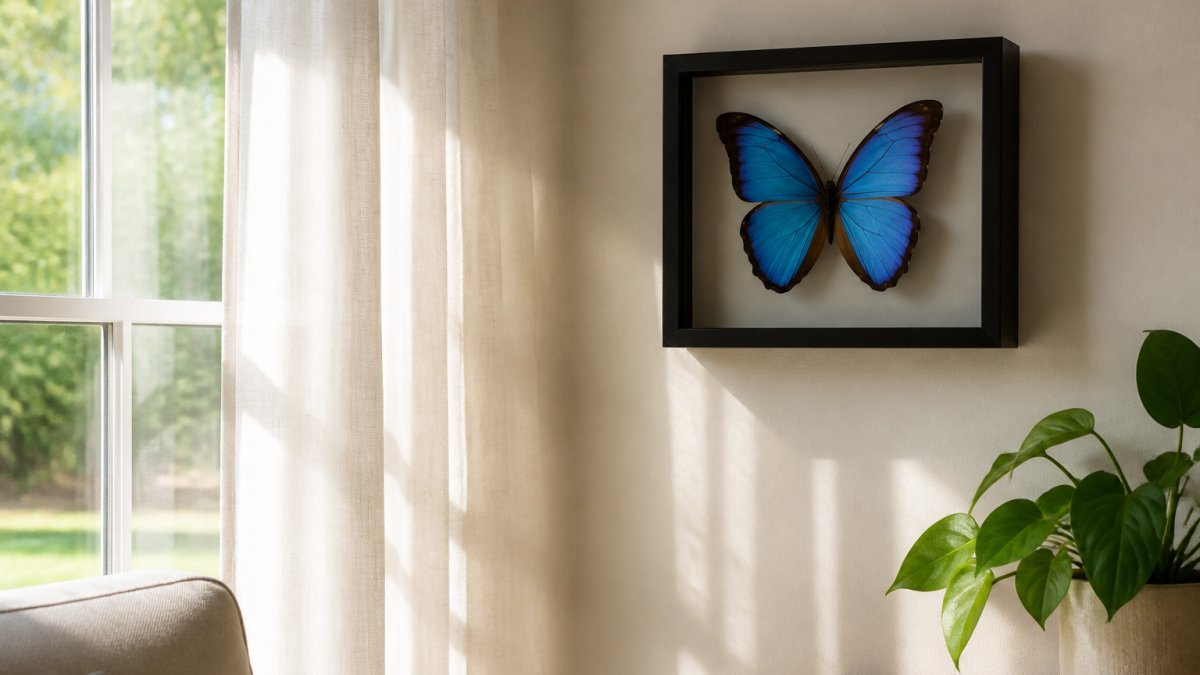
- Never hang a frame where sun lands directly on the glass. Even brief daily sun adds up.
- Use sheer curtains or blinds to cut daylight intensity in bright rooms.
- Choose a shaded wall for your most valuable or light-sensitive pieces.
Preventing Insect Specimen Decay: Moisture, Pests and Handling
Moisture is the biggest hidden risk. Damp air encourages mould growth inside a frame, and mould damages specimens permanently. Our complete guide to preventing mould in shadowbox frames covers this risk in full. Keep humidity steady and avoid damp walls.
Pests such as carpet beetles and museum beetles will happily eat dried specimens. An airtight box or sealed frame is your main defence. Check stored pieces regularly for fine dust or tiny holes.
Handling causes breaks and lost scales. Hold frames by the edges, never the glass, and keep them upright when moving them.
Telling Fading Apart From Natural Colour Variation
| What you see | Likely cause | What to do |
|---|---|---|
| Colour shifts as you move | Structural colour, normal | Nothing |
| Slight variation between specimens | Natural individual difference | Nothing |
| Uniform dulling over years | Fading from light exposure | Move to a shaded spot |
| Pale patches on one side | Direct sun damage | Relocate immediately |
| White fuzz or spotting | Moisture and mould | Isolate and seek advice |
Choosing Your First Museum-Preserved Display
Start with a piece that suits your space. A small dome takes up little room and sits well on a desk or shelf, which suits apartments with limited wall space.
The Japanese emperor butterfly in a dome is a neat, compact option, and the Danaus plexippus, Monarch Butterfly, in a Dome is mounted on an amethyst crystal for something a little different.


If you are ready to build a collection, our guide on how to start a natural history collection covers where to begin.
Our collection includes museum-preserved specimens in shadowbox frames or glass domes, and shipping is free in Australia. CSIRO's advice on preserving insect specimens
Frequently Asked Questions
Why do insect specimens lose their colour over time?
Two things drive it. Pigments in the wings and body break down when ultraviolet light hits them, and structural colours like the blue of a Morpho depend on microscopic wing scales that can dull or loosen with handling and age. Humidity and mould add to the damage. Keeping displays out of direct sun and away from damp rooms slows the process considerably, which is why museum collections control light and relative humidity so carefully.
Does direct sunlight damage framed insect displays?
Yes. Sunlight carries ultraviolet light, which is the main cause of specimen fading. A display hung in direct sun can lose noticeable colour within a few years, while the same piece in a shaded spot holds its colour far longer. Keep shadowbox frames off walls that catch strong afternoon sun, or draw a curtain during the brightest hours. UV-resistant glass helps, but it slows damage rather than stopping it.
Do iridescent insect wings fade faster than matte specimens?
Iridescent butterflies such as the Morpho didius rely on structural colour, where microscopic scales reflect light at certain angles. That shimmer can dull if the scales are disturbed by handling, moisture or physical damage, while pigmented browns and oranges fade mainly through UV exposure. Both types benefit from the same care: UV protection for shadowbox frames, stable humidity and minimal handling.
How often should I rotate my insect displays to avoid light damage?
Rotate pieces every three to six months if a spot receives bright indirect light, and move anything in direct sun immediately. Rotation spreads exposure across the collection so no single specimen absorbs years of continuous light. Combine it with a quick check for dust, loose pins and any sign of mould, and note the date so you can track how each piece is holding up over time.
Fading is a slow process, not an instant one, and a few sensible choices keep a specimen looking sharp for years. If you want a display built to last, Newman Art Designs offers museum-quality preservation, a wide range of framed butterflies and domes, and free shipping across Australia. Get started with Newman Art Designs and bring a piece of the natural world into your home.

