
How to Start a Natural History Collection
Table of Contents
- What a Natural History Collection Actually Is
- Ethical Specimen Collection Guidelines Every Beginner Should Know
- How to Preserve Insect Specimens at Home
- Alternatives to Standard Glass for Framing Insects
- Cataloging and Documentation for Your Natural History Collection
- Storage, Display, and Pest Management
- Displaying Specimens as Home Decor
- Frequently Asked Questions
Last Updated: August 31, 2026
What a Natural History Collection Actually Is
A natural history collection is a curated assembly of specimens from the natural world, insects, shells, bones, pressed plants, minerals, fossils, and rocks, preserved and documented for scientific, educational, or aesthetic purposes. At Newman Art Designs, we've worked with natural specimens since 1996, and the question we hear most often is: where do I actually start?
Starting a natural history collection is less about acquiring rare specimens and more about building good habits early. Professional museum collections and home collections share the same core principles: ethical sourcing, careful preservation, rigorous documentation, and appropriate storage. Get those four things right from the beginning, and everything else follows.
The distinction between a collection and an accumulation matters enormously. A collection has structure, every specimen has a label, provenance, and place in a larger system. An accumulation is just a box of interesting things. A single well-documented, properly preserved insect specimen is more valuable to science and to your own enjoyment than fifty unlabelled ones rattling around in a drawer.

Ethical Specimen Collection Guidelines Every Beginner Should Know
Ethical collecting is not a bureaucratic hurdle. It is the foundation that determines whether your natural history collection has any long-term value or credibility. The core principle is straightforward: collect only what you can properly care for, from sources that do not harm wild populations or ecosystems.
Legal Permit Requirements in Australia
Legal requirements for collecting natural specimens are governed by federal and state legislation. The Environment Protection and Biodiversity Conservation Act 1999 is the primary federal framework, covering threatened species and matters of national environmental significance. State and territory governments layer additional requirements on top of this.
Practically speaking:
- Collecting insects, shells, or plant material from national parks or conservation reserves generally requires a permit
- Some species are protected regardless of where they are found
- Importing specimens from overseas requires compliance with biosecurity rules administered by the Department of Agriculture, Fisheries and Forestry biosecurity requirements
- Collecting vertebrate specimens is heavily regulated and typically requires specific licences
The safest approach for beginners is to source specimens from reputable suppliers who can provide documentation of legal and ethical origin. Captive-bred specimens, naturally deceased finds, and specimens sourced from licensed overseas suppliers are all legitimate starting points.
Responsibly Sourcing Specimens
Ethical sourcing means understanding the biodiversity impact of what you acquire. Captive-bred insects have no impact on wild populations. Specimens that died naturally and were collected opportunistically are also unproblematic. The concern arises when demand for particular species drives wild collection at unsustainable levels.
Ask suppliers directly: are these specimens captive-bred or wild-caught? Can you provide documentation? Reputable suppliers welcome these questions. Evasive answers are a red flag.
How to Preserve Insect Specimens at Home
Preserving insect specimens at home is entirely achievable with the right tools and a methodical approach. The goal is to arrest biological decay while maintaining the specimen's physical integrity, colour, and scientific value.
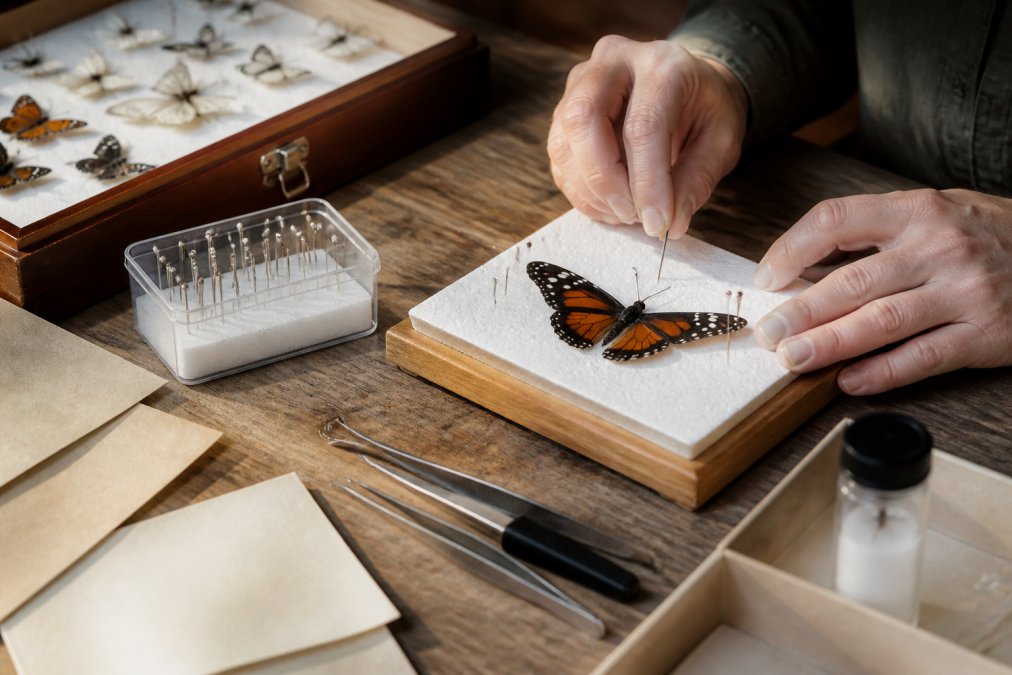
Tools and Materials You Will Need
Before you begin, assemble the following:
- Spreading board: A foam or cork board with a central groove to hold the specimen's body while wings or limbs are positioned
- Entomological pins: Stainless steel, size 2 or 3 for most insects; never use regular sewing pins as they corrode
- Relaxing chamber: A sealed container with a damp substrate used to rehydrate dried specimens before spreading
- Archival paper strips: Used to hold wings flat during drying
- Forceps and fine scissors: For handling delicate specimens
- Labelling materials: Acid-free card stock and archival-quality pen
- Silica gel packets: For controlling humidity in storage
Step-by-Step Preservation Process
-
Relax the specimen. Place dried insects in a relaxing chamber for 24-48 hours until limbs and wings move without resistance.
-
Pin through the thorax. Insert the entomological pin vertically through the right side of the thorax. For beetles, pin through the right elytron.
-
Position on the spreading board. Set the pin in the central groove so the body sits flush with the board surface.
-
Spread the wings. Gently move the forewings into position using a fine needle, then secure with archival paper strips and additional pins.
-
Allow to dry completely. Most insects require 1-3 weeks of drying time at room temperature.
-
Label immediately. Write the species name, collection date, location, and source on an archival label. Pin it below the specimen.
-
Transfer to permanent storage. Move the dried, labelled specimen to a sealed display case or storage box with silica gel.
Alternatives to Standard Glass for Framing Insects
Standard glass has been the default for framed insect specimens for generations, but it is heavy, fragile, and offers no UV protection, meaning colours fade significantly over years of light exposure.
| Glazing Option | Weight | UV Protection | Impact Resistance | Best For |
|---|---|---|---|---|
| Standard float glass | Heavy | None | Low | Budget frames, low-light rooms |
| Museum/conservation glass | Heavy | High (99%+) | Low | High-value specimens, lit rooms |
| Acrylic (Perspex) | Light | Moderate | High | Shipping, high-traffic spaces |
| UV-filtering acrylic | Light | High | High | Long-term display, sunny rooms |
| Anti-reflective acrylic | Light | Moderate-high | High | Gallery-style presentation |
UV-filtering acrylic is the most practical choice for most home collectors. It is significantly lighter than glass, resists shattering, and blocks the UV radiation that degrades pigments in butterfly wings and beetle elytra. The trade-off is that acrylic scratches more easily than glass and must be cleaned with a soft, non-abrasive cloth.
Museum-quality conservation glass is the professional standard for irreplaceable specimens, offering superior optical clarity and the highest UV protection available, but at considerably higher cost.
For shadowbox frames displaying three-dimensional specimens, the depth of the frame matters as much as the glazing material. The specimen should not touch the glass or acrylic surface, as contact causes pressure damage and moisture transfer.
Cataloging and Documentation for Your Natural History Collection
Documentation is where most home collections fall apart. A well-documented natural history collection is searchable, shareable, and scientifically useful. The minimum metadata for any specimen includes:
- Taxonomic name: Genus and species where known; family at minimum
- Common name: For accessibility
- Date acquired or collected
- Geographic origin: Country and region at minimum
- Source: Captive-bred, wild-collected, or purchased (with supplier name)
- Preservation method: How and when the specimen was prepared
- Condition notes: Any damage, repairs, or anomalies
For digital cataloging, a simple spreadsheet works well for small collections. The Atlas of Living Australia specimen data standards provides guidance on metadata fields used by professional collections, and adapting these standards for home use is straightforward.
Each physical specimen should carry a label with at minimum the species name, origin, and date. Use acid-free card and archival ink. Photograph every specimen before and after mounting for easier identification and comparison later.
Storage, Display, and Pest Management
Proper storage determines the long-term fate of a natural history collection. Beautiful preservation work can be undone within months by poor environmental conditions or pest infestation.
Environmental Controls for Long-Term Preservation
High humidity promotes mould growth and accelerates biological breakdown. Fluctuating temperatures cause repeated expansion and contraction that stresses pinned specimens and can crack dried tissue.
Target storage conditions for most biological specimens:
- Relative humidity: 45-55%
- Temperature: Stable, ideally between 15-20°C
- Light exposure: Minimal; UV light degrades pigments and desiccates tissue
Silica gel packets placed inside sealed storage boxes are the most practical humidity control for home collectors. Replace or recharge them every 6-12 months. A small digital hygrometer inside each storage box lets you monitor conditions without opening it frequently.
Preventing and Managing Pest Damage
Pest damage is the most common cause of collection loss. The main culprits are dermestid beetles, clothes moths, and psocids (booklice), which feed on dried biological material.
Prevention is far more effective than treatment:
- Seal all storage containers. Airtight boxes with foam gaskets are the standard.
- Inspect new acquisitions before adding them to the collection. Quarantine new specimens for two weeks and monitor for signs of activity.
- Use pest deterrents. Naphthalene-free insect repellent blocks or cedar products placed inside storage boxes deter common pests.
- Conduct regular inspections. Check every specimen at least annually for frass, shed skins, or structural damage.
If an infestation is detected, affected specimens should be isolated immediately. Freezing at -20°C for 72 hours kills most pest insects and their eggs without damaging the specimen.
Displaying Specimens as Home Decor
The gap between a storage collection and a display collection is smaller than most people think. The same principles of environmental control and pest prevention apply whether specimens are in a closed box or mounted on a wall.
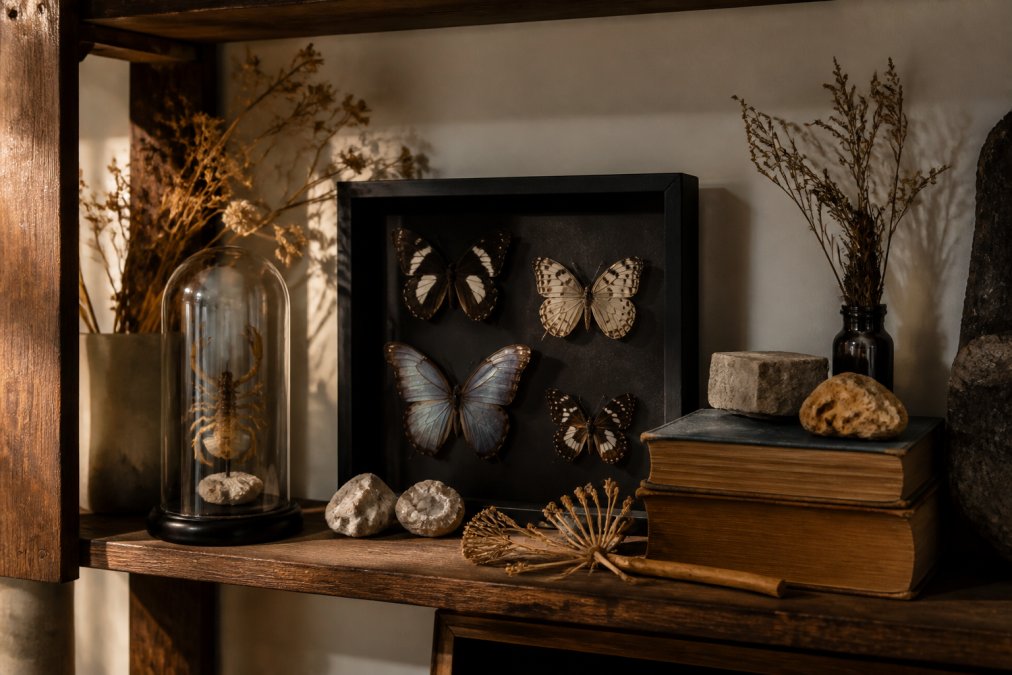
Displayed specimens face additional challenges: light exposure, dust accumulation, and handling by visitors. Position displayed specimens away from direct sunlight and artificial UV sources. Even indirect light causes gradual fading in butterfly wings and beetle elytra. North-facing walls or interior walls are ideal.
Shadowbox frames and glass domes are the two most practical display formats for home collections. Shadowboxes protect specimens from dust and handling while allowing close inspection. Glass domes work beautifully for three-dimensional specimens like scorpions or mounted beetles.
For collectors who want museum-quality presentation without the DIY effort, Newman Art Designs offers professionally preserved specimens in both formats. The Swirl of Butterfly Delight features three captive-bred butterflies arranged in a dynamic composition within a black shadowbox frame, preserved to last 20 years or more. The Scorpion in a Small Dome presents a Malaysian rainforest scorpion under a glass dome on a wooden base. The Triple Stag Beetles in a Frame and the Coiled Snake Skeleton in a Frame round out a collection with genuine visual impact.


Displaying specimens as conversation pieces works best when the display tells a story. Group specimens by taxonomy, geography, or theme rather than placing them randomly. Dust displays with a soft brush, not a cloth. Never use liquid cleaners near specimens.
The question of whether displayed specimens feel appropriate in a home is one we hear often. The honest answer is that context and presentation matter enormously. A well-framed butterfly specimen in a quality shadowbox reads as art. Craftsmanship is what makes the difference between a curiosity and a centrepiece.
As documented in Museums Australia professional standards for collection care, the principles that govern institutional collections apply directly to home collecting at any scale. The gap between professional and amateur practice is mostly one of documentation rigour and environmental consistency, both of which are achievable without specialist equipment.
Building a natural history collection takes patience, but the barrier to starting is genuinely low. The challenge most beginners face is not finding specimens or learning preservation techniques. It is finding professionally presented pieces that combine scientific integrity with genuine aesthetic quality. Newman Art Designs has been solving that problem since 1996, with museum-preserved specimens in shadowbox frames and glass domes, free shipping across Australia, and a track record of quality that customers consistently describe as stunning. Shop now and add a piece of the natural world to your home.
Frequently Asked Questions
What is considered a natural history collection?
A natural history collection is a curated set of specimens from the natural world, including biological samples such as insects, bones, shells, feathers, and geological specimens like rocks and minerals. Collections range from casual hobbyist assemblages kept at home to formally accessioned institutional archives. What distinguishes a collection from a random pile of objects is intentional curation: each piece is identified, labelled with metadata, and stored in conditions that protect its biological integrity for the long term.
How do you ethically source specimens for a private collection?
Ethical sourcing means acquiring specimens through legal, transparent channels that do not harm wild populations. Captive-bred insects that died naturally, specimens from licensed dealers, and items with documented provenance are all sound options. Under the Environment Protection and Biodiversity Conservation Act 1999, collecting protected native species without a permit is illegal. Always request documentation from suppliers, and avoid purchasing specimens whose origin cannot be verified. Professionally preserved pieces from established suppliers already carry this assurance.
How do you preserve insect specimens for long-term display?
Freshly collected or relaxed insects are pinned on a spreading board, positioned while still pliable, then dried slowly at room temperature for one to two weeks. Once fully set, they are transferred to an archival display case or shadowbox frame. UV-filtering glazing protects colours from fading. Silica gel sachets inside the case control humidity, and regular checks for pest activity prevent dermestid beetle damage. Museum-quality preservation techniques, like those used by specialist suppliers, can keep specimens stable for 20 years or more.
What are the best alternatives to standard glass for framing insect displays?
Standard float glass transmits UV light that fades pigments over time. UV-filtering acrylic (often called conservation acrylic or Plexiglas) blocks up to 99% of UV radiation, weighs significantly less than glass, and resists shattering, making it safer for postal shipping. Museum glass is another option: it combines UV filtering with anti-reflective coatings for near-invisible clarity. For home collectors on a tighter budget, UV-filtering acrylic offers the best balance of protection, safety, and cost.
This article was written using GrandRanker
