
7 Ethical Sourcing Standards for Insect Specimens
Last Updated: October 27, 2026
Quick Summary
Ethical sourcing standards for insect specimens rest on three pillars: provenance you can trace, welfare through every life stage, and a measurable conservation benefit. Ask for the breeder or farm name, country of origin, collection date and species name, then confirm the species is not protected under CITES.
- Chain of custody records each handover from breeder to framer, and gaps are the warning sign.
- Check the current CITES appendices, since they are amended at Conferences of the Parties.
- A permit for a different species is not a permit for yours.
- Natural-death specimens often show minor wear, so flawless batches claimed as natural death warrant questioning.
- A seller offering a protected species without paperwork is offering a legal problem, not a bargain.
Table of Contents
- What Ethical Sourcing Means for Insect Specimens
- Insect Specimen Provenance: Reading the Paper Trail
- Wild-Collected Versus Captive-Bred Insect Specimens
- CITES and Insect Collecting: What the Rules Actually Cover
- Do Specimens Come From Natural Death or Natural Lifespan Endings?
- A Supplier-Verification Checklist for Reputable Sources
- Red Flags, Traceability Failures and What to Do
- Choosing Your First Ethically Sourced Specimen
- Frequently Asked Questions
What Ethical Sourcing Means for Insect Specimens
Ethical sourcing standards for insect specimens rest on three pillars: provenance you can trace, welfare through every life stage, and a measurable conservation benefit. At Newman Art Designs, we have been established since 1996.
Ethical sourcing is the practice of buying insect specimens only where the supplier can document where the animal came from, how it lived and died, and what the sale does for wild populations. It is a chain of evidence, not a label. For the commercial side, see our breakdown of why insect art is expensive.
The Three Pillars: Provenance, Welfare and Conservation
- Provenance: written records from breeder or farm to your frame.
- Welfare: humane breeding, handling and transport conditions.
- Conservation: a paper trail showing the trade supports habitat, not plunder.
Most buyers ask only about the third. The first two are where the real failures hide.
Insect Specimen Provenance: Reading the Paper Trail
Insect specimen provenance is the documented history of a single specimen, from egg or capture point to finished display.
Ask for the breeder or farm name, the country of origin, the collection date and the species name. Then check that the species is not protected. The Convention on International Trade in Endangered Species lists which insects need permits.
Collection Records and Chain of Custody
Chain of custody means each handover is recorded: breeder to exporter, exporter to importer, importer to framer. Gaps are the warning sign. If a seller cannot name the farm, assume the record does not exist.
Wild-Collected Versus Captive-Bred Insect Specimens
Captive-bred insect specimens come from controlled breeding programs, while wild-collected specimens are taken from natural habitats. The difference matters for both conservation and legality.
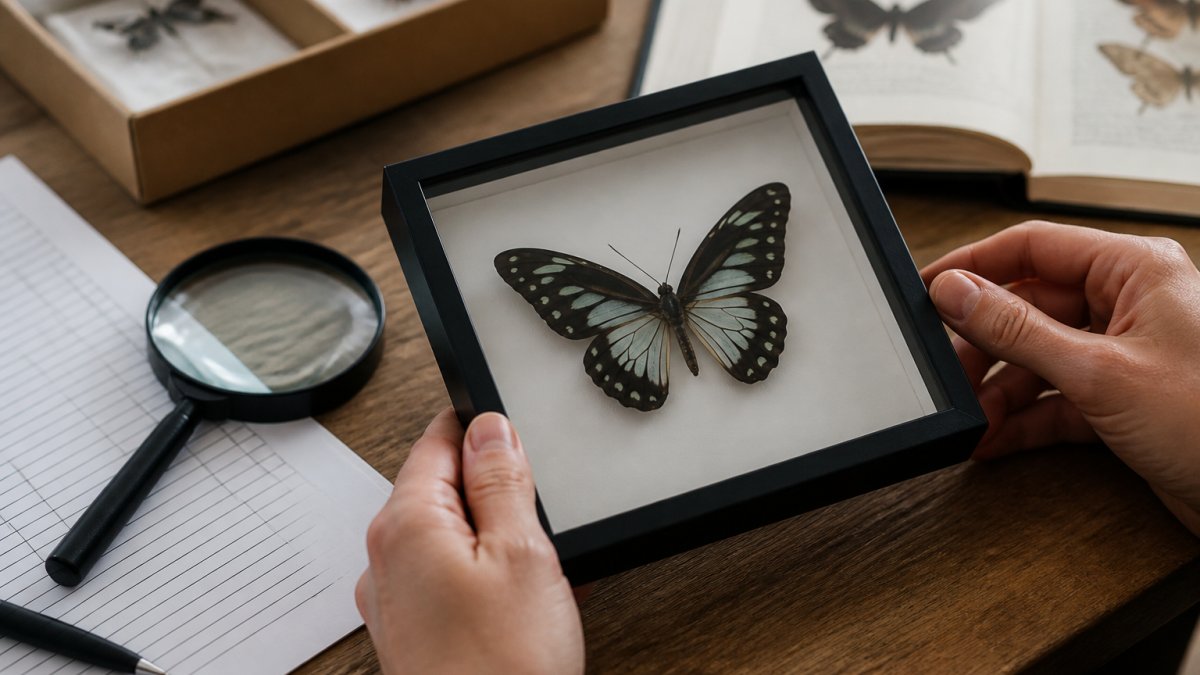
Wild collection can be legal and sustainable. A framed Phyllium giganteum leaf insect shows what the captive-bred versus wild-collected distinction looks like in practice.
Conservation Farms, Conservatories and Specialist Breeders
Ask each type one question: what happens to the habitat your animals come from? The answer separates a farm from a front.
CITES and Insect Collecting: What the Rules Actually Cover
In Australia, the Convention on International Trade in Endangered Species is implemented through the Environment Protection and Biodiversity Conservation Act 1999 (EPBC Act). The Australian Government Department of Climate Change, Energy, the Environment and Water administers wildlife trade permits under that Act, including the household-name permits most buyers will encounter: the Australian CITES export permit, the Australian CITES import permit, and the non-CITES wildlife trade permit for species that are regulated domestically but not listed internationally.
A Four-Step Legal Check Before You Buy
- Check the international listing. Search the species name against the current CITES appendices. Appendix I is the strictest (commercial trade generally prohibited); Appendix II requires export permits; Appendix III requires certificates of origin. The appendices are amended at Conferences of the Parties, so check the current version, not a cached list.
- Check the domestic status in the country of origin. A species can be unlisted by CITES and still be protected by national or state law where it lives. For Australian-origin specimens, check the EPBC Act listed threatened species and the relevant state or territory wildlife Act. For imported stock, ask the supplier which national law governs the export.
- Check the Australian import side. Even a legally exported specimen needs to satisfy Australian import requirements. The Department of Climate Change, Energy, the Environment and Water issues import permits and will check that the export permit matches the specimen. Commercial imports of CITES Appendix I species are generally not permitted.
- Check the state or territory layer. Wildlife and biodiversity legislation differs between jurisdictions, and some states regulate possession or display of native insects independently of the federal scheme. If you are displaying or reselling, confirm the local rules where the piece will be held.
Import, Export and Permits in Practice
- Match the permit to the specimen: species name, scientific name, date, quantity and exporter must all line up. A permit for a different species is not a permit for yours.
- Keep the export permit, the import permit and the airway bill or shipping record together. Inspectors and future buyers will ask for the set, not one document.
- Note the permit validity window. Permits expire, and a specimen shipped after expiry is a compliance problem even if the paperwork was once valid.
- For non-CITES species, keep the commercial invoice and the breeder's declaration. These are not permits, but they are the evidence trail if a shipment is queried.
For the full legal picture on bringing specimens in, read our guide to legal requirements for importing butterfly specimens.
Do Specimens Come From Natural Death or Natural Lifespan Endings?
Some specimens are collected after natural death, at the end of a natural lifespan. This is the most defensible origin, and the hardest to prove. But natural-death sourcing is only one part of a welfare picture that most sourcing guides skip entirely: how the insect was bred, handled, transported and, where death is not natural, killed.
Welfare Through Every Life Stage
- Breeding and rearing. Look for enclosure density, temperature and humidity control, and a described larval diet. A breeder who can describe rearing conditions in writing is more credible than one who cannot.
- Handling. Butterflies and beetles are fragile; excessive handling causes wing damage and stress. Ask whether adults are handled at all before preservation.
- Transport. Live transport and specimen transport are different problems. For live stock, ask about ventilation, duration and temperature. For preserved stock, ask about humidity control and padding to prevent breakage.
- Killing method (where death is not natural). Humane entomological practice generally favours rapid methods that minimise distress. Ask what method is used. A supplier who cannot answer is not necessarily unethical, but a supplier who will not answer is a warning sign.
- End-of-life collection. For natural-death sourcing, ask for the date of death and the breeding batch. Vague answers usually mean the specimen was collected alive.
Distinguishing Natural-Death Claims From Marketing
- Batch records. A breeder working at scale keeps batch records showing when a cohort emerged and when adults died. Ask to see the batch reference, not just a date.
- Condition consistency. Natural-death specimens often show minor wear, a missing antennal tip, faded wing scales. A batch of flawless specimens all claimed as natural death is a pattern worth questioning.
- Volume plausibility. A small breeder can plausibly supply a handful of natural-death specimens a month. A seller offering hundreds of identical "natural death" pieces is describing a supply chain, not a lifecycle.
A Supplier-Verification Checklist for Reputable Sources
- Species name confirmed and checked against CITES appendices
- Breeder or farm named, with location
- Collection or death date supplied
- Captive-bred or wild-collected status stated clearly
- Export and import permits provided where required
- Chain of custody documented from source to seller
- Welfare and handling practices described
- Conservation contribution explained, with evidence
- Returns policy in writing
| Problem | Fix | Impact |
|---|---|---|
| No breeder named | Request source records | Blocks unverifiable stock |
| Species not checked | Search CITES appendices | Avoids legal risk |
| No permits | Walk away | Prevents seizure |
| Vague death date | Ask for batch records | Confirms natural ending |
| No welfare detail | Request handling notes | Protects animal welfare |
Red Flags, Traceability Failures and What to Do
Watch out: a seller who offers a protected species "without the paperwork hassle" is offering you a legal problem, not a bargain. Report suspected illegal trade to the Australian wildlife trade regulator and keep your correspondence.
Choosing Your First Ethically Sourced Specimen
At Newman Art Designs, our collection includes museum-preserved specimens displayed in shadowbox frames or glass domes, with free shipping in Australia. Readers ready to buy can consult our buyer's guide to ethically sourced butterfly wall art.
Frequently Asked Questions
What makes an insect specimen ethically sourced?
An ethically sourced insect specimen has three things behind it: documented provenance, welfare-conscious handling, and consideration of wild populations. Ask about collection records, breeding origin and any relevant documentation.
How can I verify where a preserved insect specimen came from?
Start by asking about the specimen's provenance, including its species, country of origin, date, and whether it was captive-bred or wild-collected. Ask about any relevant documentation.
Are captive-bred insect specimens more ethical than wild-collected ones?
The label alone does not establish how a specimen was sourced. Ask about its provenance and the practices behind its sourcing.
Do insect specimens need permits or documentation?
Requirements depend on the species and the circumstances of the transaction. If you are buying framed butterflies or beetles from overseas, check the applicable requirements with an official source before purchase.
The challenge is simple: most sellers cannot prove where their specimens came from. We can, because we have built our collection on traceable, museum-quality pieces since 1996. Every frame is preserved to museum standard, shipped free across Australia, and backed by the craftsmanship that keeps colours true for years. Get started with Newman Art Designs and bring a piece of the natural world into your home with confidence.

