
Which Materials Are Truly Acid-Free for Insect Mounting?
Last Updated: October 29, 2026
Quick Summary
Acid free materials for insect mounting include pure cork or acid-free cork composite bases, buffered acid-free mounting board, undyed cotton or linen lining, and archival labels. Materials should state a pH of 7.0 or higher and be lignin-free, since acidic breakdown can yellow and damage specimens.
- Pure cork with no visible binder is the default base for pinned specimens.
- Check the pH of the base itself, not just the board above it.
- Choose lignin-free board, because lignin breaks down into acidic by-products over time.
- Use water-based or archival adhesives and avoid rubber cement and general-purpose glues.
- Test both the surface and cut edge of boards with a pH test pen before use.
Table of Contents
- Why Acid-Free Materials Matter for Insect Mounting
- Step 1: Choose the Best Pinning Base for Insect Collections
- Step 2: Select an Acid-Free Mounting Board for Insects
- Step 3: Pick a Fabric for Insect Specimen Cases
- Step 4: Check Whether a Material Is Genuinely Acid-Free
- Step 5: Compare Adhesives, Foams and Other Materials in Contact With Specimens
- Your Next Step: Building an Acid-Free Mounting Kit
- Frequently Asked Questions
Why Acid-Free Materials Matter for Insect Mounting
Choosing acid-free materials is the single most important decision you make when mounting an insect specimen. Acid breaks down paper, card and fabric over time, and that same acid can slowly damage the insect itself.
Most collectors only notice the problem when a backing board turns yellow or brittle. By then, the specimen may already be stained or loose on its pin. That is why we recommend checking materials before you buy, not after.
Acid-free means a material has a neutral or slightly alkaline pH, usually a figure of 7.0 or higher on a standard pH scale. Materials labelled archival or acid-free are typically made without acidic wood pulp and buffered with a mild alkaline reserve. Check the product description carefully, because some marketing terms are not backed by any testing standard.
Specimen mounting is a long-term hobby, and good acid free materials help protect a collection over time.
Step 1: Choose the Best Pinning Base for Insect Collections
The pinning base is the surface your pins go into. It holds the pin firmly, but it should not crush, split or chemically interact with the specimen. A poor base leads to loose pins, wobbly specimens and, over years, corrosion at the pin shaft where it meets the base.
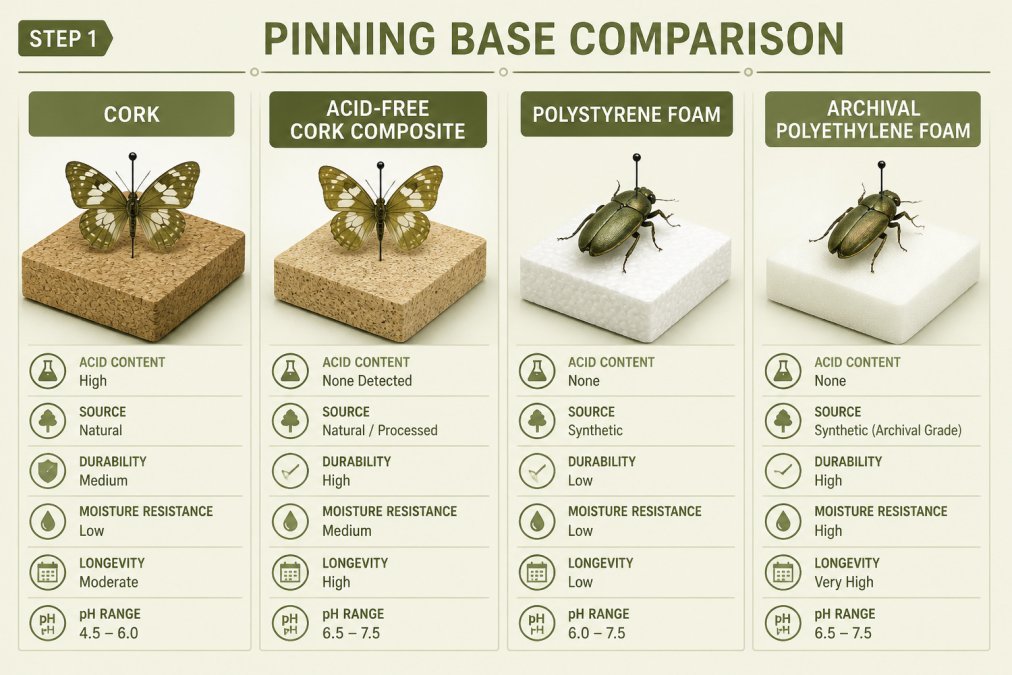
Most collectors choose between four common types. The table below compares them on the factors that actually matter for long-term insect mounting.
| Base material | Pin grip | pH behaviour | Durability | Typical cost (AUD) | Best for |
|---|---|---|---|---|---|
| Pure cork sheet (no binder) | Firm, self-sealing | Neutral to slightly acidic unless specified acid-free | Good; can crumble at edges over decades | Approx. $15-$30 per A3 sheet | Pinned butterflies and moths in display drawers |
| Acid-free cork composite | Firm | Buffered, pH 7.5-8.5 when certified | Very good | Approx. $30-$55 per A3 sheet | Valuable or type specimens |
| Polystyrene foam (closed-cell, extruded) | Moderate; pins can enlarge holes | Chemically inert if uncoloured, but some foams off-gas | Fair; crumbles with repeated pinning | Approx. $8-$20 per A3 sheet | Temporary or working bases |
| Archival polyethylene foam | Moderate to firm | Inert, no plasticisers | Good | Approx. $25-$45 per A3 sheet | Storage trays and drawer liners |
A few practical rules follow from that comparison:
- Cork is the default for pinned specimens because it grips pin shafts and closes around them. Choose pure cork with no visible binder; binders are where acidic glues hide.
- Foam is a working surface, not a long-term home. Extruded polystyrene is fine for spreading and temporary holding, but repeated pinning enlarges holes and some coloured foams contain dyes that can migrate.
- Match the base to the specimen. Heavy beetles need a firmer base than delicate moths; a soft foam that lets a large pin rock will eventually enlarge the hole and let the specimen tilt.
- Ask for the pH of the base itself, not just the board above it. A certified acid-free board over an acidic cork base still exposes the pin and the specimen's underside to acid.
Step 2: Select an Acid-Free Mounting Board for Insects
Mounting board sits underneath your specimen and forms the visible background. It is the part most likely to yellow if it is not acid-free, so it deserves close attention.
When you shop, look for these signs:
- The label states the board is acid-free or has a neutral pH
- The board has a buffered or alkaline reserve
- It is made from cotton rag or purpose-made archival pulp
- The edges feel firm, not crumbly
Hold a sample near a light source. Acid-free board should look clean and stable, not glossy or coated. Coated board can contain plastics that affect your specimens over time.
Step 3: Pick a Fabric for Insect Specimen Cases
If your display case uses fabric lining, that fabric touches your specimens directly. Choose it carefully, because natural fibres and dyes can cause problems.
Good options include:
- Undyed cotton, washed to remove sizing
- Unbleached linen with no finishes
- Purpose-made archival fabric, where available
Avoid fabrics treated with flame retardants, mothproofing chemicals or heavy dyes. Test a small swatch first by placing it in a sealed container with a specimen for several weeks. Check for staining, fading or odour before you commit to the full case.
Step 4: Check Whether a Material Is Genuinely Acid-Free
Many products claim to be acid-free, but the claim alone proves little. A material can be acid-free at the moment of purchase and still turn acidic as it ages, especially if it contains lignin or an unbuffered pulp. Here is a practical way to check, moving from the label to the bench.
1. Read the label for the right words
Reputable suppliers state one of the following:
- A pH value (7.0 or higher, ideally 7.5-9.0 for buffered board)
- A buffered or alkaline reserve claim, usually expressed as a percentage of calcium carbonate
- A reference to a recognised archival standard, such as a lignin-free or buffered archival board specification
- A cotton rag or purified wood pulp composition
Vague wording such as "museum quality" or "archival" with no number behind it is a warning sign, not a guarantee.
2. Understand lignin and why it matters
Lignin is the natural polymer that makes wood stiff. In paper and board it breaks down over time, producing acidic by-products that yellow the material and can stain or corrode a specimen. A board can be acid-free today and still contain lignin that turns it acidic in five to ten years. Look for lignin-free on the label, not just acid-free.
3. Understand the buffer
A buffered material contains an alkaline reserve, commonly calcium carbonate, that neutralises acid as it forms. Buffering is what separates a board that stays neutral for decades from one that is merely neutral on the day it is made. For insect mounting, a buffered board is the safer choice for the backing beneath a specimen.
4. Test the surface and the edge
Inexpensive pH test pens and strips give a quick reading. Test both the surface and a cut edge, because surface coatings can mask an acidic core. A reading below 7.0 on either surface means the material is not suitable for direct contact with a specimen.
5. Run an ageing check
Keep a sample in a warm, dry place for a few months and inspect it for yellowing, brittleness or odour. A material that discolours in a sample will do the same under a specimen, only more slowly and less visibly.
6. Keep a record
Note the supplier, product name, stated pH, buffer claim and your test results. Over time this record becomes the most reliable guide to which materials you can trust for the next specimen.
If a material fails any of these checks, do not use it near your specimens. The cost of a replacement board is small compared with a damaged collection.
archival board pH and buffering guidance
Step 5: Compare Adhesives, Foams and Other Materials in Contact With Specimens
Anything that touches a specimen needs the same scrutiny as the mounting board. This includes glues, foams, labels and tapes.
- Adhesives: Use water-based or archival-grade adhesives. Avoid rubber cement and general-purpose glues, which can stain and become brittle.
- Foam: Pick closed-cell foam that does not release chemicals. Some foams break down into sticky residue.
- Labels: Print labels on archival paper with pigment-based ink. Inkjet prints on ordinary paper can fade or bleed.
- Tapes: Choose acid-free, pH-neutral tape, or avoid tape altogether where you can.
A simple rule helps here. If a material is not clearly labelled as safe for archival use, keep it away from the specimen itself.
Your Next Step: Building an Acid-Free Mounting Kit
Now you know what to look for, so start small. Put together a basic kit with a pinning base, a sample of acid-free mounting board, undyed cotton fabric, archival labels and a pH test pen.
Test each item before you mount a valuable specimen. Keep a note of the supplier, the product name and the test results, so you can buy the same material again later. Over time, your kit will become a reliable set of materials you trust.
Frequently Asked Questions
Why should insect mounting materials be acid-free?
Acidic materials can discolour and weaken the paper, card and fabric around a specimen over time. Acid-free materials are generally made with a neutral or alkaline pH, which is why many collectors prefer them.
What is the best pinning base for an insect collection?
Cork and purpose-made foams are commonly used as pinning bases. Check the product specification to confirm whether it is labelled acid-free or archival.
Which fabrics are suitable for insect specimen cases?
Undyed cotton and unbleached linen are common choices for lining specimen cases. Washing fabric before use is a sensible precaution.
How can I tell whether mounting board is acid-free?
Look for a manufacturer statement that the board is acid-free and lignin-free, and a stated pH value in the specification. If the supplier cannot state the pH or the archival standard, treat the board as unverified.

