Ethically Sourced Insect Specimens: A 2026 Guide
Table of Contents
- What Ethically Sourced Insect Specimens Actually Means
- Ethical Insect Collection: Captive Breeding vs Wild Collection
- Insect Specimen Sourcing Questions to Ask Every Seller
- Insect Specimen Import Regulations and Legal Compliance
- How to Verify Provenance and Traceability Before You Buy
- Insect Art Care and Display: Storage, Fading, and Longevity
- Pricing Ethically Sourced Insect Specimens: What You're Paying For
- Conclusion
- Frequently Asked Questions
Last Updated: October 12, 2026
What Ethically Sourced Insect Specimens Actually Means
Ethically sourced insect specimens are preserved insects acquired through methods that avoid harm to wild populations, respect local ecosystems, and comply with wildlife regulations, covering how an insect was obtained, handled, and whether its collection supported or damaged its habitat.
"Ethically sourced" is one of the loosest phrases in the insect art trade.
The core distinction is between supply that can be traced and supply that cannot.
Ethical Insect Collection: Captive Breeding vs Wild Collection
Breeding farms, sometimes called conservation farms, are the backbone of responsible supply: they maintain breeding stock, manage genetics, and reduce pressure on wild populations.
Wild collection is not automatically unethical. Responsible collecting works within limits, targets abundant species, and avoids protected species.
A useful way to compare the two:
| Sourcing Method | Population Impact | Traceability | Typical Use |
|---|---|---|---|
| Captive breeding farms | Low, controlled stock | High, farm records | Common display species |
| Managed wild collection | Low if limits enforced | Medium, depends on records | Regional species |
| Unmanaged wild collection | Potentially high | Low to none | Avoid where unverifiable |
Farmed or managed supply is easier to verify and lower risk. If a seller cannot say which category their stock falls into, that is a red flag.
Insect Specimen Sourcing Questions to Ask Every Seller
A short set of questions separates serious suppliers from resellers who pass along what they were told. Treat vague answers as answers in themselves.
- What is the exact species name, and where was it collected or bred?
- Was this specimen captive bred or wild collected?
- Can you provide provenance documentation or a supplier reference?
- Which permits or export records cover this specimen?
- How was the insect euthanised and preserved?
- Is this species protected or restricted in any market you ship to?
The pattern matters more than any single reply. A seller who names the species, origin, and breeding method runs a real supply chain; one who answers everything with "ethically sourced, don't worry" is asking you to take their word for it.
Insect Specimen Import Regulations and Legal Compliance
Legal compliance is where ethical sourcing and paperwork meet, and it is the part most buyers overlook until a parcel is held at the border. Insect specimens cross borders under wildlife trade rules that depend on the species, its conservation status, and the jurisdictions involved. This section covers imports into Australia.
The three layers of regulation
Australian insect imports are governed by three overlapping layers, and a specimen must satisfy all of them:
- International treaty obligations. The Convention on International Trade in Endangered Species of Wild Fauna and Flora (CITES) controls cross-border trade in listed species. Appendix I species are effectively banned from commercial trade; Appendix II species require export permits from the country of origin and, in most cases, an Australian import permit; Appendix III species require export permits from the listing country. Many popular display beetles, birdwings, and stag beetles sit on Appendix II, so permits are the norm.
- National environment law. CITES is implemented in Australia through the Environment Protection and Biodiversity Conservation Act 1999 (EPBC Act), which also controls live imports through the List of Specimens Taken to be Suitable for Live Import (the Live Import List). Dead, preserved specimens are generally assessed under CITES provisions rather than the Live Import List, but the distinction matters if you buy live stock, pupae, or eggs for rearing.
- State and territory controls. Each state and territory has its own biosecurity and wildlife laws. Some native insects cannot be collected or moved across state lines without a permit, and some jurisdictions restrict possession of listed species regardless of where they were bred. A specimen lawful to import may still be unlawful to hold in your state.
What the permit process actually involves
The federal environment department administers CITES permits in Australia and publishes guidance on Australian wildlife trade permit requirements. In practice, the pathway for a preserved specimen looks like this:

- The overseas supplier applies for a CITES export permit from their own country's management authority.
- The Australian importer applies for a CITES import permit from the federal department before the specimen is shipped.
- Both permits travel with the shipment. A permit issued after the specimen has already left is not valid.
For non-CITES species, the process is lighter but not absent. Biosecurity requirements still apply, and some specimens are treated as quarantine risk material depending on how they were preserved.
The practical implications for buyers
- Species listed under CITES need valid import and export permits before shipment. No permit, no lawful import, regardless of how the specimen was sourced.
- Protected species may be illegal to import outright. Appendix I species and species listed under Australian law as threatened cannot be traded commercially.
- Documentation should travel with the specimen, not be promised on request after the sale.
This is the strongest argument for buying from established suppliers with real paperwork. A seller who ships internationally as routine business knows which species clear customs; a casual reseller does not, and the buyer carries the risk.
How to Verify Provenance and Traceability Before You Buy
Provenance is the documented history of a specimen: what it is, where it came from, and how it reached the seller. Traceability is whether that history can be followed and checked. Together they are the only real evidence behind an ethical sourcing claim. This section covers credible evidence, how to check species-level conservation risk, and the warning signs of a fabricated supply chain.
What credible provenance evidence looks like
A genuine supply chain produces documents as a matter of course. A serious seller should be able to provide, or at least describe in specific terms:
- Species name in full, including the binomial (genus and species), not just a common name like "stag beetle".
- Country and, where possible, region of origin, not just "Asia" or "the tropics".
- Sourcing method: captive bred, farmed, or wild collected, stated explicitly.
A single document is rarely enough. Look for a chain where each link can be checked against the next: if the seller can name the farm but not the country, or the country but not the species, the chain has a gap.
How to check species-level conservation risk
Two specimens of the same size and price can carry very different conservation risk depending on species and origin. Captive-bred stock of a common farmed species is low risk; wild-collected stock of a slow-reproducing or range-restricted species is not, even if the seller calls it ethical.
You can check this yourself in a few minutes:
- Look up the species on the CITES appendices. Appendix I means commercial trade is prohibited; Appendix II means permits are required; Appendix III means export controls apply from the listing country.
- Check the IUCN Red List for the species' global conservation status. Categories run from Least Concern through Near Threatened, Vulnerable, Endangered, and Critically Endangered. A specimen offered as "farmed" from a Critically Endangered species deserves hard questions.
- Check Australian listings. The EPBC Act maintains a list of threatened species, and state and territory governments maintain their own. A species can be common globally but protected locally, or vice versa.
- Consider the species' biology. Long-lived, slow-breeding, or habitat-specialist insects recover poorly from collection pressure. Fast-breeding, widespread species tolerate managed collection far better.
Warning signs of a fabricated supply chain
Most misleading listings are not outright fraud. They are vague in ways that sound reassuring. Watch for:
Triple Stag Beetles in a Frame →
- "Ethically sourced" with no species, origin, or method. This is a marketing phrase, not a sourcing claim.
- Common names only. Without a binomial, you cannot check conservation status or legality.
- Origin described as a region rather than a country. "Southeast Asia" covers dozens of jurisdictions with different rules.
A practical verification checklist
Use this before committing to a purchase:
- Species name provided in full, not just a common name
- Country or region of origin stated
- Sourcing method stated as captive bred, farmed, or wild collected
The sellers worth buying from will not find this intrusive. They will already have the answers ready, because a genuine supply chain produces them as a matter of course.
Insect Art Care and Display: Storage, Fading, and Longevity
Preserved insect displays last for years when kept away from direct sunlight, moisture, and physical knocks.
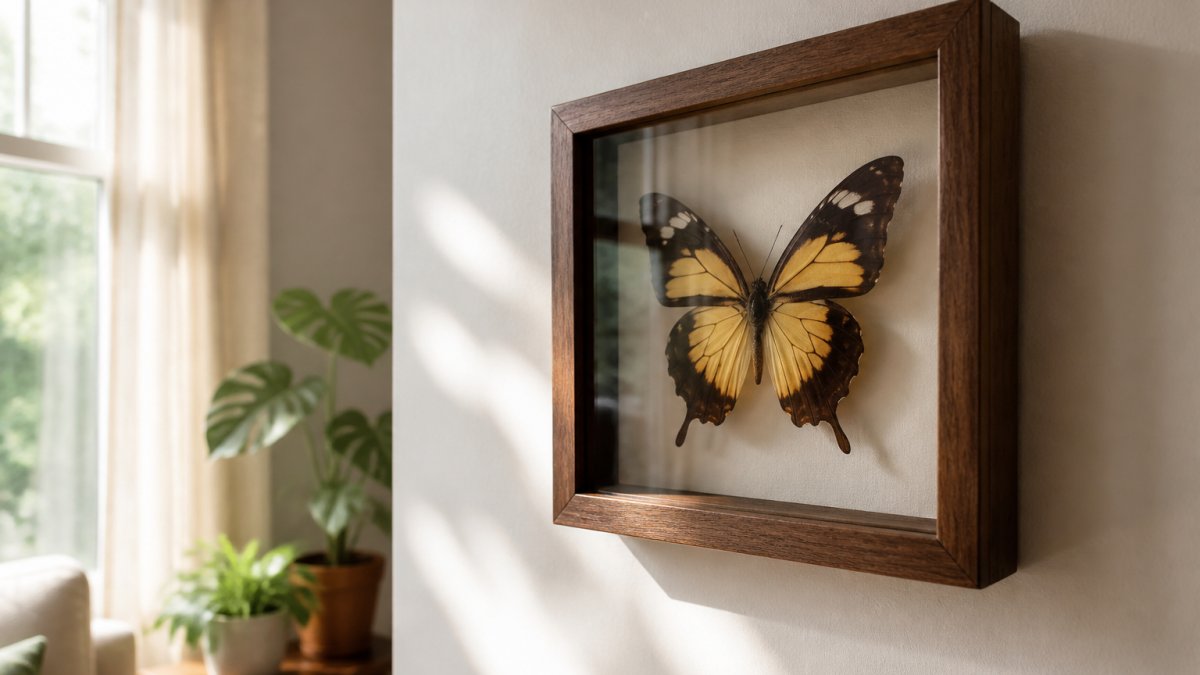
A few habits keep a collection in good condition:
- Hang or place displays out of direct sun, ideally on an interior wall
- Keep frames and domes away from bathrooms, kitchens, and other damp rooms
- Dust with a soft dry brush rather than a damp cloth
For smaller spaces, shadowbox frames and glass domes work well because they display vertically and need no shelf space.
Storage matters too. If you rotate pieces or pack a collection away, keep specimens in a dry, dark place, ideally in a sealed container with a desiccant.
Pricing Ethically Sourced Insect Specimens: What You're Paying For
Ethically sourced insect specimens cost more because verifiable supply costs more to produce. The price reflects the species, the size and complexity of the display, the preservation work, and the documentation behind the sourcing.
Here is how pricing breaks down across our own framed and domed pieces:
| Piece | Price |
|---|---|
| Violin Beetle in a Frame | $69.95 |
| Thorny Leaf Insect Framed | $89.95 |
| Three Horned Rhino Beetle Framed | $94.95 |
| Triple Stag Beetles in a Frame | $119.95 |
| White Ghost Cicada in a Dome | $134.95 |
What you are paying for is not just the insect: it is the shadowbox or dome, the mounting and preservation work, the species, and the sourcing that makes the piece defensible.

The comparison to ordinary wall art is worth making honestly. A mass-produced print is cheaper because it is printed; a preserved specimen is a one-off natural object that has been sourced, prepared, and framed, and no two are identical. That is the difference you are paying for.
Conclusion
The gap between an ethical sourcing claim and actual evidence is where most buyers get caught out, and closing it takes nothing more than asking the right questions and expecting real answers.
At Newman Art Designs, we have been supplying museum-preserved insect art since 1996, with pieces including framed beetles, thorny leaf insects, and domed ghost cicadas, all mounted in shadowbox frames or glass domes and shipped free within Australia.

Shop now with Newman Art Designs and bring a verifiable piece of the natural world into your home.
Frequently Asked Questions
What does ethically sourced mean for insect specimens?
Ethically sourced insect specimens come from suppliers who follow clear welfare and conservation standards. This usually means insects are captive-bred on licensed farms rather than taken from wild populations, are humanely euthanised, and are traceable to a known species and origin. Reputable sellers can tell you the species name, country of origin, and whether the insect was bred or collected. Without that information, you cannot confirm the sourcing meets ethical standards.
How can I tell whether a preserved insect was ethically sourced?
Ask the seller for the species name, country of origin, and whether the insect was captive-bred or wild-collected. A transparent seller will answer without hesitation. Look for documentation such as farm certificates or supplier declarations. Check whether the species appears on protected lists, because threatened species should not be sold without permits. If a listing gives no origin or breeding information, treat that as a warning sign rather than assuming the best.
Are insect specimens collected from the wild or bred in captivity?
Both happen, but the ethical preference is captive breeding. Breeding farms raise insects in controlled conditions, which reduces pressure on wild populations and gives suppliers more control over welfare and species identification. Wild collection still occurs, particularly for species that are difficult to breed, and it can be sustainable when it follows collection limits and local regulations. The key is whether the supplier can show which method was used and that it complies with wildlife rules.
What questions should I ask a seller about insect sourcing?
Ask five things: the exact species name, the country of origin, whether the insect was captive-bred or wild-collected, what welfare and conservation standards the supplier follows, and whether any permits are required for the species. A seller who answers all five clearly is demonstrating supply-chain transparency. If answers are vague or the seller deflects, look elsewhere. These questions protect you from inadvertently supporting unsustainable or illegal collection.
Are there rules about importing or selling insect specimens?
Yes. Importing and selling insect specimens can fall under wildlife trade regulations, and requirements vary by species and country of origin. Protected species typically need permits, and shipments may be inspected at the border. Sellers should be able to tell you whether a species requires documentation. If you are buying from overseas, check the import requirements before you order, because non-compliant shipments can be seized and destroyed.
How should preserved insect specimens be displayed and cared for?
Keep framed specimens out of direct sunlight, because UV light fades colours over time. Avoid damp rooms such as bathrooms, since humidity can damage preserved insects. A shadowbox frame or glass dome protects the specimen from dust and physical contact. Display them at eye level in a dry, stable spot away from heat sources. With proper care, museum-quality preserved specimens can last for many years without deterioration.
What makes preserved insect art valuable?
Value comes from several factors: the rarity and condition of the species, the quality of preservation, the craftsmanship of the frame or dome, and whether the sourcing is documented and ethical. Museum-quality mounting and solid frames add durability. Species that are legally and ethically sourced, with clear provenance, hold value better than undocumented specimens. Limited availability of a particular species also affects price, as does the overall aesthetic appeal of the display.
