
How to Display Shadowbox Insect Art: A 2026 Guide
Table of Contents
- Shadowbox Insect Art: A Complete Beginner's Workflow
- How to Keep an Insect in a Shadow Box
- Best Glass for Insect Display: UV Protection and Clarity
- How Long Do Framed Insects Last?
- Insect Shadow Box Display Ideas for Every Space
- Troubleshooting Common Mounting and Display Problems
- Frequently Asked Questions
Last Updated: October 12, 2026
Shadowbox Insect Art: A Complete Beginner's Workflow
Shadowbox insect art is the practice of mounting preserved butterflies, beetles and other specimens inside a deep, glass-fronted frame so they can be viewed from the side as well as the front.
The good news is that a well-built display needs very little ongoing work.
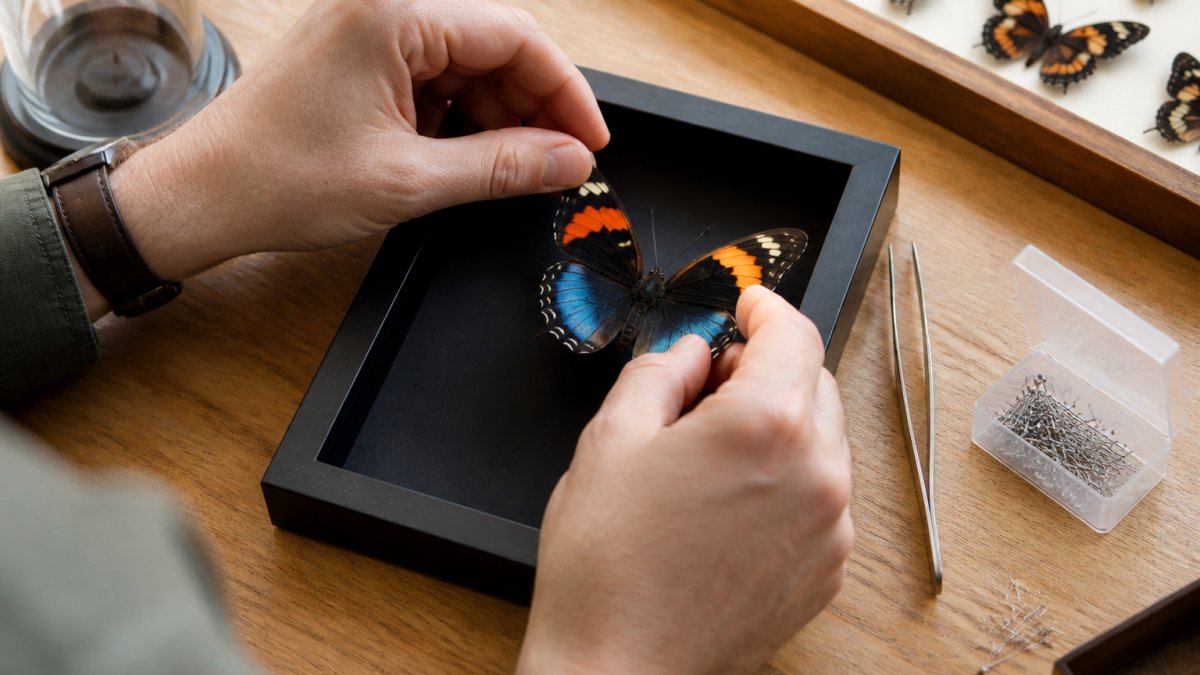
What You'll Need Before You Start
Gather your tools before you open the frame. Working in one calm session protects fragile wings.
- A shadow box frame with at least 3 cm of internal depth
- Acid-free mounting board or mat board
- UV-blocking glass or acrylic glazing
For very small or delicate insects, choose finer pins and a lighter backing. Heavier beetles can carry a thicker pin and sit closer to the glass.
How to Keep an Insect in a Shadow Box
Keeping an insect in a shadow box comes down to three things: a stable mount, a dry environment, and protection from light. Get those right and the specimen holds its position for years.
Pinning, Positioning and Securing Your Specimen
Start by deciding whether the insect will be pinned or mounted flat. Pinned specimens sit slightly raised, which suits beetles and larger moths. Flat mounting works better for butterflies with broad wings, because it spreads the weight across the board.
- Rehydrate dried specimens first so the wings and legs move without cracking.
- Lay the specimen on the backing board and mark its position with a pencil.
- Pin through the thorax, or fix the body with a small dot of acid-free adhesive.
- Spread the wings into your chosen pose and hold them with temporary pins.
- Add a small specimen label with the species and origin.
- Leave the piece to settle for a day before sealing the frame.
A common mistake is pinning too close to the glass. Wings that touch the glazing can rub and lose scales over time.
Best Glass for Insect Display: UV Protection and Clarity
The best glass for insect display is UV-blocking glass or acrylic glazing, because ultraviolet light is the main cause of fading in preserved specimens.
There is a trade-off to weigh. Glass is scratch-resistant and gives the sharpest clarity, but it is heavier and more fragile in transit.
Whichever you choose, look for a UV filter rating and an anti-reflective coating if the piece will hang near a window.
For a ready-made example, our Morpho didius Butterfly in a Frame is built in an 8" x 10" black shadow box with a deep-set mount, which keeps the wings clear of the glazing.

How Long Do Framed Insects Last?
Framed insects can last for decades when they are kept dry, out of direct sun, and sealed against pests. Left in a bright, humid spot, the same specimen may fade or loosen within a year or two.
Most practitioners find that a well-sealed display in a stable room holds its colour and position for twenty years or more. The specimens that fail early almost always fail for one of four reasons: moisture swings, direct light, pest access, or a mount that was never quite secure.
Environmental Factors That Affect Longevity
Four conditions do most of the damage to insect shadow box displays.
- Light: Direct sun fades colour fastest. Keep displays away from windows that catch strong afternoon light. Even indirect daylight accumulates damage over years, which is why UV-blocking glazing matters for any piece that lives in a bright room.
- Humidity: Damp air encourages mould and can cause wings to buckle. Aim for a dry, well-ventilated room. A common target is a relative humidity between 40% and 55%; below that, wings can become brittle, and above it, mould and condensation become likely.
- Pests: Carpet beetles and museum beetles will feed on dried specimens if they can reach them. A sealed frame is your main defence, but a small sachet of silica gel or a museum-style pest strip tucked behind the backing adds a second layer of protection.
A sealed display also keeps out dust, which is hard to remove once it settles on wing scales.
Long-Term Maintenance and Monitoring
A display that is checked once or twice a year will outlast one that is never inspected. Build a simple routine around the same four threats.
Morpho didius Butterfly in a Frame →
- Inspect the seal. Run a finger along the back edge of the frame. Any gap, lifting tape, or soft corner is an entry point for dust and pests. Re-tape with acid-free framer's tape before the problem spreads.
- Watch for frass. Fine powder or tiny holes near the specimen mean beetles have found a way in. Isolate the piece immediately, freeze the frame for 72 hours in a sealed bag to kill eggs and larvae, then reseal it in a clean frame.
- Check for condensation. A faint haze on the inside of the glass after a cold night points to moisture trapped in the frame. Move the piece to a drier wall and add a silica sachet behind the backing.
- Look for movement. Tilt the frame gently. If the specimen shifts, the pin or adhesive has loosened. Reset the mount before the insect rubs against the glazing.
- Dust the outside only. Wipe the glass with a dry microfibre cloth. Never open the frame to clean inside unless you are prepared to reseal it.
Storage and Rotation
If you rotate displays or store pieces between seasons, treat storage as carefully as display. Keep spare frames in a cool, dark cupboard away from the floor, where damp and pests are most active.
A display that is rotated off the wall for a few months and stored correctly will come back looking the same. One left in a hot car or a damp shed usually will not.
Insect Shadow Box Display Ideas for Every Space
Insect shadow box display ideas range from a single framed specimen on a shelf to a grouped wall arrangement. The trick is matching the scale of the piece to the space you have, and matching the materials to the insect you are mounting.
Matching Materials to Insect Size and Weight
The single biggest cause of a display that sags or shifts is a mount that was too light for the specimen. Use this as a starting point.
| Insect type | Backing | Pin or adhesive | Minimum case depth |
|---|---|---|---|
| Small moths, damselflies, tiny beetles | Foam board or acid-free mat board | Fine entomological pins (size 1-2) or acid-free adhesive dots | 2.5 cm |
| Butterflies, medium moths | Acid-free mat board over foam | Size 2-3 pins through the thorax | 3 cm |
| Large beetles, stag and rhino beetles | Cork or dense foam board | Size 3-4 pins, or a hidden wire armature for very heavy bodies | 4-5 cm |
| Mixed groups | Foam board with a linen or paper overlay | Mix of pins sized to each specimen | 4 cm |
For very small or delicate insects, choose finer pins and a lighter backing. Heavier beetles can carry a thicker pin and sit closer to the glass, but they still need at least 1 cm of clearance so the highest point of the body does not touch the glazing.
Labelling Without Clutter
A specimen with no label is decoration; a specimen with a clean label is a collection piece. The convention in entomology is a small rectangular card placed below or beside the insect, carrying the species name, the collection location, and the collection date. You do not need to follow museum format exactly, but the three details are worth keeping.
- Write in pencil or archival ink on acid-free card. Ordinary ink can bleed or fade.
- Keep the label smaller than the insect where possible, so it reads as a caption rather than a competing element.
- Place labels in a consistent position across a grouped display. Aligned labels look deliberate; scattered ones look accidental.
Display Ideas by Space
For a small apartment with limited wall space, a single 5 x 7" frame or a glass dome works well on a bookshelf or side table. Our Triple Stag Beetles in a Frame is a compact 5 x 7" piece that suits a narrow shelf, while the Triplet Damselfly in a Frame groups three colourful specimens in the same small footprint.

For larger walls, plan a gallery of three to five frames with matching backing. Keep the spacing even, and hang at eye level so the detail is visible.
| Space | Best Option | Why It Works |
|---|---|---|
| Small apartment | Single 5 x 7" frame or dome | Fits shelves and side tables |
| Living room wall | Grouped 8 x 10" frames | Creates a focal point |
| Study or office | Rhino beetle or stag beetle frame | Strong shapes suit darker walls |
| Entryway | Glass dome case | 3D display visible from all sides |
| Hallway | Vertical stack of three small frames | Uses narrow wall space without crowding |
A dark background makes pale or metallic specimens stand out. A linen backing softens the look and suits lighter rooms. If you plan to add to the display later, choose a backing you can still buy in a year, so the new piece matches the old.

Troubleshooting Common Mounting and Display Problems
Most display problems trace back to moisture, light, or a loose mount, and each has a simple fix.
- Wings curling or lifting: The room is too humid. Move the frame to a drier spot and check the seal.
- Colours fading: Direct light is the cause. Relocate away from windows, or refit with UV-blocking glazing.
- Specimen coming loose: The pin or adhesive has failed. Open the frame, reset the mount, and reseal.
If you are unsure whether a specimen is mounted safely, check that it does not move when you tilt the frame gently. Any shift means the mount needs attention.
Frequently Asked Questions
How do I keep an insect in a shadow box without it deteriorating?
Keep your shadowbox insect art out of direct sunlight and away from humid rooms like bathrooms or kitchens. UV-blocking glass or acrylic slows colour fading, and a sealed frame keeps dust and pests out. Aim for stable indoor conditions, roughly 18-24°C with moderate humidity. A framed Morpho didius butterfly, for example, holds its iridescent blue far better when displayed on an interior wall rather than near a window.
How long do framed insects last?
A properly preserved and sealed specimen can last decades. Museum-quality pieces often survive 50 years or more when kept away from UV light, moisture and pests. The main threats are direct sunlight fading colours, high humidity causing mould, and carpet beetles or clothes moths feeding on dried tissue. Choosing a sealed shadow box with UV-blocking glazing and hanging it on an interior wall gives your specimen the best chance of lasting a lifetime.
Can I display insect shadow box art in a room with lots of natural light?
You can, but position it away from direct sun. Even UV-blocking glass only slows fading rather than stopping it completely. A wall that receives bright indirect light, or a spot opposite a window, works well. If you want a sunlit spot, rotate the piece periodically or choose a darker-backed frame, since black or dark backing helps mask minor colour shifts over time.
How do I clean a shadow box containing insect specimens?
Dust the outside of the frame and glass only. Use a soft microfibre cloth or a dry brush on the frame edges, and a slightly damp cloth on the glass, never spraying liquid near the seal. Do not open the shadow box to clean inside, as this exposes fragile wings and antennae to moisture, dust and physical damage. If debris appears inside a sealed frame, contact the maker rather than attempting repairs yourself.
Displaying insect art well is really a lesson in patience: stable mounts, dry air, and low light do more for a specimen than any single product. If you would rather skip the pinning and rehydration, Newman Art Designs offers museum-preserved specimens already set in shadowbox frames and glass domes, backed by free shipping in Australia and craftsmanship we have refined since 1996. Browse the collection and find a piece that brings a little of the natural world into your space.
