
How to Style Preserved Botanical Art in a Minimalist Room?
Last Updated: November 4, 2026
Quick Summary
Style preserved botanical art in a minimalist room by choosing one well-framed specimen with a restrained colour palette, a simple frame that matches the room's darkest tone, and careful placement. Keep the wall uncluttered so the piece can anchor the space without competing for attention.
- Choose a motif whose shapes echo the room's existing lines, such as round lamps or arched windows.
- Aim for framed art 50 to 75 per cent as wide as the furniture beneath it.
- Hang the centre of living-area pieces at roughly 145 to 150 cm from the floor.
- Dust gently every four to six weeks and keep specimens away from direct sun and heat sources.
- Test gallery layouts with paper templates on the wall before drilling any holes.
Table of Contents
- Why Preserved Botanical Art Suits Minimalist Interiors
- Step 1: Choose Botanical Motifs That Match Your Space
- Step 2: Select a Restrained Colour Palette and Frame Finish
- Step 3: Plan Scale, Spacing and Gallery Wall Layouts
- Step 4: Place Specimens for Balance in Living Rooms and Bedrooms
- Step 5: Protect and Maintain Preserved Specimens Over Time
- Common Mistakes When Styling Preserved Art
- Choosing Your First Piece for a Minimalist Wall
- Frequently Asked Questions
Why Preserved Botanical Art Suits Minimalist Interiors
Preserved botanical art is one of the easiest ways to add nature to a clean, uncluttered room. Its fine detail and muted tones fit the minimalist idea of doing more with less. A single well-chosen specimen can anchor a whole wall without crowding it.
A minimalist room relies on negative space, restrained colour and clear lines. Preserved specimens bring organic shape into that setting. They add texture and life while keeping the overall look calm. Australian interior design guidance on minimalist styling often emphasises this balance.
Many people assume natural decor will feel busy. In practice, one framed piece in a simple frame often looks more intentional than a wall of prints. The trick is restraint.
Step 1: Choose Botanical Motifs That Match Your Space
Start by choosing a motif that suits the room's mood. Butterflies with bold, open wings work well in bright, airy rooms. Smaller, more delicate specimens suit quiet bedrooms and reading nooks.
Consider these questions before you buy:
- Does the motif echo the room's existing shapes, such as round lamps or arched windows?
- Is the subject calm enough for the space, or does it feel too dramatic?
- Will the piece still look good when you walk past it every day?
A PRODUCT: Papilio palinurus in a Black Frame | Papilio palinurus in a Black Frame is a strong starting point for a first piece.

Step 2: Select a Restrained Colour Palette and Frame Finish
Choose two or three colours for the room and let the specimen be the accent. Neutral hues such as warm white, stone, oak and charcoal help the artwork stand out without competing.
Frame finish matters too. Matte black and natural wood frames suit many minimalist rooms.
Watch out: a bright or patterned frame can pull attention away from the specimen. Stick to frames that match the room's darkest tone.
Step 3: Plan Scale, Spacing and Gallery Wall Layouts
Scale is where most minimalist displays succeed or fail, and it is the part most guides skip. A small frame on a large wall looks lost; an oversized piece over a low sideboard can feel heavy. The fix is to work from ratios rather than guesswork.
The furniture-width ratio. As a starting point, aim for the total width of your framed piece (or gallery cluster) to sit between 50 and 75 per cent of the width of the furniture beneath it. A 180 cm sideboard, for example, comfortably carries a single frame up to about 135 cm wide, or a cluster with the same overall footprint. Below 50 per cent the art reads as an afterthought; above 75 per cent it starts to overpower the furniture line that minimalism relies on.
The rule of thirds in practice. Divide the wall into thirds horizontally and vertically. Place the centre of your frame on one of the intersecting lines rather than dead centre; this is what gives a single specimen visual tension without clutter. For a gallery wall, treat the whole cluster as one rectangle and align that rectangle to the same thirds grid.
Spacing between frames. Keep gaps consistent at 5 to 7 cm for a tight, curated look, or widen to 8 to 10 cm if the frames are large and you want the negative space to breathe. Consistency matters more than the exact number: uneven gaps are the fastest way to make a minimalist wall look accidental.
Height and eye level. Hang the centre of the piece at roughly 145 to 150 cm from the floor in living areas, or about 20 to 25 cm above the top of the furniture it sits over. In a bedroom, where you view the wall from a seated or lying position, drop the centre to around 130 to 140 cm.
Test before you drill. Cut paper templates to the exact outer dimensions of each frame, tape them to the wall, and live with the layout for a day. Check the spacing with a tape measure, not by eye; a 1 cm drift across four frames is visible from across the room.
Larger botanical pieces need their own planning logic. For detailed guidance, read 7 Steps to Framing Large Botanical Art Pieces.
The article gives specific scale, spacing and height guidelines that are easy to scan:
| Item | Value | Note |
|---|---|---|
| Frame width vs furniture width | 50-75% | Based on furniture width beneath |
| Example sideboard width | 180 cm | Carries frame up to about 135 cm |
| Gap between frames (tight) | 5-7 cm | Curated look |
| Gap between frames (wide) | 8-10 cm | Large frames, more breathing room |
| Centre height, living areas | 145-150 cm | From floor |
| Centre height above furniture | 20-25 cm | Above top of furniture |
| Centre height, bedrooms | 130-140 cm | Viewed seated or lying down |
Step 4: Place Specimens for Balance in Living Rooms and Bedrooms
Placement sets the tone of the room. In a living room, hang a framed specimen above a low sideboard or sofa, at eye level for someone seated. In a bedroom, a single piece on the wall opposite the bed creates a calm focal point.
Papilio palinurus in a Black Frame →
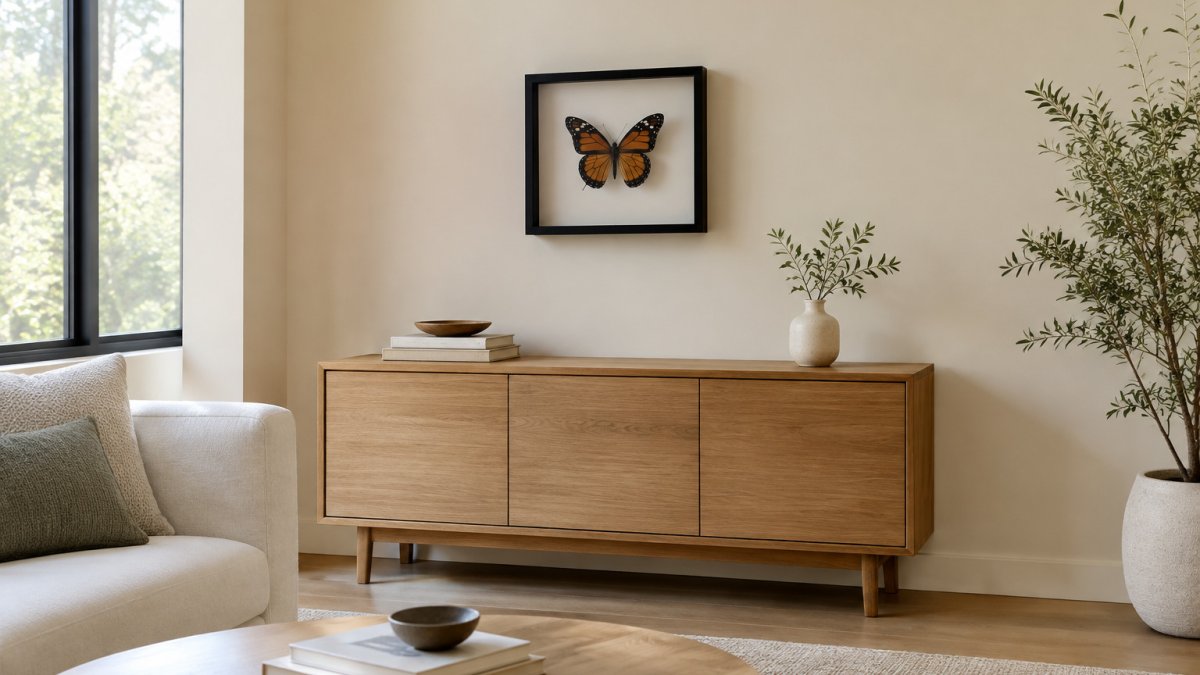
A calm minimalist living room with warm neutral walls works well as a model. One framed butterfly in a black shadow box, hung above a low timber sideboard beside a small ceramic vase, shows how little is needed.
For more styling ideas, see Nature Art for Living Rooms: The 2026 Styling Guide.
Step 5: Protect and Maintain Preserved Specimens Over Time
Preserved botanicals benefit from a little routine care.
Light. Keep pieces away from direct sun where possible, as strong light can affect colour over time.
Dust. Dust gently every four to six weeks with a soft, dry brush or a microfibre cloth, working from the top of the frame down. For a sealed shadow box, wipe the outside of the glass only; never open the frame to clean inside, as this can disturb the mount and let in moisture. Avoid aerosol cleaners and anything sprayed directly onto the glass; apply to the cloth first, away from the frame.
Humidity and temperature. Aim for a stable indoor environment and keep pieces away from radiators, heating vents and stovetops.
Handling. When moving a framed specimen, hold the frame by its sides, not the top edge, and keep it vertical. Laying a shadow box flat can shift the mount inside.
A simple maintenance rhythm. Brush monthly, check the hanging hardware every six months, and inspect the mount annually for any loosening or discolouration. If you notice fading or a shifting mount, take the piece to a framer rather than attempting a repair yourself.
For more on how natural textures hold up, read How to Preserve Natural Textures in Wall Decor.
Common Mistakes When Styling Preserved Art
A common mistake is hanging the piece too high. Eye level, roughly 145 to 150 centimetres from the floor to the centre of the frame, usually looks most natural.
Another mistake is mixing too many styles. Pairing a preserved specimen with ornate frames, busy patterns and bright accent colours breaks the minimalist look.
Finally, many people hang a single piece in a corner of a large room. A small display gets lost there. Move it to a wall where it can be seen from the main seating area.
Choosing Your First Piece for a Minimalist Wall
If you are buying your first piece, start small. A simple black-framed specimen lets you test the look before committing to a larger gallery wall. Once you know how it sits in the room, add a second piece that echoes the first in colour or shape.
Preserved specimens can cost more than mass-produced prints. Why Preserved Specimens Cost More explains what goes into that price.
Ready to start? Explore Papilio palinurus in a Black Frame and find a piece that suits your room.
Frequently Asked Questions
How do you display botanical art in a minimalist room?
Keep the wall simple and let one or two framed pieces carry the room. Hang a single specimen at eye level, roughly 150 to 160 centimetres from the floor to the centre of the frame, and leave generous empty wall around it. Choose one dominant piece rather than several competing items, and keep surrounding furniture low and uncluttered so the specimen reads clearly. Newman Art Designs offers a 5 x 7 inch shadow box frame, the Papilio palinurus in a Black Frame, at $69.95 AUD.
What frame colours work best with preserved botanical art in a minimalist interior?
Black, white oak and natural timber frames suit minimalist rooms because they add structure without competing with the specimen. Black frames give strong contrast and a gallery feel, while pale timber softens a room with neutral hues. Match the frame to your existing metal or wood finishes where possible. Newman Art Designs' Blue Triangle Butterfly in a Frame is listed at $69.95 AUD in a 5 x 7 inch shadow box format.
How do you care for preserved specimens displayed at home?
Keep framed specimens out of direct sunlight, which is the main cause of colour fade, and avoid hanging them above heaters, in steamy bathrooms or in damp corners. Dust the glass gently with a soft dry cloth rather than spraying cleaner directly onto the frame.
Can insect specimens suit a minimalist interior?
Yes, when they are framed cleanly and displayed in small numbers. A single symmetrical specimen in a simple frame can suit minimalist principles of negative space and restraint. Problems arise when many specimens crowd one wall. Pairing one specimen with a few natural textures such as timber, linen or stone keeps the look calm and intentional.

