
Nature Art for Living Rooms: The 2026 Styling Guide
Table of Contents
- Why Nature Art Belongs in Your Living Room
- Choosing Nature Art That Fits Your Space and Style
- The Benefits of Biophilic Decor in Bedrooms and Living Areas
- How to Style Shadowbox Frames on Walls, Shelves and Coffee Tables
- Sizing, Placement and Lighting for Lasting Impact
- What Museum-Preserved Nature Art Costs in 2026
- Caring for Your Nature Art: Maintenance, Materials and Sustainability
- Frequently Asked Questions
Last Updated: September 20, 2026
Why Nature Art Belongs in Your Living Room
Nature art for living rooms does more than fill a blank wall. It changes how a room feels the moment you walk in. At Newman Art Designs, we source and preserve specimens that bring that outside world indoors, and the difference is hard to ignore.
A living room is where you unwind, host guests, and spend quiet evenings. Plain walls rarely support any of that. A framed butterfly or a dome of preserved beetles gives the eye somewhere to rest and starts conversations without you saying a word.
Below, we break down how to choose, style, and care for nature art so it looks considered rather than cluttered.
Choosing Nature Art That Fits Your Space and Style
The right piece depends on three things: your room's colour palette, its available light, and how much visual weight you want.
A common mistake is buying art before measuring the wall. A large glass dome can look lost on a wide open wall, while a tight gallery arrangement of framed prints can overwhelm a small apartment. Match the scale to the space first, then choose the specimen.
Popular nature themes range from botanical prints and landscape photography to preserved insects in shadowbox frames. Each reads differently:
- Forests and mountains: calming, expansive, best for larger walls
- Lakes and coastlines: soft and airy, suits light and coastal interiors
- Preserved specimens: bold, detailed, ideal as a single conversation piece
If your interior leans minimalist or monochromatic, a single dome with a clean wooden base adds texture without noise. Bohemian and modern farmhouse rooms handle layered, mismatched frames well.

The Benefits of Biophilic Decor in Bedrooms and Living Areas
The benefits of biophilic decor in bedrooms and living areas come down to how the brain responds to natural forms. Curved lines, organic colour, and detailed patterns signal calm. That is why a preserved specimen or a botanical print can settle a room in a way a geometric poster cannot.
Research on biophilic design and wellbeing consistently links natural elements in interiors with lower stress and improved focus. For instance, studies published in the Journal of Environmental Psychology have highlighted these positive correlations.
How to Style Shadowbox Frames on Walls, Shelves and Coffee Tables
Styling shadowbox frames is less about rules and more about grouping. Treat each frame or dome as an object with weight and give it space to breathe.
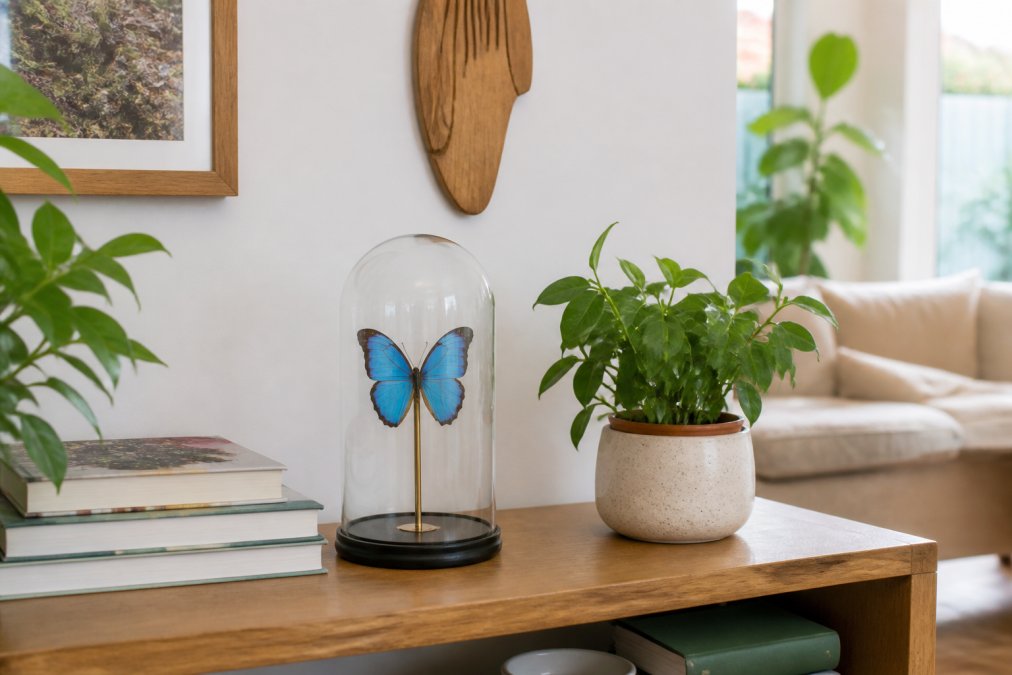
- Walls: eye-level, evenly spaced, themed grouping
- Shelves: layer with books and plants
- Coffee tables: one hero piece, nothing crowded around it
Sizing, Placement and Lighting for Lasting Impact
Most guides treat sizing as a single rule and lighting as an afterthought. In practice, the two are linked: the medium you choose decides how much light the piece can take before it starts to degrade, and the size decides how far the viewer needs to stand for the detail to read.
Sizing that survives a side-by-side comparison
Work from the furniture, not the wall. A common pattern among interior stylists is to size a single piece to roughly two-thirds to three-quarters of the width of the sofa, console or sideboard beneath it. Anything narrower looks like a stamp; anything wider crowds the edges of the room.
| Space | Recommended piece | Placement |
|---|---|---|
| Small apartment | Small framed print or compact dome | Shelf, side table or narrow wall |
| Standard living room | Medium dome or single frame | Eye-level wall or console |
| Large open wall | Extra-large dome or grouped frames | Centred above seating |
| Double-height or void wall | Grouped frames or a tall stacked column | Centred, with the midpoint at eye level |
Lighting: how each medium actually behaves
- Canvas prints have a matte, textured surface. They scatter light rather than reflect it, so they resist glare well in rooms with large windows, but the texture can flatten fine detail under weak, diffuse light. They also collect dust in the weave.
- Acrylic and glass-faced prints are glossy. They deliver punchy colour and sharp detail under directional light, but they mirror windows, lamps and TV screens. In a room with a bright window opposite the wall, a glossy piece can become a glare panel for most of the afternoon.
- Framed and domed specimens sit behind glass or acrylic and are the most light-sensitive of the three. UV exposure fades pigments and can degrade mounting materials over years, not weeks. Indirect, stable light is ideal; direct sun is the enemy.
Mounting hardware matters too. Glass domes and shadowbox frames carry weight, so use fittings rated for the load and fix into studs where possible. The Australian Building Codes Board provides guidance on structural integrity for home installations.
What Museum-Preserved Nature Art Costs in 2026
Museum-preserved nature art sits above mass-produced wall decor, and the price reflects the work behind it. Each specimen is mounted, sealed, and finished by hand, which is why it lasts where cheap prints fade.
At Newman Art Designs, prices are straightforward:
- Monarch Butterfly in a frame: $69.95
- Monarch Butterfly in a dome: $99.95
- Blue Morpho Butterfly in a dome: $129.95
- Multi-butterflies in an extra-large glass dome: $189.95
Caring for Your Nature Art: Maintenance, Materials and Sustainability
Looking after preserved specimens and printed nature art is easier than most people expect, provided you understand what actually causes damage. Three things do most of the harm: ultraviolet light, humidity swings, and physical handling.
What actually degrades a piece
- UV light breaks down pigments in prints and can fade the colours of preserved specimens over months to years, depending on exposure. According to conservation guidelines from institutions like the National Gallery of Victoria, UV filtering is crucial for longevity.
- Humidity is the bigger risk for domes and sealed frames. Warm, moist air trapped inside a dome can condense on the inner glass when the room cools, and repeated cycles can damage the mount and encourage mould. Bathrooms, kitchens and rooms above heaters are the worst offenders.
- Handling causes more damage than most owners realise. Oils from fingers, dropped frames and over-tight cleaning all take a toll.
A simple maintenance routine
- Dust sealed frames and domes with a soft, dry microfibre cloth. Do not spray cleaner onto the glass, spray the cloth, or better, use a barely damp cloth on the outside of the glass only, then dry immediately.
- Never open a sealed dome or frame to clean inside. If condensation or debris appears inside, that is a job for the maker or a conservator, not a home fix.
- Keep pieces out of direct sun, away from heat sources, and off walls that back onto a hot afternoon sun.
- Check hanging hardware once a year. Fittings loosen, and a heavy dome is unforgiving if it falls.
- Rotate pieces seasonally. Moving a light-sensitive work to a dimmer spot gives it a rest and refreshes the room at the same time.
Materials and sustainability: what to ask before you buy
Sustainability in nature art comes down to two questions: where the specimens come from, and how the piece is made and shipped.
On materials, the choices that matter most are:
- Framing timber, look for recycled or sustainably sourced wood, and finishes that are low in volatile organic compounds (VOCs) as recommended by Sustainability Victoria.
- Glazing, UV-filtering glass or acrylic slows fading and is worth the upgrade for any piece in a bright room.
- Mounting and adhesives, acid-free and archival-grade materials prevent yellowing and breakdown over time.
- Packaging, recyclable or compostable packing reduces the footprint of shipping, which matters most for fragile items that need bulky protection.
Frequently Asked Questions
What kind of art looks good in a living room?
Nature art works in almost any living room because it brings colour, texture and a calming feel. Botanical prints, landscape photography and framed specimens suit most interiors. A large piece can act as a focal point above a sofa, while smaller shadowbox frames or glass domes work well on shelves or side tables. Match the frame to your existing timber or metal tones, and choose a colour palette that echoes your cushions or rug for a cohesive look.
Is nature wall art good for bedrooms?
Yes. The benefits of biophilic decor in bedrooms include a calmer atmosphere and a stronger connection to the natural world, which many people find helps them unwind. Softer themes such as botanical prints, pressed leaves or a single butterfly in a dome tend to suit bedrooms better than bold, high-contrast pieces. Keep the palette muted and the scale modest so the room still feels restful rather than busy.
How do I style shadowbox frames without making the wall look cluttered?
Start with one hero piece, then build around it. Group two or three shadowbox frames of different sizes in a loose grid, leaving 5-7 cm between each frame. Hang them at eye level, roughly 145-150 cm from the floor. If you prefer a minimalist look, lean a single frame on a console or shelf instead of hanging it. The same approach applies to glass domes: one larger dome plus one small companion piece is usually enough.
Why does museum-preserved nature art cost more than a standard print?
The price reflects the specimen, the preservation work and the display case. For example, a Monarch Butterfly in a frame is $69.95, a Monarch in a dome is $99.95, a Blue Morpho Didius dome is $129.95, and a multi-butterfly piece in a large glass dome is $189.95. Each piece is individually mounted and made in Australia, so no two are identical. You are buying a one-off object rather than a mass-produced reproduction.
Choosing nature art for a living room is really about picking pieces that earn their space. Start with one hero piece, light it well, and let it do the talking.
Newman Art Designs has been crafting museum-quality, nature-inspired art since 1996, with free shipping across Australia. From the Blue Morpho Butterfly in a dome to framed Monarch pieces and extra-large multi-butterfly displays, every item is made to last. Shop now and bring a genuine conversation piece into your home.
