
Rare Beetle Specimens for Collectors: A 2026 Guide
Table of Contents
- Why Rare Beetle Specimens Are the Cornerstone of a Serious Collection
- Quick Comparison: Rare Beetle Specimens for Collectors
- Ethical Insect Art: How to Source Rare Beetle Specimens Responsibly
- How to Preserve Beetle Specimens: A Collector's Maintenance Guide
- Rare Insect Display Ideas for Small Spaces and Statement Walls
- Grading and Valuing Rare Beetle Specimens: What Separates Good from Exceptional
- Conclusion
- Frequently Asked Questions
Last Updated: September 19, 2026
Why Rare Beetle Specimens Are the Cornerstone of a Serious Collection
Rare beetle specimens for collectors sit at the intersection of science, art, and patience. This guide from Newman Art Designs explains how to source, grade and care for them. Beetles make up the order Coleoptera, the largest group of animals on Earth, and that variety makes a curated collection compelling.
Quick Comparison: Rare Beetle Specimens for Collectors
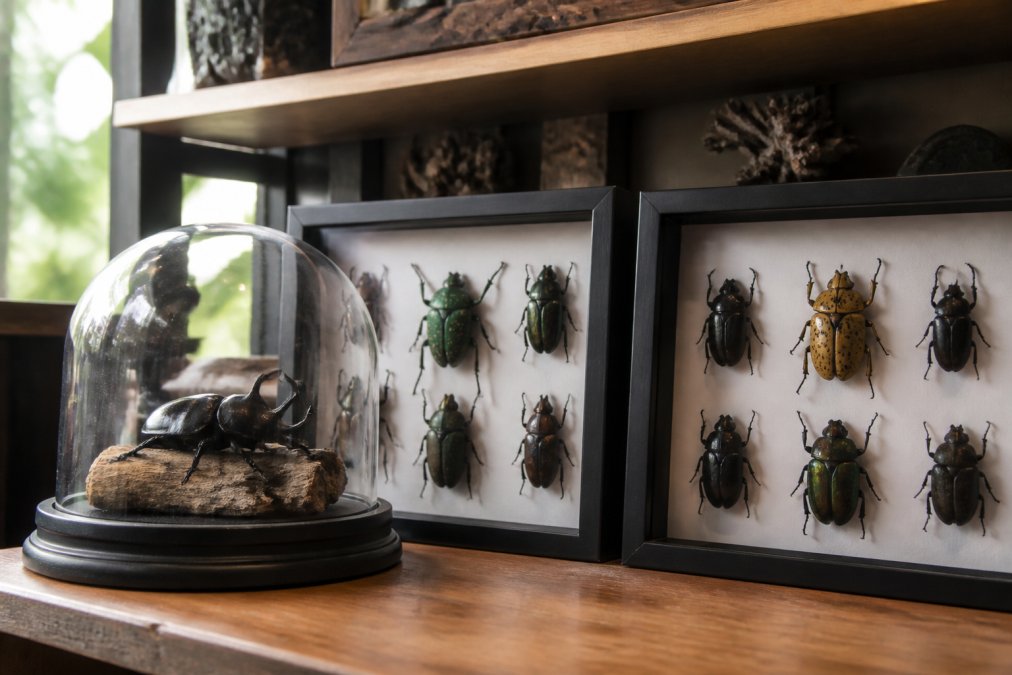
The fastest way to understand the market is to compare formats side by side. Shadow box frames suit wall display and stack neatly; glass domes suit shelf and sideboard placement. Both protect the specimen from dust and handling.
| Piece | Format | Size | Price | Best For |
|---|---|---|---|---|
| Violin Beetle in a Frame | Shadow box | 10 x 15 cm | $69.95 | First purchase, unusual silhouette |
| Cyclommatus truncatus Stag Beetle | Shadow box | 10 x 15 cm | $69.95 | Metallic colour, small spaces |
| Five Horned Rhino Beetle | Shadow box | 20 x 25 cm | $89.95 | Statement wall piece |
| Three Horned Rhino Beetle | Shadow box | 20 x 25 cm | $94.95 | Large species, bold horns |
| Goliathus albosigniatus | Shadow box | 20 x 25 cm | $99.95 | Bulk and weight, African species |
| 5 Horned Rhinoceros Beetle in a Dome | Glass dome | 18 cm | $109.95 | Shelf display, gift |
| Triple Stag Beetles in a Frame | Shadow box | 12.5 x 17.5 cm | $119.95 | Three-species grouping |
| Giant Three Horned Rhino Beetle in a Dome | Glass dome | 18 cm | $119.95 | Centrepiece dome |
| Rhinoceros Beetles in a Frame | Shadow box | 20 x 25 cm | $139.95 | Mixed-species collection |
Ethical Insect Art: How to Source Rare Beetle Specimens Responsibly
Ethical insect art begins with one rule: know where the specimen came from. Reputable suppliers work through licensed breeders and sustainable farms, not wild collection from protected populations. Ask for origin documentation before you buy.

The regulatory layer most sellers never explain
Three instruments do most of the work here:
- CITES appendices. Appendix I species are effectively banned from commercial trade; Appendix II species require export permits from the country of origin and, on arrival, an import permit. Appendix III is a lighter listing maintained by individual countries. Most display beetles sold legally sit outside the appendices entirely, which is why origin paperwork matters more than the species name alone.
- The Environment Protection and Biodiversity Conservation Act 1999 (EPBC Act). This domestic legislation gives effect to CITES in Australia and controls the import and export of listed specimens, administered by the Department of Climate Change, Energy, the Environment and Water.
- The Biosecurity Act 2015. Even a legally sourced, non-listed specimen can be stopped at the border without the right declarations or if it carries pest or disease risk. Officers assess the physical consignment, not just the paperwork.
A common mistake is assuming a species not listed on CITES is automatically free to import. Non-listed specimens still need to satisfy biosecurity requirements, and some countries impose their own export controls regardless of CITES status.
What good provenance documentation looks like
A supplier who knows their chain can usually provide, on request:
- Country of origin, stated in writing, not inferred from the species range.
- Breeder or farm name, where the supply is captive-bred.
- CITES permit numbers for any Appendix-listed species, matching the specimen to the document.
- A declaration that the specimen is captive-bred or farmed, not wild-collected, where wild take is restricted.
Why this protects your collection's value
Provenance is not only an ethical question but a valuation question. A specimen with documented, lawful origin holds value and can be resold, exhibited or donated. One with no paperwork is a liability: it may be unsellable, and in the worst case seized.
The practical checklist before any purchase
- Origin stated in writing. Country and, where possible, the breeder or farm.
- Species not listed as threatened. Ask the seller directly, and check the listing yourself if the species is unfamiliar.
- No wild-caught claims for protected species. Farmed or captive-bred stock is the norm for common display species.
- Permits sighted, not promised. For any listed species, ask to see the permit before payment.
- Biosecurity declarations prepared. If importing yourself, confirm current declaration and inspection requirements before the consignment ships.
How to Preserve Beetle Specimens: A Collector's Maintenance Guide
Preserving beetle specimens is mostly about controlling three things: light, humidity and physical contact. Dry-preserved insects are stable for decades away from direct sun and moisture, but UV light fades colours and damp air invites mould.
- Keep out of direct sunlight. Indirect light only, the biggest cause of fading.
- Aim for stable indoor humidity. Avoid bathrooms, kitchens and unheated garages.
- Dust the outside of the frame or dome only. A dry microfibre cloth, never a wet one.
- Never open a sealed frame. The mount and seal protect the specimen.
- Check mounts twice a year. Look for loosening of the specimen or backing.
- Handle domes by the base. Glass is the fragile part, not the beetle.
If a specimen loosens, contact the supplier.
Rare Insect Display Ideas for Small Spaces and Statement Walls
Rare insect display ideas range from a single small frame on a bookshelf to a full gallery wall of mixed species. The trick is scale. A 10 x 15 cm shadow box reads as a quiet detail; a 20 x 25 cm frame commands attention.
A few arrangements that work well:
- The trio grid. Three 10 x 15 cm frames, evenly spaced, same orientation.
- The centrepiece. One 20 x 25 cm frame with two smaller frames either side.
- The dome shelf. A single dome on a sideboard, lit from above.
- The collection wall. Six or more frames in a loose grid, mixed species, matched frames.
Grading and Valuing Rare Beetle Specimens: What Separates Good from Exceptional
Grading rare beetle specimens comes down to four criteria: condition, size, rarity and mount quality. Condition means intact antennae, legs, mandibles and wing cases, with no fading or damage. Size matters within a species: a large male stag beetle with full mandibles beats a small one. Rarity reflects how hard the species is to obtain legally, and mount quality covers the frame, backing and preservation standard.

The condition grades you will see in the trade
Suppliers and auction houses use a shorthand for condition:
Triple Stag Beetles in a Frame →
- A1. Perfect. All appendages present and intact, no fading, no repairs, no missing antennal segments. The top grade and the only one that reliably appreciates.
- A-. Near-perfect. One minor flaw, such as a single repaired leg or very slight colour loss, not visible at normal viewing distance.
- A2. Good. Intact overall but with a visible repair, a missing tarsal segment, or noticeable fading. Still collectible, priced well below A1.
- A3 / B. Decorative. Multiple defects, obvious repairs, or significant colour loss. Fine for display, not for investment.
A specimen described only as "good condition" with no grade is one whose grade the seller does not want to state. Ask for the specific grade and, if buying remotely, close-up photographs of the antennae, legs and mandibles.
The defect taxonomy: what actually reduces value
Not all flaws are equal. Ranked from most to least damaging:
- Missing or repaired antennae. The most fragile part of a dried beetle and the hardest to repair invisibly. A broken antenna can halve a specimen's value.
- Missing legs or tarsal segments. The tarsi (segmented feet) are frequently lost. A missing tarsus is minor; a missing whole leg is major.
- Fading. UV exposure bleaches iridescence and metallic colour. Irreversible and cannot be restored.
- Grease or mould damage. Body fats can leach out over time, staining the mount; mould indicates past humidity exposure and can spread.
- Repairs and re-pinning. A well-executed repair is acceptable at A-; a clumsy one drops the specimen to A2 or below.
- Mount and frame condition. A cracked dome or warped frame does not damage the specimen but reduces the piece's value as a finished object.
How rarity actually works
Rarity is the criterion buyers misunderstand most. It is not the same as fame: a well-known species bred in large numbers is not rare, however impressive it looks. Genuine rarity has three components:
- Legal availability. A CITES-listed species is rare in trade by definition, because lawful supply is constrained.
- Geographic range. Endemic species with a small range are harder to source legally than widespread species.
- Supply consistency. A species appearing once a year is rarer than one available every month, even if both are equally attractive.
A worked scoring approach
Score each criterion out of five, total twenty:
- Condition: intact, unfaded, no repairs. A1 scores five; A- four; A2 two to three; A3 or below one.
- Size: upper range for the species. Top-decile size scores five; average three.
- Rarity: legal, limited, documented origin. CITES-listed or endemic with paperwork scores five; common farmed species two.
- Mount: sealed, clean, well-finished frame or dome. Museum-standard mount scores five; a loose or dusty mount two.
Above sixteen is collector's grade. Twelve to sixteen is a solid display piece. Below twelve, treat it as decor.
Why documented provenance changes the valuation
Why does a framed specimen cost more than a print? Because it is a one-off: no two specimens are identical, and sourcing, preserving and mounting is skilled and slow. This craftsmanship is what you are paying for.
Conclusion
Building a collection of rare beetle specimens for collectors rewards patience and good sourcing more than budget. Start with one piece you can trace to a legal, ethical origin, keep it out of direct sun, and let the collection grow. At Newman Art Designs, we have been preserving and framing specimens since 1996, using museum-quality techniques and shipping free across Australia.
Frequently Asked Questions
What makes a rare beetle specimen valuable to a collector?
Value in rare beetle specimens comes from a mix of factors: species rarity, specimen quality, size, and how well it is preserved. A collector's grade specimen will have intact antennae, legs, and mandibles, with no fading or damage. Provenance also matters, including where it was sourced and whether it was ethically obtained. Display quality, like a well-made shadow box frame or glass dome, adds to both the aesthetic and monetary worth.
How do I know if beetle specimens are ethically sourced?
Ethical insect art means the specimens were not taken from endangered populations or protected habitats. Reputable sellers provide origin details, such as the country and region, and confirm they follow local wildlife trade regulations. Look for sellers who are transparent about their supply chain and can explain how their specimens were acquired. Avoid any seller who cannot answer basic questions about sourcing.
What is the best way to preserve beetle specimens for long-term display?
To preserve beetle specimens, keep them out of direct sunlight, which fades colours, and away from damp areas that encourage mould. A sealed shadow box frame or glass dome protects them from dust and physical damage. Avoid extreme temperature swings. If you need to handle a specimen, hold it by the edges of the frame or dome, not the insect itself. With proper care, museum-preserved beetles can last for decades.
Are there regulations for importing or trading rare beetle specimens in Australia?
Yes. Australia has strict biosecurity and wildlife trade laws. Importing insect specimens generally requires permits from the Department of Agriculture, Fisheries and Forestry, and some species are protected under the Convention on International Trade in Endangered Species (CITES). Always buy from sellers who comply with these rules and can provide documentation. Domestic sellers who source ethically and legally are the safest option for collectors.
Can I display rare beetle specimens in a small apartment?
Absolutely. Many rare beetle specimens come in compact shadow box frames or small glass domes that fit on a bookshelf, desk, or narrow wall. A 10x15 cm frame or a 18 cm dome takes up minimal space while still making a striking conversation piece. Grouping a few smaller pieces vertically can create a gallery effect without overwhelming a small room.
