
Decorating Small Apartments With Art: A How-To Guide
Table of Contents
- Before You Hang Anything: Measure, Scale, and Plan
- How to Hang Art in Rental Apartments Without Losing Your Bond
- Small Apartment Wall Art Ideas That Add Depth
- The Benefits of Biophilic Decor in Bedrooms and Living Spaces
- Lighting, Colour Palette, and Focal Point Placement
- Art Maintenance in Humid, Compact Spaces
- Common Mistakes When Decorating Small Apartments With Art
- Frequently Asked Questions
Last Updated: September 21, 2026
Before You Hang Anything: Measure, Scale, and Plan
Decorating small apartments with art starts with measurement, not shopping. A piece that looks perfect in a showroom can overwhelm a narrow wall, and a print that seems too small can vanish above a sofa.
- Measure your wall width and the furniture below it
- Note the ceiling height, since tall rooms handle vertical art better
- Mark the centre point of the wall with painter's tape
- Cut paper templates to the size of your intended piece and tape them up
- Live with the template for a day before committing
Work Out the Right Art Scale for Your Wall
Scale is about proportion, not size alone. A large canvas works on a big empty wall. A narrow hallway wall needs something tall and slim instead.
Use Vertical Space and Negative Space Together
Small apartments have more vertical space than floor space, so use it. Hang art higher than you would in a large home, but keep the centre of the piece at eye level, roughly 145-150 cm from the floor.
How to Hang Art in Rental Apartments Without Losing Your Bond
Rental-friendly hanging is the single biggest constraint most guides ignore. In a small apartment you often cannot drill, and in Australia bond disputes over wall damage are common enough that damage-free methods are worth the small upfront cost. The key is matching the hardware to both the wall surface and the weight of your art, then removing it correctly when you leave.
Damage-Free Mounting Hardware Compared
| Method | Best For | Typical Weight Limit | Wall Damage | Removal Notes |
|---|---|---|---|---|
| Adhesive strips | Light prints, posters | Up to about 1 kg per pair | None if removed correctly | Stretch the tab straight down, slowly |
| Adhesive hooks | Small frames | Up to about 2 kg | Minimal | Warm the adhesive with a hair dryer before peeling |
| Picture hanging strips | Medium frames | Up to about 3-4 kg per pair | None if removed correctly | Press for the full recommended time before loading |
| Small nail hooks | Heavier frames | 5-10 kg | Small hole to fill | Patch with filler and touch-up paint |
| Monkey hooks | Heavier frames | 10-20 kg | Tiny hole, easy patch | One small hole, strong hold in plasterboard |
Adhesive strips work well for lightweight pieces, but they fail on textured, dusty, or freshly painted walls. Always clean the wall with isopropyl alcohol first and press firmly for the full recommended time. A common pattern is that renters overload adhesive strips and then blame the product when the frame falls.
Floating Shelves and Ledges as Rental-Friendly Alternatives
Floating shelves and picture ledges let you display art without hanging it at all. You rest frames and domes on the ledge, so there is nothing to drill into the wall for the art itself. This works especially well for glass domes and shadowbox frames that are awkward to hang, and a slim ledge lets you swap pieces whenever you like.
Protecting Your Bond: What Actually Counts as Damage
Most bond disputes come down to visible holes, paint chips, or adhesive residue that pulls paint off. Small nail holes are generally considered fair wear and tear in many Australian rental agreements, but larger holes, torn paint, and sticky residue are not. Check your state or territory tenancy authority's guidance on fair wear and tear before you hang anything, and photograph the wall before and after.
Small Apartment Wall Art Ideas That Add Depth
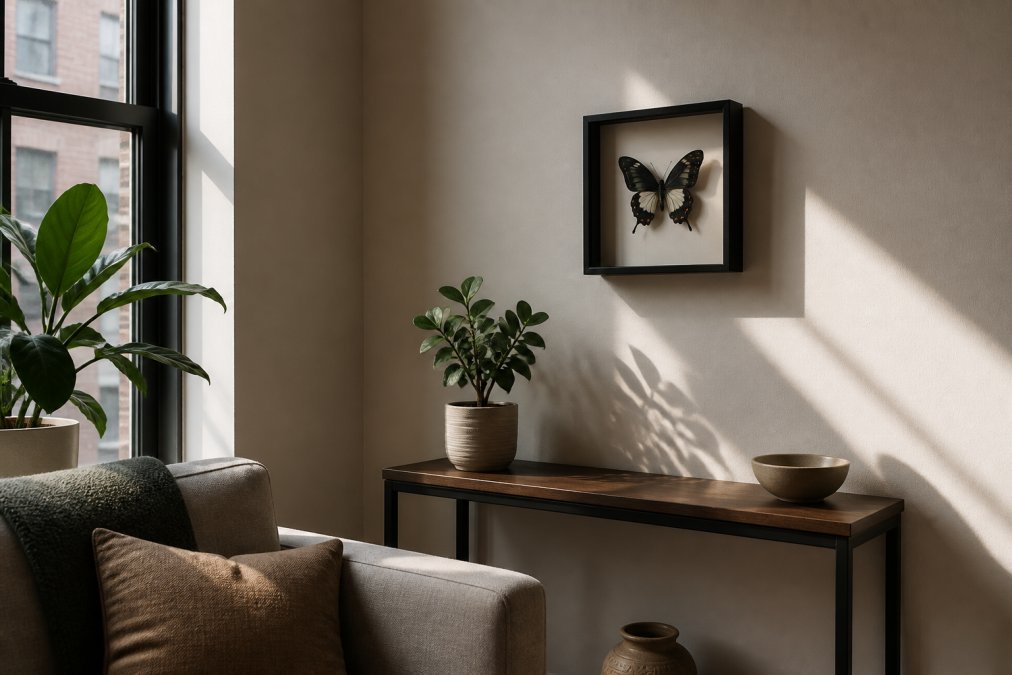
Depth is what stops a small room feeling flat. Layering art at different distances from the wall, mixing frame depths, and using pieces with real texture all create a sense of dimension.
Oversized Canvas vs Gallery Wall in a Small Room
A single oversized canvas and a gallery wall solve different problems. An oversized piece creates one strong focal point and makes a small room feel deliberate. A gallery wall adds variety and covers more wall, but it can crowd a tight space.
Minimalist vs Maximalist Approaches
Minimalist styling uses few pieces, lots of negative space, and a calm palette. It suits small rooms because it reduces visual noise and lets the space feel airy.
The Benefits of Biophilic Decor in Bedrooms and Living Spaces
Biophilic decor brings natural elements indoors, and in a small apartment it does more than look nice. The psychological effect of nature imagery is well documented in environmental psychology: views of natural scenes tend to reduce stress and restore attention more effectively than built or abstract scenes. In a confined space, that effect matters more, not less, because you cannot escape the room as easily.
Why Nature Imagery Makes a Small Room Feel Larger
Depth is what stops a small room feeling flat, and nature imagery is unusually good at creating it. A landscape with a receding horizon, a forest path, or a botanical print with layered foliage gives the eye somewhere to travel. That perceived depth is what makes a compact room read as bigger than its dimensions.
Choosing Nature Art That Adds Depth, Not Clutter
Not all nature art works in a small room. Busy wildlife photography with a cluttered background can add visual noise. The pieces that help most share three traits:
- A clear focal subject, so the eye knows where to rest
- A sense of depth or recession, such as a path, horizon, or layered foreground
- A restrained palette, so the piece does not fight the room's colours
Biophilic Decor Beyond the Frame
Biophilic decor is not only wall art. Natural materials such as timber, linen, rattan, and stone, plus a small potted plant or two, reinforce the effect. In a small apartment, keep it restrained: one nature artwork, one plant, and one natural-texture element per room is usually enough. More than that and the room starts to feel crowded rather than calm.
Lighting, Colour Palette, and Focal Point Placement
Lighting decides whether your art reads well or disappears. Small apartments often have uneven light, so placement matters as much as the piece itself.
Art Maintenance in Humid, Compact Spaces
Humidity is the quiet enemy of wall art in small apartments. Bathrooms, kitchens, and poorly ventilated bedrooms hold moisture that can damage frames, prints, and preserved specimens over time.
Common Mistakes When Decorating Small Apartments With Art
The biggest mistake is hanging art too high. Many people place pieces near the ceiling, which disconnects the art from the furniture below and makes the room feel taller but emptier.
Other frequent errors include:
- Buying too small, leaving walls looking bare
- Filling every wall with no negative space
- Mixing too many frame styles with no shared thread
- Ignoring the room's light when choosing placement
- Skipping the template step and drilling in the wrong spot
Frequently Asked Questions
How do you arrange art in a small room without making it look cluttered?
Stick to one focal point per wall and let negative space do the rest. A single statement piece, such as a Monarch Butterfly in a 10 x 15 cm black shadow box frame, reads calmer than five small prints competing for attention. Keep the centre of the piece at roughly eye level (about 145 cm from the floor), and leave at least 15 to 20 cm between frames if you group more than one. Choosing a cohesive colour palette across frames also stops a small apartment art display from feeling busy.
What are the 3-5-7 rule and does it work in a small apartment?
The 3-5-7 rule says to group art in odd numbers, with the largest piece in the centre and smaller ones balanced around it. Odd numbers create a natural focal point because the eye cannot split them into symmetrical pairs. In a small apartment, scale it down: three pieces of 20 x 25 cm or smaller can work on a narrow wall, while a full seven-piece gallery wall usually needs a wider expanse. Judge by the wall, not the rule.
How can nature-inspired art make a small apartment feel larger?
Nature imagery gives the eye somewhere to travel, which creates depth perception in a tight room. The benefits of biophilic decor in bedrooms and living spaces include a calmer, more airy atmosphere, and pieces with light backgrounds or reflective surfaces bounce more light around. A Morpho didius butterfly in an 8 x 10 inch shadow box frame works well because its iridescent blue shifts with your viewing angle, so the wall never looks static. Hang it opposite a window where possible.
Will preserved specimens fade or deteriorate over time?
Museum-preserved specimens kept out of direct sunlight hold their colour for years. UV light is the main cause of fading, so avoid walls that take harsh afternoon sun, or use a frame with UV-filtering glass. Humidity matters too: in a small, steamy apartment, keep domes and shadow boxes away from bathrooms and kitchen cooktops, and let the room ventilate daily. Dust frames with a dry, soft brush.
Decorating a small apartment with art is really about restraint and scale. Get the proportions right, protect your bond with rental-friendly hanging, and let each piece breathe.
Newman Art Designs can help you find a nature-inspired statement piece that fits a compact space. Our shadowbox frames and glass domes are built to last, with museum-quality preservation and free shipping across Australia. Explore the collection and give your small apartment a focal point worth keeping.
