
Decorating Small Apartments With Insects: 7 Ideas
Table of Contents
- Why Insect Decor Works So Well in Small Apartments
- 7 Ways to Display Butterflies, Moths and Beetles in a Compact Space
- Small Apartment Wall Decor: Choosing Colour, Pattern and Frame Size
- Framed Insect Specimens: Shadowbox Frames, Glass Domes and Mounting Safety
- Gallery Wall Ideas for Small Spaces: Arranging Insect Art Without Clutter
- Real Specimens or Replicas? Care, Preservation and Ethical Sourcing
- Styling Insect Decor With Natural Materials and a Cohesive Interior
- Conclusion: Start With One Piece, Then Layer
- Frequently Asked Questions
Last Updated: October 15, 2026
Why Insect Decor Works So Well in Small Apartments
Decorating small apartments with insects works because a single framed specimen delivers bold visual impact without eating into floor space or budget. At Newman Art Designs, we help renters and owners style compact rooms with museum-preserved butterflies, beetles and other natural curiosities. A small shadowbox frame adds colour, texture and a talking point to a bare wall.
Visual impact without visual weight
Insect decor is nature-inspired art that does a lot with very little. A butterfly's wing carries colour and pattern no print can copy. Because each piece is small and light, it never crowds a room the way a large canvas can. The eye gets a focal point. The room keeps its sense of space.
What to measure before you buy
Check three things before you order:
- The wall width you can spare
- The height between furniture and ceiling
- Whether the spot gets direct sun
A 4x6 inch shadowbox frame suits a narrow strip of wall or a bedside ledge. A 5x7 inch piece works above a slim console. Measure first, then buy.
7 Ways to Display Butterflies, Moths and Beetles in a Compact Space
Here are seven practical ways to display butterflies, moths and beetles when floor space is tight, using vertical zones or small surfaces you already have.
Ideas 1-4: Walls, ledges, shelves and vertical zones
- Single statement frame. One large piece on a plain wall reads as art, not clutter.
- Picture ledge. Lean two or three small frames on a narrow ledge and swap them with the seasons.
- Floating shelf. A short shelf holds a framed specimen plus a small plant or candle.
- Vertical stack. Hang three frames in a neat column to draw the eye upward.
Ideas 5-7: Curio cabinets, side tables and rotating displays
- Curio cabinet. A slim glass cabinet lets you group several specimens behind glass.
- Side table vignette. Rest a glass dome on a side table next to a book and a bowl.
- Rotating display. Keep a few pieces stored and rotate them monthly so the room feels fresh.
Small Apartment Wall Decor: Choosing Colour, Pattern and Frame Size
Small apartment wall decor should match the frame to the room, not fight it. Choose a frame colour that ties into your existing palette, then let the specimen supply the bold colour.
Wing patterns matter too. A butterfly with strong markings holds a wall on its own. A muted moth or beetle works better in a group. For a rental, keep frames light and use removable hooks so you leave no marks.
| Frame size | Best spot | Why it works |
|---|---|---|
| 4x6 inch | Bedside ledge, narrow wall strip | Fits tight gaps |
| 5x7 inch | Above a console or desk | Reads clearly from across the room |
| Grouped small frames | Gallery wall | Builds a bigger feature |
Framed Insect Specimens: Shadowbox Frames, Glass Domes and Mounting Safety
Framed insect specimens are real, preserved insects mounted inside a sealed shadowbox frame or under a glass dome.
Mounting safety comes down to three things:
- Keep pieces out of direct sunlight to slow fading
- Avoid damp rooms such as steamy bathrooms
- Hang securely so nothing falls
A glass dome suits a shelf or table. Both keep the specimen sealed and safe. Our Turquoise Emperor in a frame is a good example: the iridescent blue shifts depending on the angle of light, so it rewards a spot with soft, indirect daylight.

Gallery Wall Ideas for Small Spaces: Arranging Insect Art Without Clutter
Gallery wall ideas for small spaces come down to spacing. Lay your frames on the floor and photograph the layout before you commit to nails. Keep gaps even, usually 5 to 8 cm, and stick to one theme so the group reads as a set.
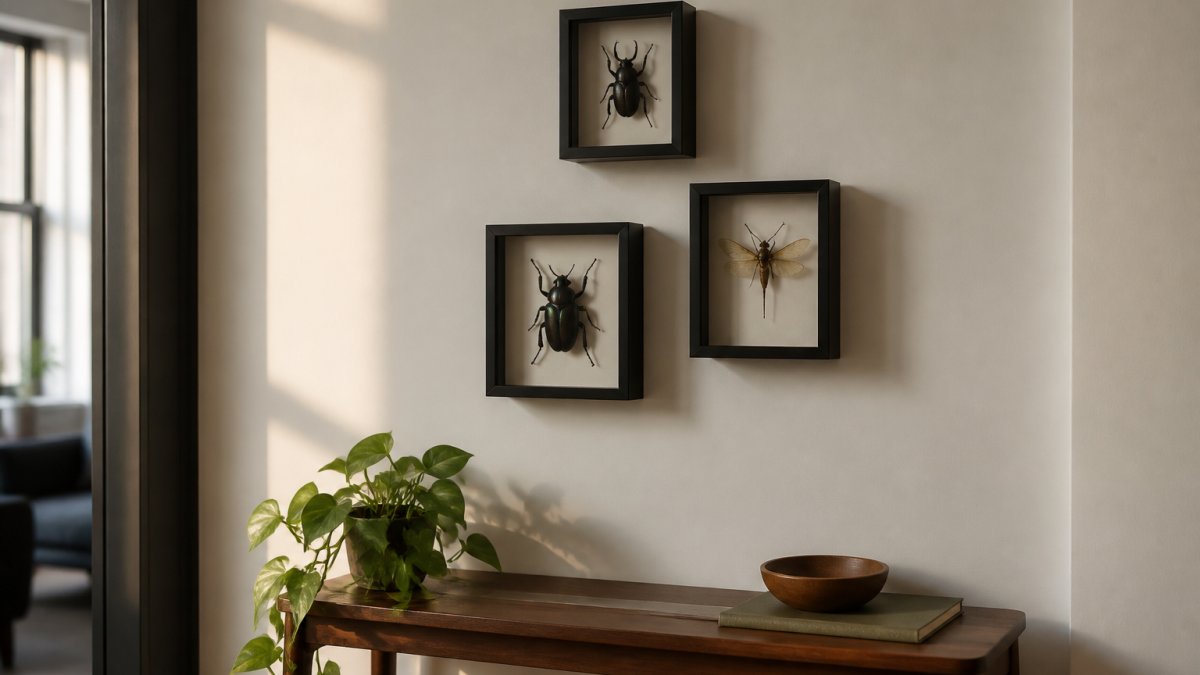
A loose grid of three works well above a console. A vertical pair suits a narrow wall. If you rent, use removable adhesive hooks and check the weight limit on the pack.
Real Specimens or Replicas? Care, Preservation and Ethical Sourcing
This is the question most buyers ask last and should ask first. A real preserved specimen and a replica can look similar in a photograph, but they behave very differently on a wall over five years. Here is how to tell them apart, check sourcing, and keep a specimen looking right at home.
Real versus replica: the honest trade-offs
| Factor | Real preserved specimen | Replica (print, resin or cast) |
|---|---|---|
| Detail | Wing scales, veins and iridescence visible under close inspection | Flat up close; colour does not shift with the light |
| Durability | Stable for years if kept dry and out of direct sun | Effectively permanent; will not fade or brittle |
| Weight | Light; a small shadowbox is easy to hang | Often heavier, especially resin casts |
| Cost | Higher, because each piece is prepared and mounted by hand | Lower, because it is mass-produced |
| Ethics | Depends entirely on the seller's supply chain | No animal involved |
| Feel | A genuine natural object; a conversation piece | Decorative, but rarely a talking point |
A real specimen wins on detail and presence. A replica wins on price and zero maintenance. Neither is wrong, the mistake is paying real-specimen prices for a replica, or expecting a real specimen to survive a steamy bathroom.
How to verify ethical sourcing
Ask the seller four questions before you buy. A transparent supplier will answer all four without hesitation.
Turquoise Emperor in a frame →
- What is the exact species name? A seller who cannot name the species cannot confirm it is not protected.
- Where did it come from? Look for captive-bred stock or specimens from established sustainable farms. Wild-caught endangered stock is the red flag.
- Is the species protected? In Australia, the import and trade of wildlife is controlled under federal environment law. A responsible seller should be able to explain how their supply chain complies. For guidance on protected species and wildlife trade, see the Australian Government wildlife trade rules.
- Is the specimen naturally deceased or farmed for display? Reputable suppliers work with sustainable farms rather than collecting from the wild.
Ethical sellers typically list the species, country of origin and sourcing method on the product page. If that information is missing, treat it as a gap, not an oversight.
Care and preservation: what actually damages a specimen
Most damage comes from four things, in this order:
- Direct sunlight. Ultraviolet light fades wing pigments and can brittle the body over time. Keep pieces on walls that receive only soft, indirect daylight.
- Humidity. Steamy bathrooms, kitchens and spots above heaters trap moisture inside the frame. Moisture encourages mould and can warp the mounting board. Keep insect art in dry, temperate rooms.
- Pests. Dermestid beetles and clothes moths will eat a dried specimen if they can reach it. A sealed shadowbox or glass dome prevents this. Never display an open, unframed specimen in a home with a known pantry-moth problem.
Handled this way, a museum-preserved specimen holds its colour for years.
Household suitability: children, pets and aversion
A framed specimen is a display object, not a toy. Keep pieces out of reach of children and pets, and hang them securely. If someone in the household is uneasy around insects, a single small frame in a hallway or study is easier to live with than a gallery wall in the main living area. Where real specimens are not welcome, replicas and printed insect art deliver the same visual theme with none of the care requirements.
Styling Insect Decor With Natural Materials and a Cohesive Interior
Styling insect decor with natural materials ties the piece to the rest of the room. Pair a framed specimen with wood, stone, linen or dried botanical elements. These materials share the earthy, organic feel of the insects and stop the piece looking out of place.
Why natural materials work: the mechanism
Insect specimens are organic objects. Their colour comes from pigment and microscopic wing structures that reflect light, which is why a butterfly's wing shifts as you move past it. Next to plastic, chrome or high-gloss laminate, the specimen reads as a curiosity dropped into a modern room. Next to timber, stone, linen or dried botanicals, the materials share a similar light response, matte, warm, slightly irregular, and the piece reads as part of the scheme rather than an add-on.
A cohesive interior in three moves
- Match frame tones to your timber furniture. A pale oak frame beside an oak console disappears into the scheme; a black frame beside pale oak becomes the focal point. Decide which effect you want before you buy.
- Add one natural texture, not three. A woven basket, a stone bowl or a linen throw is enough. More than one and the corner starts to look like a nature table.
- Repeat one colour from the specimen elsewhere in the room. A cushion, a book spine or a ceramic vase in the same hue ties the piece to the space without repeating the insect motif.
Room-by-room notes for a compact apartment
- Living room. One framed specimen above a slim console, paired with a trailing plant. Keep the wall around it plain so the piece holds the eye.
- Bedroom. A single small frame on a bedside ledge or a vertical pair on a narrow wall. Soft, indirect light suits iridescent species.
- Study or hallway. A small group of three works here because the space is transitional and the eye expects a feature. Keep gaps even, usually 5 to 8 cm between frames.
The benefits beyond appearance
This is the part most styling guides skip. A framed specimen is also a small piece of natural history, giving children and guests a reason to look closely, ask what the species is and where it lives, and notice details, wing veins, antennae, iridescence, that a printed poster cannot show.
For a nature lover's apartment, a small group of specimens styled this way becomes a calm, curated feature rather than a random collection. Our Blue Triangle Butterfly in a Frame and Green Damselflies in a frame both sit well beside timber and greenery.
Conclusion: Start With One Piece, Then Layer
The hardest part of decorating a small apartment is knowing where to stop. Start with one piece, live with it for a week, then add a second that shares its colour or theme. Our collection at Newman Art Designs is built for exactly this: museum-quality preservation, specimens from butterflies to snake skeletons, and free shipping across Australia. Every piece is crafted to last, and customers tell us the frames arrive solid and well packed.
Frequently Asked Questions
Where should you display framed insect specimens in a small room?
Put them where the eye naturally rests: above a desk, beside a doorway, or on a narrow shelf at roughly eye level. Keep them out of direct sunlight and away from steamy zones such as above a kettle or beside a shower, because heat and moisture are what age a specimen fastest. A 4x6 inch shadowbox or a small glass dome on a side table works well when floor and wall space are tight, and rotating two or three pieces every few months keeps the display feeling fresh.
How do you make insect decor a focal point without making a room feel cluttered?
Give one piece the best position and let everything else support it. A single large specimen, such as a Phyllium giganteum leaf insect in a 5x7 inch black shadowbox frame ($99.95), can anchor a wall on its own. Then keep surrounding surfaces sparse: one plant, one lamp, one stack of books. Because insect art carries strong colour and detail, two or three pieces usually read as a collection, while five or six in a small room read as clutter.
What frame styles work best for insect specimens in compact spaces?
Shallow shadowbox frames with a black or natural timber finish suit small rooms because they sit close to the wall and do not eat into walkways. Glass domes work on shelves and side tables where wall space is already used. Match the frame to your existing hardware rather than introducing a new finish, and keep frames under about 20 cm wide so a group of them still fits a narrow wall. A consistent frame style across two or three pieces creates a cohesive interior without extra styling effort.
How long do framed insect specimens last, and do the colours fade?
Museum-preserved specimens kept out of direct sunlight and away from damp air hold their colour for many years. The main risks are UV light, which dulls iridescent blues and greens over time, and humidity, which can cause mould or wing distortion. Hang or place pieces on an interior wall away from windows and heating vents, and dust gently with a dry soft brush rather than a damp cloth. Well-framed pieces from an established supplier are built to last.
One framed specimen can change how a whole room feels, but choosing the right piece for a tight space takes care. Newman Art Designs has curated nature-inspired art since 1996, with museum-quality preservation, a wide variety of specimens, and free shipping across Australia. Get started with Newman Art Designs and turn a bare wall into a conversation piece.
