
Benefits of Real Insect Decor: A 2026 Guide
Table of Contents
- Why Real Insect Decor Turns Heads (and Holds Them)
- Ethical Sourcing: What to Check Before You Buy Insect Decor
- The Art of the Preserved Insect Display
- Framed Insect Wall Art: Styling Ideas for Every Room
- Butterfly Shadow Box Decor That Works in Small Spaces
- Real Versus Faux Insect Decor: Which Lasts Longer?
- Caring for Your Specimens: Light, Humidity and Handling
- Conclusion: Bringing Nature Indoors with Confidence
- Frequently Asked Questions
Last Updated: October 14, 2026
Why Real Insect Decor Turns Heads (and Holds Them)
Real insect decor is the practice of displaying preserved butterflies, beetles, moths and other specimens in frames or domes as art for the home. It brings genuine natural history into a room in a way printed art cannot match. At Newman Art Designs, we have preserved and framed specimens since 1996, and the reaction is always the same: guests stop, lean in, and ask questions.
That is the first benefit, and it is not a small one. A framed butterfly or beetle earns a second look because no two specimens are identical. The colours shift with the light. The wing patterns carry detail a printer cannot copy.
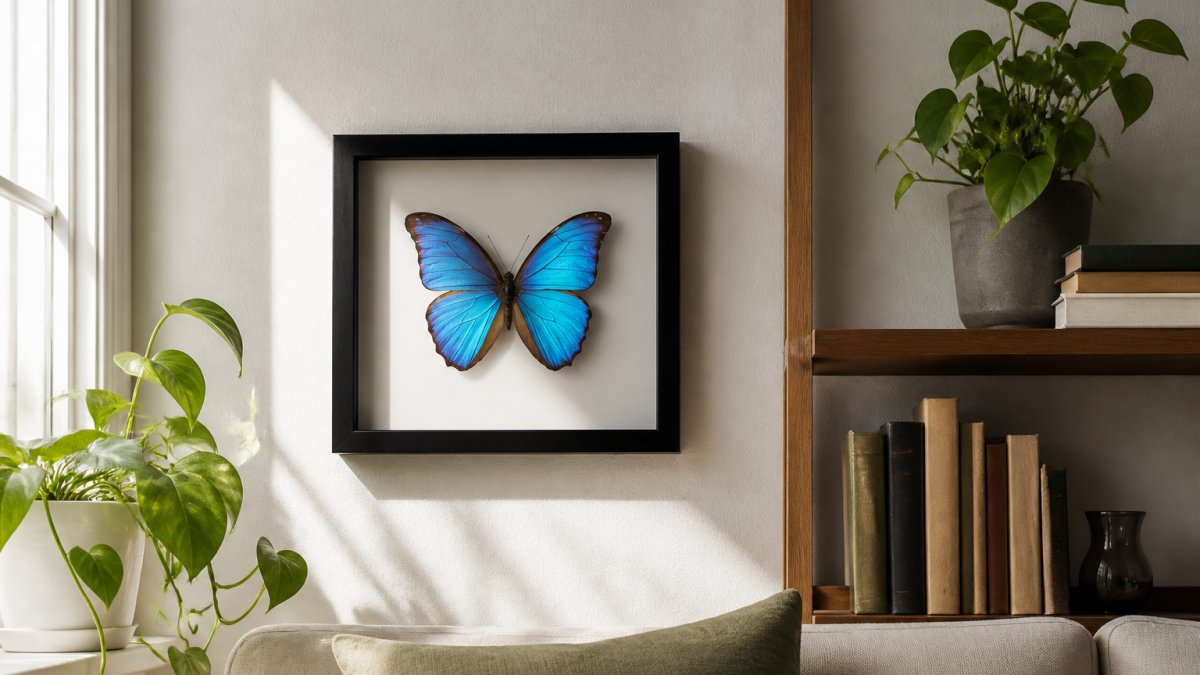
What real specimens offer that prints do not:
- True colour that changes as you move past the frame
- Structural detail you can see up close, from wing scales to beetle jaws
- A one-of-a-kind piece, since every specimen differs
- A natural history story behind each species
The benefits go past looks. Real insect decor starts conversations, anchors a wall, and gives a room a focal point that feels collected rather than bought.
Ethical Sourcing: What to Check Before You Buy Insect Decor
Ethical sourcing is the first thing to ask about, and the first thing most buyers forget. A preserved insect display is only worth owning if the specimen was obtained legally and responsibly, and "legally" and "responsibly" are not the same thing.
Start with the seller. A serious supplier knows where each specimen came from and can say so in plain terms. Farmed and sustainably raised specimens are the norm for common species such as the common birdwing, the blue morpho and the rhinoceros beetle, and that is what you want to see.
How to tell captive-bred or naturally deceased from wild-caught:
- Captive-bred: the seller can name the farm or breeder, and the species is one that is routinely reared in captivity. Common examples include many birdwing and swallowtail butterflies, atlas moths and several stag beetle species.
- Naturally deceased: the seller states the specimen was collected after a natural death, often from a butterfly house or breeding program. Ask for the source; a vague answer is a red flag.
- Wild-caught: the seller may be honest about it, but you should expect clear origin details, a species name, and confirmation the species is not protected.
A quick checklist before you buy:
- Does the seller state the origin of the specimen?
- Can they explain how it was obtained, farmed, captive-bred, naturally deceased or wild-caught?
- Do they avoid rare or protected species?
- Is the species name listed clearly, ideally with the scientific name?
- Are they willing to answer questions before purchase?
- Is the price consistent with the species and the work involved?
If a seller dodges these questions, walk away. The Convention on International Trade in Endangered Species of Wild Fauna and Flora (CITES) sets the global rules on trading protected species, and reputable suppliers work well inside them.
The biggest mistake buyers make is choosing on price alone. A suspiciously cheap specimen often means no paperwork and no clear origin. Ask first, buy second.
The Art of the Preserved Insect Display
A preserved insect display is a specimen that has been carefully dried, set and sealed so it holds its shape and colour for years. The skill is in the mounting. Wings must sit flat and symmetrical. Legs and antennae need support. The frame has to keep out dust, damp and pests.
This is where cheap work shows. A rushed mount sags over time. A proper one looks the same in a decade.
Our own approach is museum-style preservation inside sealed shadowbox frames. Take the Turquoise Emperor in a frame. Its wings shift from turquoise to deep silvery blue depending on the angle you view it from, and that effect only survives if the specimen is mounted and sealed correctly.

What separates a good display from a poor one:
- Symmetrical mounting with wings fully spread
- A sealed frame that keeps out moisture and insects
- Clear labelling with the species name and origin
- Solid backing so the specimen cannot shift
Get these right and the piece lasts. Get them wrong and you are buying a short-lived ornament.
Framed Insect Wall Art: Styling Ideas for Every Room
Framed insect wall art works in almost any room, but the styling changes with the space. The trick is to treat each frame as a focal point, not filler.
In a living room, hang one larger frame at eye level on a plain wall. Let it breathe. In a study or hallway, group three smaller frames in a row to build a wall display. In a bedroom, keep it calm with a single piece in soft, earthy colours.
Room-by-room ideas:
- Living room: one statement frame above a sideboard
- Study: a row of three beetle or butterfly frames
- Bedroom: a single piece in muted tones
- Hallway: a vertical stack of small shadowboxes
- Kitchen or dining: a glass dome on a shelf, away from steam
Pair frames with natural materials. Wood, stone and linen all sit well beside a specimen. The goal is a cohesive interior, not a cluttered one.
Butterfly Shadow Box Decor That Works in Small Spaces
Butterfly shadow box decor is the easiest way to add insect art when wall space is tight. A shadowbox is a deep frame that holds the specimen behind glass, so it stands off the wall and reads as a small sculpture.
Small does not mean forgettable. A 12.7 x 17.8 cm frame fits on a narrow shelf, a bedside table or a desk. The Phyllium giganteum Leaf Insect in a Frame is a good example. It mimics a real leaf so closely that predators cannot tell it apart, and it fits neatly in a 12.7 x 17.8 cm black shadowbox.

Where small frames work best:
Turquoise Emperor in a frame →
- A stack of two or three on a bookshelf
- Beside a lamp on a side table
- Above a desk in a home office
- On a hallway shelf with other curios
If you have minimal wall space, go vertical. A column of small frames uses height instead of width and still gives you a proper wall display.
Real Versus Faux Insect Decor: Which Lasts Longer?
Real versus faux insect decor comes down to what you value. Replicas are cheaper and tougher. Real specimens carry detail and colour no copy can match.
What "real" actually means:
- Real specimen: an actual preserved insect, mounted and sealed. It has genuine wing scales, true structural detail and natural variation.
- Replica: a printed, cast or resin copy. It is uniform, predictable and often indistinguishable from a distance.
- Hybrid: a real specimen body with printed or reconstructed wings, or a real specimen set into a decorative background. Ask the seller which parts are original.
How they compare in practice:
| Factor | Real Specimens | Faux Replicas |
|---|---|---|
| Detail and colour | Unique, true to life, shifts with light | Uniform, printed, static |
| Longevity | Decades if cared for | Years, can fade or yellow |
| Feel | Natural history piece | Decorative object |
| Best for | Shelves, studies, living rooms | Kids' rooms, busy halls, high-traffic spots |
| Cost | Higher | Lower |
| Safety | Fragile; keep out of reach of children and pets | Strong; can be handled |
Durability and care differences:
A well-mounted real specimen in a sealed shadowbox can hold its colour and shape for many years. The main threats are UV light, humidity and physical knocks.
Household suitability:
If you have young children, pets, or a busy hallway, a replica is the safer choice. Real specimens are best displayed where they will be seen but not handled, a shelf, a study wall, or a living room at eye level.
Allergies and sensitivities:
Preserved specimens are dried and sealed, so they do not usually trigger the same reactions as live insects. If you are sensitive to dust or mould, keep frames sealed and dust the outside of the glass only.
For collectors and nature lovers, real wins. For a quick pop of colour in a busy hallway, faux has its place. If you want a piece that holds value and starts conversations, choose real, and verify what you are buying before you commit.
Caring for Your Specimens: Light, Humidity and Handling
Care is simple, but it matters. Keep frames out of direct sun. Keep them away from damp rooms like bathrooms. Handle them by the frame, never the glass or the specimen.
Care basics:
- Display away from direct sunlight and heat
- Avoid humid rooms and open windows
- Dust the outside of the glass with a dry cloth
- Do not open the sealed frame
- Move pieces rarely, and hold the frame edges
Do this and a well-preserved specimen holds its colour and shape for many years. Skip it and fading starts within months.
Conclusion: Bringing Nature Indoors with Confidence
Choosing real insect decor is a small act of curiosity. It brings natural history into a home and gives a wall something worth a second look. Buy from a seller who answers your questions, care for the piece properly, and it will last for years.
That is what we do at Newman Art Designs. Every piece is museum-preserved, from butterflies and beetles to spiders and snake skeletons, and framed to last. We offer free shipping across Australia, and our collection has been trusted by buyers since 1996.
Shop now with Newman Art Designs and bring a genuine piece of the natural world into your home.
Frequently Asked Questions
What are the benefits of real insect decor?
Real insect decor brings colour, texture and a genuine conversation piece into your home. Unlike prints or replicas, each specimen is unique, with wing patterns and structural detail that shift under different light. Museum-grade preservation means these pieces hold their colour and form for years. They also connect your interior to natural history in a way mass-produced decor cannot, making them a focal point in any room.
How do you display preserved insects at home?
Shadowbox frames and glass domes work best because they protect specimens from dust and accidental damage while keeping them visible. Group two or three frames at different heights for visual interest, or place a single large piece as a focal point above a console or bedhead. Avoid direct sunlight, which fades colours over time, and keep displays away from humid areas like bathrooms and kitchens.
Are real insect specimens suitable for home decor?
Yes, provided they are properly preserved and framed. Museum-quality pieces are sealed in shadowbox frames or glass domes, so there is no handling risk. They suit most rooms, from living areas to studies, and work with styles ranging from maximalist to minimalist. If you have young children or pets, wall-mounted frames are safer than freestanding domes.
What is the difference between real insect art and faux insect decor?
Real insect art uses ethically sourced, preserved specimens, each with unique colour variation and structural detail that cannot be replicated. Faux decor, such as resin casts or printed images, offers a lower price point and no preservation needs, but lacks the depth and authenticity that makes real specimens collectible. For collectors and nature lovers, the real versus faux insect decor choice often comes down to whether you want a genuine piece of natural history or a decorative approximation.
The challenge with insect decor is finding pieces preserved well enough to last. Newman Art Designs has handled that since 1996, with museum-quality preservation, sealed shadowbox frames and glass domes, and free shipping across Australia. Browse the collection and choose a specimen that earns its place on your wall.
