
How to Style Insect Shadowboxes on Shelves (2026 Guide)
Table of Contents
- Why Insect Shadowboxes Work as Shelf Decor
- Biophilic Interior Design Tips for Shelf Displays
- How to Arrange Shadow Boxes on a Wall vs Shelves
- Best Lighting for Entomology Displays on Shelves
- Step-by-Step Styling for Insect Shadowboxes
- Mistakes to Avoid When Styling Insect Shadowboxes
- Caring for Your Insect Shadowboxes Long-Term
- Frequently Asked Questions
Last Updated: September 12, 2026
Why Insect Shadowboxes Work as Shelf Decor
Insect shadowboxes turn a small shelf into a cabinet of curiosities. The best ones pair museum-grade preservation with clean, modern framing, so a single Morpho or Monarch reads as art rather than a science project. This guide from Newman Art Designs covers how to style insect shadowboxes on shelves, from picking a focal specimen to lighting it properly. Newman Art Designs has been framing and preserving specimens since 1996.

Shelf styling has shifted toward biophilic interiors: bringing natural textures, shapes, and colours indoors to soften a space. A framed butterfly or beetle delivers that instantly. It adds organic pattern and colour that plants and timber alone can't match, and it works in rooms too small for a display cabinet.
What most styling guides miss is that an insect shadowbox isn't just another ornament. It's a curated object with its own visual weight, depth, and light requirements. Treat it that way and the shelf looks intentional. Treat it as filler and it looks like clutter.
Below, we'll show you exactly how to plan the shelf, choose a focal specimen, and layer supporting decor around it. First, though, here's the design logic that makes these pieces work.
Biophilic Interior Design Tips for Shelf Displays
Biophilic interior design is the practice of incorporating natural elements, materials, and patterns into a space to support a sense of calm and connection to nature. On a shelf, that means combining organic shapes, natural textures, and living or preserved botanicals with your insect shadowboxes.
The trick is restraint. A common mistake is filling every shelf edge-to-edge with nature-themed objects until the arrangement reads as a shop display rather than a home. Instead, group in odd numbers and leave negative space around the frame so the specimen can breathe.
Practical ways to build the biophilic layer:
- Pair a framed butterfly with a small trailing plant or dried eucalyptus stems
- Use natural materials nearby: timber, stone, linen, ceramic, rattan
- Repeat one colour from the specimen (a butterfly's blue or orange) in a cushion, book spine, or vase
- Mix heights so the eye moves: a tall dried branch, a mid-height frame, a low stack of books
How to Arrange Shadow Boxes on a Wall vs Shelves
Arranging shadow boxes on a wall calls for measured symmetry and a consistent gap; arranging them on shelves calls for asymmetry and layered depth. The wall version reads as a gallery. The shelf version reads as a curated vignette.
For a wall grouping, keep 5-8 cm between frames and align the centres of the outer pieces on a single invisible line. For shelves, stagger placement: one frame centred, the next offset left, the next offset right. Vary frame sizes so the eye travels.
| Placement | Best For | Spacing Rule | Depth Style |
|---|---|---|---|
| Wall gallery | 3+ frames, larger rooms | 5-8 cm between frames | Flat, single plane |
| Single shelf | 1-2 frames, small spaces | 10-15 cm clearance each side | Layered front-to-back |
| Bookcase mix | Frames + books + objects | Group in odd numbers | Staggered heights |
If wall space is tight, shelves are the smarter choice. A 5" x 7" or 4" x 6" frame sits comfortably on a standard shelf without dominating it, which makes insect shadowboxes a good fit for apartments and smaller rooms.
Best Lighting for Entomology Displays on Shelves
The best lighting for entomology displays is soft, indirect, and UV-free. Direct sunlight is the enemy: ultraviolet radiation breaks down the pigments in wing scales and the proteins in the specimen itself, and no preservation technique fully stops that. Position shelves out of harsh afternoon sun, or fit a sheer blind to diffuse the light.
For artificial light, LED is the safe choice. It runs cool, so it won't create heat near the specimen, and it emits far less UV than halogen or incandescent bulbs. Aim for warm white (around 2700-3000K) to flatter natural colours without a clinical cast.
What the Numbers Actually Mean
Most styling guides stop at "use LED." Here's what to look for on the box:
- Colour temperature (CCT): 2700-3000K for warm, residential-feeling light. Above 4000K starts to look clinical and can wash out iridescent blues and greens.
- Colour rendering index (CRI): Look for CRI 90 or higher. A low-CRI LED makes a Morpho's blue look flat and grey; a high-CRI source preserves the metallic shimmer that makes the specimen worth framing.
- UV output: Even LEDs emit trace UV. If the manufacturer publishes a UV figure, anything under 0.5% of total output is a reasonable target for a sealed, UV-filtered frame.
- Lux at the specimen: Keep ambient shelf lighting under roughly 200 lux for a piece you want to last decades. A bright display spotlight can push 1000 lux or more directly onto the glass.
Placement Rules That Matter
- Light from the front or slightly above, never from directly behind the frame
- Avoid spotlights that create a hot, glaring pool on the glass
- If you want a glow, use a low-output LED strip above the shelf rather than inside the box
- Angle the light so it grazes the glass at an oblique angle rather than hitting it square-on, which reduces visible reflections of the room behind you
The Preservation Angle Most Guides Skip
Light damage is cumulative and irreversible. A specimen that receives 200 lux for eight hours a day will fade noticeably faster than one that receives the same light for two hours. If your shelf sits in a room you use all evening, consider a dimmer or a smart plug that limits the display light to a few hours a day.
UV-filtering glass or acrylic is a highly effective upgrade. It won't stop visible-light fading entirely, but it removes the most damaging part of the spectrum. If your frame doesn't specify UV filtration, assume it has none, and keep the piece out of any position where it receives direct sun for more than a few minutes a day.
Step-by-Step Styling for Insect Shadowboxes
Styling insect shadowboxes is a five-minute job once you have a plan. The method below works for a single shelf or a full bookcase, and it's the same process our team uses when arranging pieces for photography.
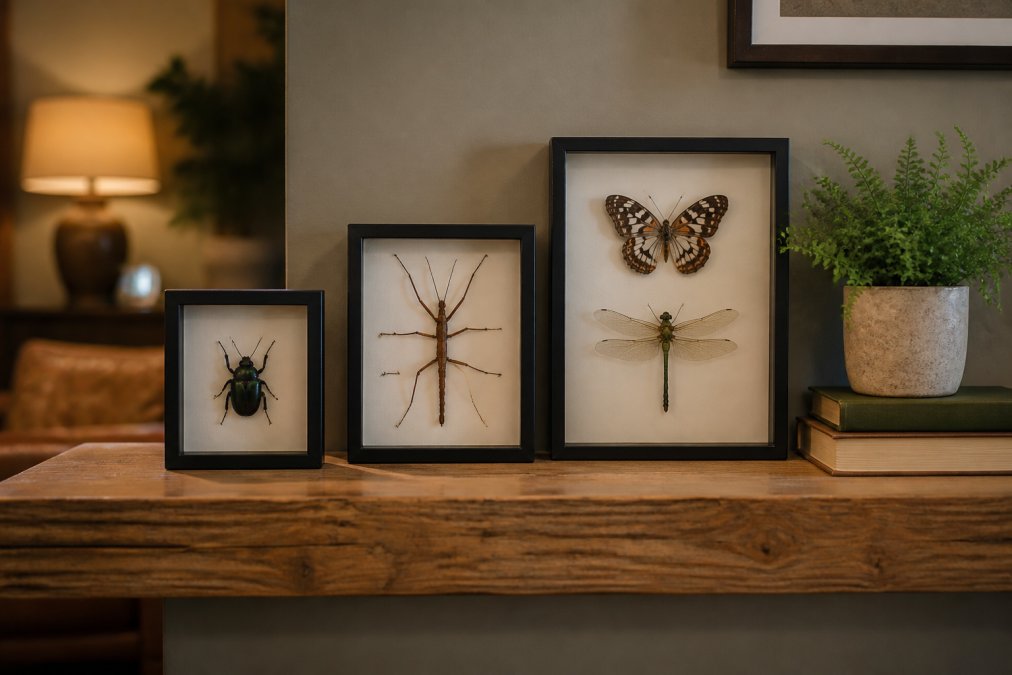
Step 1: Clear and Plan Your Shelf Space
Empty the shelf completely and measure it. Note the usable height, the depth, and how much weight the fixings or shelf board can carry. Decide whether the insect shadowboxes will be the hero of the shelf or one element among several. Most people get better results when one frame leads and everything else supports it.
Step 2: Choose a Focal Specimen
Pick one piece to anchor the arrangement. A bold, high-contrast specimen such as a Morpho didius butterfly, with its shimmering blue wings, or a Monarch with its black-and-orange pattern, holds a shelf on its own. Place the focal frame at eye level, roughly centred, and build outward from there.
Step 3: Layer with Complementary Decor
Add supporting objects in front of and beside the frame, not on top of it. A small plant, a candle, a stack of two or three books, or a ceramic dish all work. Keep the tallest object shorter than the frame so the specimen stays the focal point. Step back, check the balance, and remove anything that competes.
Mistakes to Avoid When Styling Insect Shadowboxes
The biggest styling mistake is overcrowding. When every centimetre of shelf is filled, the eye has nowhere to rest and the specimen loses impact. Leave at least a hand's width of empty space around each frame.
Other common errors worth avoiding:
- Hanging or placing frames in direct sun, which accelerates fading
- Mixing too many competing themes (nautical, botanical, industrial) on one shelf
- Placing small frames high up where their detail can't be seen
- Using strong-coloured backdrops that fight the specimen's natural palette
- Ignoring frame depth, so a deep shadowbox overhangs a shallow shelf
Caring for Your Insect Shadowboxes Long-Term
Long-term care comes down to four things: light, humidity, temperature stability, and dust. Most guides cover the first and last and skip the middle two, which is where specimens actually degrade.
Humidity: The Silent Killer
Insect specimens are hygroscopic, they absorb and release moisture from the air. When humidity swings, the specimen expands and contracts, which can cause wing scales to lift, antennae to droop, and mounted bodies to shift on their pins.
- Target range: 45-55% relative humidity. Below 40% and specimens can become brittle; above 60% and you invite mould, especially in the abdomen.
- Avoid: bathrooms, kitchens, laundry areas, and anywhere near an evaporative cooler, which pushes humidity up sharply.
- In humid climates: a small rechargeable dehumidifier in the room, or air conditioning running in damp months, is usually enough. Don't place displays against external walls where condensation forms.
- In dry climates: avoid placing displays directly above or beside a heater or ducted vent, which drops local humidity and creates temperature swings.
A cheap hygrometer, the kind sold for reptile enclosures or cigar humidors, costs very little and tells you more about your specimen's environment than any amount of guesswork.
Temperature Stability
Specimens tolerate a stable cool temperature far better than a warm one that fluctuates. Aim for a room that stays between roughly 18-22°C year-round. Avoid shelves above fireplaces, beside ovens, or in rooms that are closed up and allowed to bake in summer.
Archival Materials: What Actually Matters
Sealed, archival frames do most of the work for you. The key components are:
- Acid-free backing and mount board. Standard cardboard and cheap foam board off-gas acids that yellow paper labels and degrade the specimen over years.
- UV-filtering glass or acrylic. Removes the most damaging part of the light spectrum. Acrylic is lighter and safer for larger frames; glass is more scratch-resistant.
- A proper seal. A frame that isn't sealed lets dust, insects, and humidity in. If you can see gaps at the corners, it isn't sealed.
- Stainless steel pins or archival adhesive. Brass pins can corrode; standard tape dries out and fails.
Dust and Handling
Dust the glass gently with a dry microfibre cloth. Never spray cleaner directly onto the frame, liquid can wick into the seal and reach the specimen. If you need to move a frame, hold it by the edges of the frame, not the glass, and never lay it face-down.
Pest Prevention
Even sealed frames can attract pests if the seal fails. Watch for:
- Carpet beetles and clothes moths, which will eat dried insect specimens given access
- Booklice, which thrive in humid conditions and feed on mould and organic debris
- Fine frass or dust around the frame edges, which can indicate an active infestation
If you spot any of these, isolate the frame, check the seal, and consider a small silica gel packet inside the box if there's room. Cedar blocks or lavender sachets nearby are a traditional deterrent, though their effectiveness is limited.
A Simple Monitoring Routine
- Monthly: check the glass for condensation or dust, and check the seal at the corners
- Seasonally: check the hygrometer reading and adjust the room's humidity if needed
- Annually: inspect the specimen itself through the glass for any sign of fading, mould, or movement on the mount
Newman Art Designs pieces are built with longevity in mind, using museum-quality preservation so the colours and structure hold up over the years. But even a high-quality frame benefits from a stable room and a five-minute check every few weeks.
Frequently Asked Questions
How do you arrange multiple insect shadowboxes on a shelf?
Start with an odd number of boxes, like three or five, and vary the sizes. Place the largest box in the centre or slightly off-centre, then flank it with smaller ones. Leave at least 5 cm between frames to avoid a cluttered look. Group by colour palette or specimen type, such as all butterflies or beetles, to create a curated collection that feels intentional rather than random.
What is the best way to mount insect shadowboxes for a gallery wall look?
For a gallery wall, lay all frames on the floor first to test the arrangement. Keep consistent spacing, around 5-8 cm, and align the centres horizontally or vertically. Use picture-hanging hooks rated for the frame weight, and consider museum putty to keep frames level. If mixing with other art, let the insect shadowboxes be the focal point by giving them more breathing room.
How do you prevent insect shadowboxes from looking cluttered on open shelving?
Limit each shelf to three to five items total, including the shadowboxes. Use the rule of thirds: place the main shadowbox off-centre and balance it with a smaller object like a candle or book. Avoid stacking items directly in front of the frames. Leave empty space around each piece so the eye can rest. Rotate your display seasonally to keep it fresh without adding more items.
Are there specific lighting considerations for displaying insect specimens?
Yes. Direct sunlight fades colours and damages specimens over time, so avoid placing shadowboxes where they receive strong UV rays. Instead, use LED picture lights or shelf lamps with warm white bulbs (2700K-3000K) to highlight the iridescence of butterflies and beetles. Dimmable options let you adjust the mood. For glass domes, a small spotlight from above creates a museum-like effect without heating the specimen.
Styling insect shadowboxes on a shelf is really about editing: choosing one specimen you love, giving it room, and letting everything else support it. If you'd rather start with a piece that's already framed to a museum standard, Newman Art Designs offers preserved butterflies and other specimens in shadowbox frames and glass domes, with free shipping across Australia. Browse the collection, pick a focal piece for your shelf, and build the arrangement around it. Shop now.
