
Do Preserved Insect Specimens Fade? What to Know
Table of Contents
- Why Preserved Insect Specimens Lose Their Colour
- How Long Do Framed Butterflies Last?
- Best Lighting for Displaying Insect Collections
- Preventing Insect Specimen Colour Fading: Storage Guide
- Museum-Grade vs. Hobbyist Preservation Methods
- Conclusion: Enjoy Your Specimens for Decades
- Frequently Asked Questions
Last Updated: September 6, 2026
Why Preserved Insect Specimens Lose Their Colour
The short answer is yes, preserved insect specimens can fade, but how quickly depends entirely on how they are made and displayed. Colour loss in pinned insects is primarily caused by photodegradation, where ultraviolet light breaks down the pigments and structural colours in wing scales and exoskeletons. At Newman Art Designs, we have been preserving specimens since 1996, and the difference between a piece kept in direct sunlight versus one in a shaded corner is dramatic within just a few years.
Most people assume a framed butterfly will hold its colour indefinitely. In reality, vibrant blues and greens are often structural colours produced by microscopic scales that refract light. When UV radiation degrades the proteins in these scales, the iridescence dulls and turns brown or transparent. Pigment-based colours, such as the reds and yellows in many beetles, are more stable but still susceptible to long-term light exposure.
Properly dried specimens resist decay, but no chemical treatment can stop UV damage once the frame is hanging on your wall.
How Long Do Framed Butterflies Last?
A well-prepared framed butterfly can retain its physical structure for decades, with many museum specimens surviving over a century. The colour, however, is a separate question. Under typical indoor lighting conditions, you can expect noticeable fading to begin within five to ten years, provided the frame is kept out of direct sunlight. Move that same frame into a sunlit room, and the deterioration accelerates significantly within twelve months.
The key variable is cumulative light exposure, not the age of the specimen. Museum-grade frames use UV-filtering glass, which blocks the most damaging wavelengths. Hobbyist-grade frames typically use standard glass that offers minimal protection.
Species-Specific Fading Timelines
Different insects fade at different rates. Butterflies in the Morpho genus, with their iconic metallic blue wings, are among the most sensitive because their colour comes entirely from delicate scale structure. Many species of the doxocopa group, including the Turquoise Emperor, exhibit colour that shifts from turquoise to silvery blue depending on the viewing angle, but this iridescence is equally vulnerable to UV degradation.

Beetles with hard, pigmented exoskeletons, such as jewel beetles, generally hold their colour far longer, sometimes for generations. Zygoptera, or damselflies, and many phasmids fade quickly because their thin wings and bodies dehydrate further over time.
Best Lighting for Displaying Insect Collections
Display your preserved insect specimens in rooms that receive indirect natural light, and avoid north-facing windows (in the southern hemisphere) where harsh afternoon sun streams in for hours. The single most effective change you can make is positioning your framed butterflies on a wall opposite a window rather than beside one.
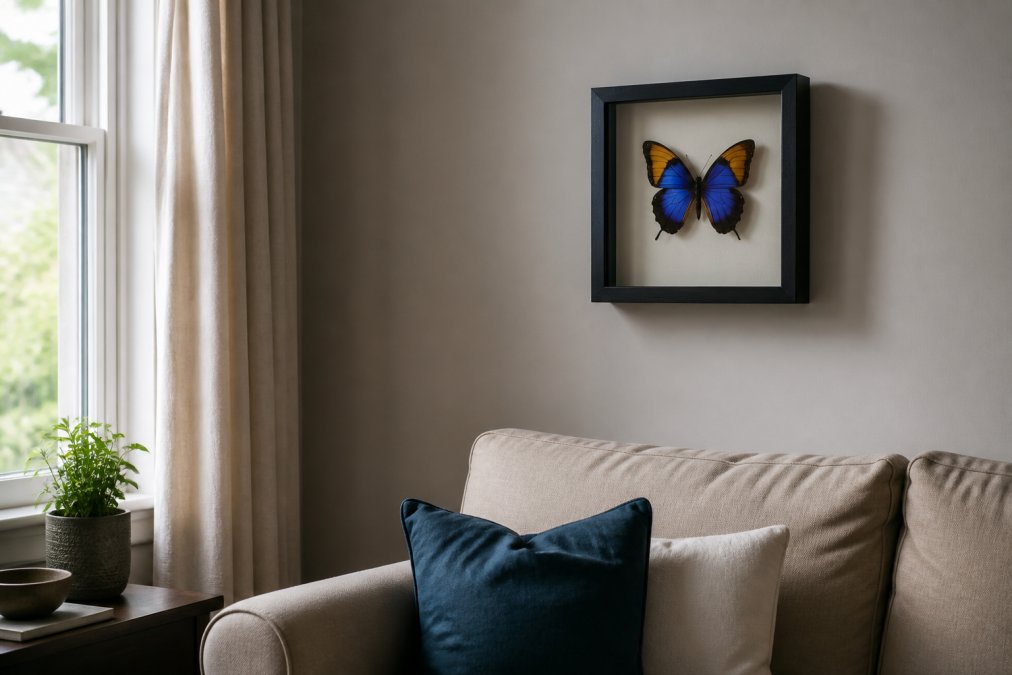
Understanding Light Damage: Lux and UV Index
Colour fading is driven by two measurable factors: illuminance (lux) and ultraviolet (UV) radiation. The museum standard for light-sensitive collections is to limit illuminance to 50 lux (about the brightness of a dim hallway) and to filter out UV radiation entirely. For a home display, achieving 50 lux might be too dark to fully enjoy the specimen, but you can make informed trade-offs.
A typical living room with indirect daylight ranges from 100 to 500 lux; a sunlit windowsill can exceed 10,000 lux. The damage is cumulative, so a specimen exposed to 500 lux for 10 hours a day will fade ten times faster than one exposed to 50 lux. Standard window glass blocks some UVB but allows most UVA to pass through. A UV meter reading of 10 microwatts per lumen is considered safe; readings above 75 microwatts per lumen can cause visible fading in sensitive species within months.
Practical Lighting Choices: Bulbs and Glazing
Standard LED bulbs emit negligible UV radiation, making them a safe choice. However, 'cool white' or 'daylight' LEDs (5000K-6500K) emit a higher proportion of blue light, which is closer to UV in energy and can still cause fading. 'Warm white' LEDs (2700K-3000K) emit less blue light and are the safer choice. Choose warm-white LEDs and consider a dimmer switch to reduce cumulative exposure.
Standard float glass blocks approximately 45% of UV radiation. UV-filtering acrylic (such as Optium Museum Acrylic or Conservation Clear) blocks over 99%. A specimen under standard glass will fade roughly twice as fast as one under UV-filtering acrylic. The trade-off is cost and weight. For valuable specimens, the investment is worthwhile.
Light-Fastness Testing: How to Test Your Display Location
For collectors serious about colour retention, light-fastness testing is worth understanding. The industry standard is the Blue Wool Scale, which uses a series of dyed wool swatches (Grade 1 is most fugitive, Grade 8 is most lightfast). You can perform a simple test at home:
- Purchase a Blue Wool Scale test card from an art supply or archival supplier.
- Cover half of the card with opaque tape or cardstock.
- Place the card in your proposed display location for four to six weeks.
- Compare the exposed half to the covered half.
If the Grade 3 or Grade 4 patch shows visible fading, your location may have high UV exposure and could be unsuitable for delicate specimens like Morpho butterflies or damselflies. If only Grade 1 or Grade 2 shows fading, your location is relatively safe.
For a more immediate reading, a UV light meter can measure the microwatts per lumen of UV radiation hitting your frame. The museum standard is to keep UV levels below 75 microwatts per lumen. If your reading is higher, you may need UV-filtering glazing or a different location.
The Trade-Off: Display vs. Preservation
Ultimately, you must choose between enjoying your specimen and preserving it perfectly. A specimen kept in a dark drawer will retain its colour for decades, but you will never see it. The best approach is a middle path: display specimens in low-light areas, use UV-filtering glazing, and rotate pieces seasonally.
Preventing Insect Specimen Colour Fading: Storage Guide
The most effective way to prevent insect specimen colour fading is to control the two primary degradation vectors: light and humidity. While the principle of a 'dark, cool, dry' environment is universal, the practical application differs significantly between a casual display and a serious collection.
The Archival Standard: Beyond the Shoebox
Museum collections use powder-coated steel cabinets or polypropylene boxes with compressible, foam-lined lids to create a near-airtight seal. This creates a microclimate that buffers against humidity swings and excludes pests. For a home collector, the closest equivalent is a dedicated entomology storage box from specialist suppliers.
Never use standard craft glue or nail polish on a pinned specimen you intend to keep long-term. These contain solvents that can wick into the thorax and cause discolouration over time. Archival practice uses water-soluble or pH-neutral adhesives, and pins should be stainless steel or 'black' enameled pins, which do not corrode and stain the specimen.
Chemical Safety: The Missing Protocol
Many online guides recommend using acetone or ethyl acetate to 'relax' dried specimens, but these are hazardous chemicals. Acetone is highly flammable and can dissolve certain plastics and varnishes. Ethyl acetate is a respiratory irritant. For the home hobbyist, the safest method is the 'humid chamber' technique: place the specimen in an airtight container on a layer of moistened paper towel with a few drops of thymol (a natural mould inhibitor). Leave it for 24-48 hours.
If you do use acetone for degreasing, do so outdoors or under a fume hood. Never pour it down a sink; dispose of it as hazardous waste.
Light-Fastness Testing: A Practical Method
Instead of guessing whether your display wall is 'safe', you can test it. Purchase a small card of Blue Wool standards (Grade 1 is most fugitive, Grade 8 is most lightfast) from an art supply store. Cover half of the card with opaque tape, place it in your proposed display location for four to six weeks, and compare the exposed half to the covered half. If the Grade 3 or Grade 4 patch shows visible fading, your location is unsuitable for delicate specimens like damselflies or Morpho butterflies.
For a more immediate reading, a UV light meter can measure the microwatts per lumen of UV radiation hitting your frame. The museum standard is to keep UV levels below 75 microwatts per lumen. If your reading is higher, you may need UV-filtering glazing or a different location.
Humidity Control and Pest Prevention: The Specifics
Humidity is the second great enemy of preserved insects. High humidity (above 65%) encourages mould growth and softens the exoskeleton. Low humidity (below 30%) causes brittleness where legs and antennae snap off. The ideal range is between 40 and 55 percent relative humidity. Australian conditions vary dramatically, from humid tropical zones to arid interiors. In humid areas, use silica gel beads (not the indicating type, which can contain cobalt chloride) inside your storage box. In dry areas, a small piece of damp sponge in a perforated container can add necessary moisture.
Pest prevention is equally critical. Common household pests such as carpet beetles (Anthrenus spp.) and clothes moths (Tineola bisselliella) will consume dried insect specimens. Museum standards call for periodic freezing of new acquisitions. Freeze the specimen in a sealed bag at -20°C for 72 hours, thaw for 24 hours, then freeze again for another 72 hours. This double-freeze cycle helps ensure that any eggs that survived the first freeze are killed in the second.
A Practical Storage Checklist
To summarise, here is a checklist that goes beyond the basics:
- Container: Use a polypropylene or powder-coated metal box with a gasket seal, not a wooden box.
- Pins: Use stainless steel or black enamel pins; never brass.
- Relaxing: Use a humid chamber with thymol, not acetone, for routine work.
- Testing: Perform a Blue Wool Scale test on any new display wall.
- Monitoring: Place a small hygrometer inside your storage box to track humidity.
- Quarantine: Double-freeze any new specimen before adding it to your main collection.
By adopting these museum-grade protocols, you move from passive storage to active preservation, ensuring your specimens retain their colour and structure for decades, not just a few years.
Museum-Grade vs. Hobbyist Preservation Methods
Museum-grade preservation is about controlling every variable. Professional preparators use techniques such as papering, where specimens are temporarily stored in folded paper triangles to dry slowly, preserving both colour and structural integrity. Specimens are then relaxed, pinned through the thorax, and mounted with wings spread at precise angles.
Hobbyist methods often cut corners. Quick drying can cause specimens to become brittle, while inadequate dehydration leaves moisture that fuels decay. The mounting quality directly affects how long the piece survives, but colour preservation depends on the display environment regardless of method.
The practical difference emerges over decades rather than years. A well-prepared specimen that is properly stored can outlive its owner, retaining structural integrity and much of its original colour.
| Preservation Aspect | Museum-Grade | Hobbyist-Grade | Impact on Longevity |
|---|---|---|---|
| Drying method | Slow, controlled papering | Often rapid air drying | Structural integrity |
| Mounting | Precision pinning, thorax | Variable technique | Physical stability |
| Frame glass | UV-filtering archival | Standard glass | Colour retention |
| Storage | Dark, climate-controlled | Variable conditions | Overall lifespan |
At Newman Art Designs, every specimen we offer, from the Turquoise Emperor in a frame to our Japanese emperor butterfly in a dome, is prepared using museum-quality preservation techniques refined since 1996. Our shadowbox frames and glass domes are sealed to protect against pests and humidity, and we ship free across Australia. The craftsmanship is built to last, which is why collectors trust us for pieces that become conversation-starting heirlooms.

Conclusion: Enjoy Your Specimens for Decades
Preserved insect specimens do fade, but with the right display choices and storage habits, you can enjoy their vibrant colours for decades rather than years. The three rules are simple: keep specimens out of direct sunlight, control humidity, and rotate your display pieces.
Whether you are adding your first framed butterfly or expanding a serious collection, the joy of these pieces lies in their intricate detail and natural beauty. A Dotted Glory butterfly in a dome or a Blomfield butterfly in a dome brings a touch of the wild into your home, and with minimal care, it will stay stunning for a lifetime. Explore our collection today and find the piece that speaks to you.

Frequently Asked Questions
How long do preserved insect specimens last?
With proper care, preserved insect specimens can last for decades or even centuries. Museum collections hold specimens over 100 years old. The key factors are limiting UV light exposure, controlling humidity between 40-50%, and protecting against pests. A well-sealed frame with archival materials keeps specimens stable. Without protection from direct sunlight, colours can fade noticeably within a few years.
Does direct sunlight cause insect specimens to fade?
Yes, direct sunlight is the primary cause of fading in preserved insect specimens. UV radiation breaks down the pigments in wings and bodies, particularly structural colours like the iridescent blues and greens of many butterflies. Display your specimens away from windows or use UV-filtering glass in your frame. Indirect, low-level light causes minimal damage, allowing colours to stay vibrant for many years.
What is the best way to store pinned insects to prevent colour loss?
Store pinned insects in a sealed display case or frame kept out of direct sunlight. Maintain a stable humidity level around 40-50% to prevent mould and dehydration damage. Add a small desiccant packet inside the frame if your home is humid. Avoid placing specimens near heat sources. For unframed collections, use a tight-fitting storage box to protect against dermestid beetles.
Can you restore the colour of a faded butterfly specimen?
True colour restoration of a faded butterfly is not possible. Once pigments break down from UV exposure, the original hues cannot be recovered. Some collectors use acetone to rehydrate specimens during the pinning process, which can enhance natural colour intensity at that stage. For an already faded specimen, your best option is replacing it. To prevent future fading, display specimens away from direct light.
Fading is a natural process, but it is one you can control with knowledge and care. The team at Newman Art Designs has spent nearly three decades perfecting museum-quality preservation, ensuring every specimen arrives ready for a long life in your home. With free shipping across Australia and a reputation built on craftsmanship, we make it easy to own a piece of the natural world that lasts. Get started with Newman Art Designs and bring home a specimen you will treasure for years.
