
Buy Preserved Snake Skeleton Art: 2026 Expert Guide
Table of Contents
- Why Preserved Snake Skeleton Art Belongs in Your Home
- Anatomy of a Snake Skeleton: What You're Actually Buying
- Framed, Domed, or Resin: Choosing Your Display Format
- Ethical Taxidermy in Australia: What to Look For
- Biophilic Interior Design Trends: Styling Your Specimen
- Care and Maintenance for Preserved Snake Skeletons
- Preserved Snake Skeleton Art as a Gift: What to Know
- Frequently Asked Questions
Last Updated: September 13, 2026
Why Preserved Snake Skeleton Art Belongs in Your Home
There's a particular kind of quiet a coiled snake skeleton brings to a room. Not the macabre thrill people expect, but something closer to wonder: hundreds of ribs curved in perfect order, a skull built to swallow prey larger than itself, all frozen mid-motion behind glass. This guide from Newman Art Designs covers how to buy preserved snake skeleton art with confidence, from anatomy to ethics to styling.
If you've only ever seen cheap novelty decor, you're in for a surprise. Real snake skeleton art is closer to a natural history specimen than a poster: hand-cleaned bones, museum-quality mounting, and a silhouette that reads as sculpture from across the room. It suits the biophilic interiors trend, where natural forms, textures and curiosities replace mass-produced prints. The display formats we offer range from $99.95 to $209.95, so there's an entry point for most budgets.
Here's what most guides get wrong: they treat these pieces as shock value. In practice, buyers tell us the opposite. The people who love them are science lovers, collectors of osteology and curiosities, and design-led homeowners who want a genuine cabinet of curiosities moment.
Anatomy of a Snake Skeleton: What You're Actually Buying
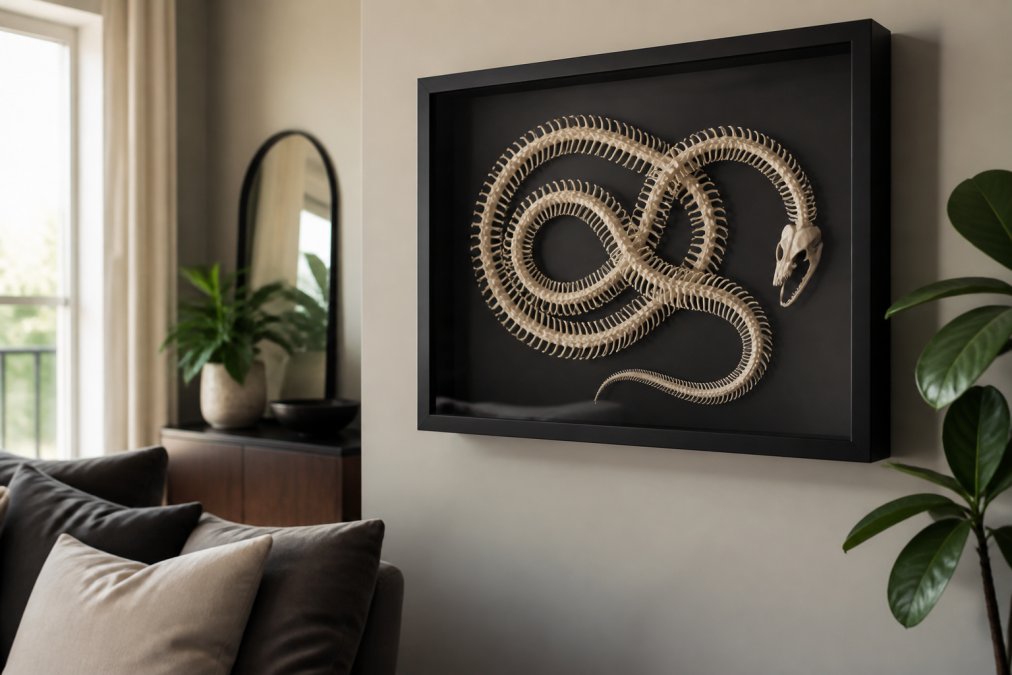
A snake skeleton is a biological specimen made up of three visible components: the skull, a long vertebral spine, and hundreds of pairs of ribs. Understanding these structures helps you judge quality before you buy, and it turns a purchase into something you can actually read.
Skull, Spine, and Ribs: The Key Structures
The skull is the centrepiece. Snake skulls are built from loosely connected bones that allow the jaw to open far wider than the head, which is why a mounted skull looks so different from a mammal's. On a Painted Bronzeback specimen, you can see the enlarged head, the eye sockets and the fine jaw articulation. The quadrate bone, which links the upper and lower jaws, is what gives snakes that famous gape; on a clean mount it sits as a distinct strut behind the eye, not a fused lump.
The spine is where mounting skill shows. A snake can have several hundred vertebrae, each connecting to a rib pair. In a coiled display, those vertebrae must curve smoothly without gaps or kinks. The ribs should fan evenly on both sides. Look for the neural spines, the small projections along the top of each vertebra; on a well-prepared specimen they form a fine, regular ridge along the coil.
Osteology is the study of bones, and it's the discipline behind every good specimen. A hand-cleaned skeleton retains natural bone colour and fine detail; a rushed one looks greasy or brittle.
How to Identify What You're Looking At
Most buyers can't tell a Bronzeback from a generic snake, and that's the gap this section fills. Three features do most of the work:
- Vertebra count and coil density. A longer species produces a tighter, more layered coil. If the coil looks sparse, the specimen may be a shorter species or a partial skeleton.
- Rib curvature. Ribs curve gently outward and downward. Sharp angles or flattened ribs usually mean heat damage during cleaning.
- Skull-to-body ratio. A small skull on a long body points to a slender arboreal species; a broader skull suggests a heavier-bodied ground snake.
A named species like Dendrelaphis pictus, the Painted Bronzeback, is a good sign because it tells you exactly what you're buying. Vague labels like "assorted snake" are not.

Judging Preparation Quality
Preparation is where two specimens of the same species diverge. A common pattern among collectors is to check four things in order:
- Grease. Hold the piece to light. Yellow or translucent patches mean fat wasn't fully degreased.
- Articulation. Every vertebra should meet the next without visible glue blobs or wire.
- Colour. Natural bone is off-white to cream. Bleached white is a warning sign; it usually means harsh chemical treatment that weakens the bone.
- Odour. A properly cleaned specimen has no smell. Any lingering organic scent means residual tissue.
Why This Matters When You Buy
Anatomy knowledge is your quality filter. A seller who can name the species, describe the vertebra count and explain the cleaning method is almost always selling a better piece than one who only shows a photo. Ask for a close-up of the skull and a side-on shot of the coil; those two images reveal more about preparation than any marketing copy.
Framed, Domed, or Resin: Choosing Your Display Format
The right display format depends on your space, your budget and how close you want viewers to get. Three options dominate: shadowbox frames, glass domes, and resin blocks.
| Format | Price Range | Best For | Viewing Angle |
|---|---|---|---|
| Shadowbox frame | $114.95-$209.95 | Wall display, small spaces | Front-on |
| Glass dome | $154.95 | Shelves, side tables | 360 degrees |
| Resin paperweight | $99.95 | Desks, handling | All angles, protected |
Shadowbox Frames
Shadowbox frames are the most versatile option. A black shadowbox sets the pale bones against dark negative space, which makes the coil read clearly from a distance. Newman Art Designs offers four frame sizes, from a 6 x 6" entry piece at $114.95 up to a 16 x 20" statement frame at $209.95. If you're short on wall space, the smaller frames work on a narrow wall or above a desk.
Glass Domes and Resin Blocks
Glass domes let you walk around the specimen. The 7" dome on a wooden base ($154.95) suits a bookshelf or mantel where the piece can be viewed from every angle.
Resin blocks are the practical choice for anyone who wants to handle the piece. The Lucite resin paperweight ($99.95) encases a Bronzeback skeleton in clear resin, so it needs no dusting and survives being picked up. It's the format we recommend for a first purchase or a desk gift.

Ethical Taxidermy in Australia: What to Look For
Ethical taxidermy means the animal was not killed for the purpose of becoming decor. Reputable sellers work with species that are non-venomous, widespread, and legally sourced, and they can tell you the origin and species name of every specimen.
Ask three questions before buying. First, what is the species? A named species like Dendrelaphis pictus, the Painted Bronzeback, is a good sign; vague labels like "assorted snake" are not. Second, where did it originate? Third, is it farmed, captive-bred, or a by-product of existing population management?
Australia has some of the strictest wildlife trade controls in the world. The federal regulator, the Department of Climate Change, Energy, the Environment and Water, administers the Environment Protection and Biodiversity Conservation Act 1999 and its wildlife trade provisions. Any specimen entering the country legally must pass through a permitted import pathway, and sellers should be able to speak to that. If a seller can't explain their sourcing, walk away.
For buyers in Australia, the cleanest signal is transparency: a stated species name, a stated origin, and a seller willing to answer questions in writing.
Biophilic Interior Design Trends: Styling Your Specimen
Biophilic interior design is the practice of bringing natural elements, forms and materials into built spaces to support a sense of connection with nature. A preserved specimen is one of the most literal expressions of that idea.
Styling matters more than placement. A few approaches that work:
- Gallery wall anchor: Pair a large frame with botanical prints and a mirror. The skeleton becomes the focal point; the rest softens it.
- Shelf vignette: A dome beside stacked books, a candle and a small potted plant. Vary heights so the eye moves.
- Dark corner: Against a deep green or charcoal wall, a black shadowbox and pale bones create contrast without clutter.
The aesthetic overlaps with gothic decor and the cabinet of curiosities tradition, but it doesn't have to be dark. In a bright, neutral room, a framed specimen reads as scientific display rather than macabre art.
Care and Maintenance for Preserved Snake Skeletons
Preserved skeletons need very little attention, but the small things matter. Keep them out of direct sunlight, away from humid rooms like bathrooms, and away from open flames or heaters. Beyond that, the difference between a specimen that lasts five years and one that lasts fifty comes down to three risks: light, moisture and insects.
Light and Humidity
UV exposure is the slowest and most common killer. It doesn't crack bone overnight; it bleaches it, turning cream to chalky white over months. If a piece must sit in a bright room, rotate it away from the window side or fit UV-filtering glass.
Humidity is the faster risk. Bone is porous and expands and contracts with moisture. A bathroom, laundry or unventilated kitchen wall will eventually loosen a mount and encourage mould in the fine spaces between ribs. Aim for a stable indoor environment; sudden swings do more damage than a steady, slightly humid room.
Insects and Dust
Dermestid beetles and clothes moths are the two pests that attack bone collections. A sealed frame or dome is your first defence. If you keep an open specimen, inspect it every few months for fine dust-like residue under the piece, which is a sign of insect activity.
For framed pieces, dust the glass with a microfibre cloth. Don't open the frame; the seal protects the specimen from dust and insects. For domes, lift the glass only if absolutely necessary, and never touch the bones with bare hands, since skin oils can stain them. For resin blocks, a soft cloth and a little warm water is all you need.
Handling and Moving
If you need to move a piece, support the frame or base from underneath, never the glass or dome. Wrap it in acid-free tissue rather than bubble wrap for long storage; bubble wrap can leave impressions on bone over time. Store flat, not upright, and keep it out of garages and sheds where temperature and humidity swing widely.
What to Expect Over Time
If a piece is mounted correctly and kept stable, it should hold its appearance for years. The main risks are physical: knocks, drops and rapid temperature swings. A small hairline crack in a single rib is normal in older specimens and rarely spreads if the piece is left undisturbed. If a mount loosens, don't try to re-glue it yourself; contact the seller, because the wrong adhesive can stain bone permanently.
Preserved Snake Skeleton Art as a Gift: What to Know
A preserved snake skeleton is a memorable gift, but it's not a neutral one. It works beautifully for science lovers, natural history enthusiasts, medical and biology students, and anyone who collects oddities and curiosities. It's a poor fit for someone who dislikes taxidermy or has a genuine phobia.
If you're unsure, choose a smaller piece. A resin paperweight or a 6 x 6" frame is a low-commitment introduction, and it sits on a desk rather than a wall, so it doesn't dominate a room. Pair it with a note about the species, which turns a curiosity into a conversation piece.
For shipping, ask how the seller packs. Delicate specimens should arrive in a rigid box with the frame or dome cushioned on all sides. Newman Art Designs ships free across Australia, and customer feedback consistently mentions the quality of the packing: "Absolutely amazing piece, the shipping was impeccable."
Frequently Asked Questions
Are preserved snake skeletons ethically sourced?
Ethical sourcing means the specimen was not taken from the wild for commercial purposes. Reputable suppliers work with established breeding programs or source from natural deaths. When you buy preserved snake skeleton art from Newman Art Designs, each piece comes from species like Dendrelaphis pictus, which are widespread and not endangered. Ask any supplier for origin details before purchasing.
How should I display a snake skeleton in my home?
Shadowbox frames work best on walls in living rooms, studies, or hallways where they become conversation pieces. Glass domes suit shelves, mantels, or side tables. For small spaces, the 6 x 6 inch coiled frame or the 89mm resin paperweight adds impact without dominating a room. Avoid direct sunlight and damp areas like bathrooms to protect the specimen.
What is the difference between taxidermy and osteological specimens?
Taxidermy preserves the animal's skin and outer appearance, while osteological specimens focus on the skeleton. Snake skeleton art is an osteological display, showing the skull, vertebrae, and rib cage. This makes it closer to a scientific display or anatomical model than traditional taxidermy art. Both fall under natural history collecting, but the preparation methods differ significantly.
How do I care for a preserved snake skeleton display?
Keep your display out of direct sunlight to prevent fading, and away from humid areas like kitchens or bathrooms. Dust gently with a soft brush or compressed air. Glass domes and sealed shadowbox frames offer the best protection. With proper care, museum-quality preserved bones last for decades. Newman Art Designs pieces are built to last when handled with basic care.
Choosing a preserved snake skeleton is part science, part design. Get the anatomy, sourcing and format right, and you end up with a piece that earns its place on the wall for years. Newman Art Designs has been crafting museum-quality, nature-inspired specimens since 1996, with hand-cleaned skeletons in shadowbox frames, glass domes and Lucite resin, all shipped free across Australia. Browse the collection and choose the piece that fits your space.
