
Framed Moth Buying Guide: Museum-Quality Display
Table of Contents
- Why a Framed Moth Makes a Striking Natural History Display
- Popular Framed Moth Species and What They Cost
- Ethical Insect Taxidermy: How to Verify Sustainable Sourcing
- Shadowbox Frame Styling: Ideas for Every Room
- Biophilic Decor Bedroom: Using Framed Moths to Create Calm
- Caring for Your Framed Moth: Longevity and Display Tips
- Conclusion
- Frequently Asked Questions
Last Updated: October 1, 2026
Why a Framed Moth Makes a Striking Natural History Display
A framed moth turns one of nature's most intricate designs into wall art you can study up close, and it remains one of the most affordable ways to bring genuine natural history into a home. Unlike prints or posters, each piece is a real specimen, hand-pinned and dry-preserved behind glass.
Popular Framed Moth Species and What They Cost
The four species below cover most of what collectors ask for, each suiting a different budget and room. Prices reflect frame size and specimen count.
Urania ripheus (Sunset Moth)
The sunset moth is often regarded as the most spectacular of all moths, and it is the piece we recommend to first-time buyers. Its Madagascan origins give it a colour range that shifts between green, gold and deep blue as you move around the room. Mounted in an 8" x 10" shadow box frame, it costs $94.95, and its hind wings carry numerous short, slender tails.
Argema mittrei (Comet Moth)
If you want a statement piece, the comet moth delivers. Our pair of male and female comet moths sits in a 12" x 16" black shadow box frame at $169.95, and the size is justified: this is considered one of the biggest moths in the world. The male carries long, thin tails while the female has rounder wings and much shorter tails, so the pair shows the species' differences side by side.
Alcides odontes (Zodiac Moth)
The zodiac moth is a day-flying species often mistaken for a swallowtail butterfly, and it is the most approachable of the group. We mount a pair in a 7" diameter wooden base under a 7" acrylic dome for $129.95, made in Australia. Found mostly in the rainforests of North Queensland, these moths are social and unafraid of humans, and the wing underside is as striking as the front.
Attacus atlas (Atlas Moth)
The Atlas moth is one of the largest moths in the world, with females noticeably bigger than males. Mounted in an 8" x 10" black shadowbox frame at $104.95, it suits buyers who want maximum presence in a standard frame size.
| Species | Display | Price | Best For |
|---|---|---|---|
| Urania ripheus | 8" x 10" shadow box | $94.95 | First framed moth purchase |
| Argema mittrei | 12" x 16" shadow box, pair | $169.95 | Statement wall pieces |
| Alcides odontes | 7" acrylic dome, pair | $129.95 | Shelves and side tables |
| Attacus atlas | 8" x 10" shadowbox | $104.95 | Large single specimen |
Ethical Insect Taxidermy: How to Verify Sustainable Sourcing
Ethical insect taxidermy means every specimen was reared in a controlled environment or collected under permit, never taken from a wild population in decline. Here is the regulatory machinery behind that claim and where to check it.
The two legal pathways a specimen can travel
In Australia, the import and export of wildlife specimens is regulated under the Environment Protection and Biodiversity Conservation Act 1999 (the EPBC Act), administered by the Department of Climate Change, Energy, the Environment and Water (DCCEEW). The Act gives effect to CITES, the Convention on International Trade in Endangered Species, through the List of CITES Species, the single most useful document a buyer can consult.
There are effectively two lawful pathways:
- Captive-reared stock, the specimen was bred in a butterfly house, farm or laboratory, and the seller can name the facility. This is the norm for the showy species sold as framed art, including the sunset moth and the comet moth.
- Permitted wild collection, the specimen was taken under a quota or licence issued by the source country's wildlife authority. This is rarer, and the paperwork is the proof.
How to verify a claim in five minutes
- Ask for the scientific name (genus and species), not just the common name. Common names are not regulated; scientific names are.
- Search that name against the DCCEEW List of CITES Species. A match means a permit should exist.
- Ask for the country of origin and the name of the rearing facility or the permit number.
- Check whether the species is listed as threatened in its country of origin under that country's own legislation.
- Ask the seller to put the sourcing answer in writing, email is fine.
If you want to check a species yourself, the Australian Government Department of Climate Change, Energy, the Environment and Water publishes guidance on wildlife trade, protected species and the permit application process.

Why 'sustainable' is not the same as 'ethical'
A specimen can be sustainably harvested and still be ethically questionable, for example, if it was collected from a population that is stable but locally significant to an Indigenous community, or if the collector damaged the habitat. The reverse is also true: a captive-reared specimen from a facility with poor welfare standards is not automatically ethical.
What to look for on the frame itself
A well-made piece usually carries a small label or certificate on the reverse with the scientific name, the country of origin and the year of mounting. This is not a legal requirement in Australia, but it is a strong signal that the seller tracks provenance. If you intend to resell, ask for that documentation at the point of sale and keep it with the frame.
Shadowbox Frame Styling: Ideas for Every Room
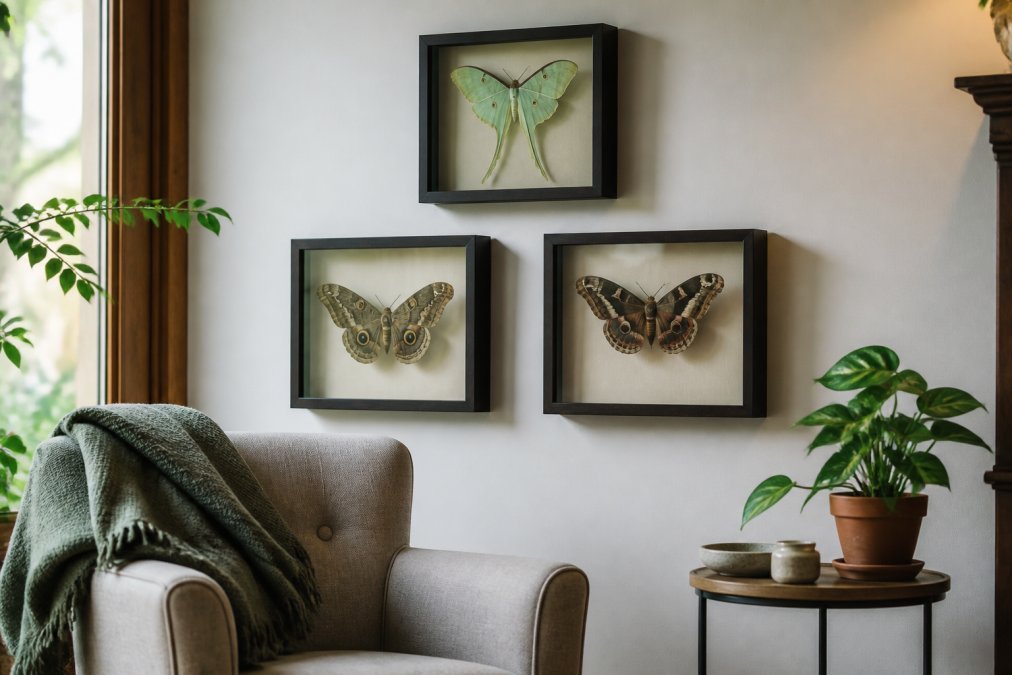
Shadowbox frame styling works best when the frame is a focal point rather than filler. A framed moth needs breathing room, so resist the urge to crowd it with other art.
Gallery Wall Arrangements
Grouping works when you have three or more pieces. Keep spacing consistent, around 5 to 8 centimetres, and align either the top or bottom edges rather than centring each frame individually. Mixing an 8" x 10" frame with a larger 12" x 16" piece creates a natural anchor.
Urania ripheus Moth in a Frame →
Small Space Solutions
A single dome is the answer for renters and small apartments. The zodiac moth dome measures 7" across, so it fits on a bedside table, a bookshelf or a narrow console without dominating the space. One well-chosen piece reads as deliberate; five small frames on a cramped wall read as clutter.

Hang a framed moth at eye level, roughly 145 to 150 centimetres from the floor, so the wing detail sits in your natural line of sight. Pieces hung too high lose the effect entirely.
Biophilic Decor Bedroom: Using Framed Moths to Create Calm
Biophilic decor in the bedroom works on a simple principle: natural forms and muted colours lower visual tension, which helps a room feel restful. A framed moth fits that brief better than most wall art because the palette is drawn straight from nature.
Caring for Your Framed Moth: Longevity and Display Tips
A properly preserved framed moth will outlast most of the furniture in the room, provided you manage three things most guides never mention: pest insects, humidity and light. The colours are the fragile part, not the structure, and damage is usually cumulative rather than sudden.
The three threats, in order of how often they strike
1. Dermestid beetles and other museum pests. These are the single biggest cause of destroyed insect collections worldwide, and the reason museum entomology departments run freezer cycles and pest monitoring. The adult beetles lay eggs on the specimen; the larvae then eat the dried tissue, starting with the abdomen and working outward.
A simple maintenance routine
- Weekly: a visual check of the glass for condensation or dust.
- Monthly: a check of the frame's reverse for any sign of pest activity, fine dust, shed skins or small holes in the mounting board.
- Every six months: a gentle dust of the outside of the glass with a dry microfibre cloth. Never spray cleaner onto the frame; liquid can wick under the edge and reach the mounting board.
- Annually: check the hanging hardware and the seal on the back of the frame.
What to do if you see damage
If you spot pest activity, isolate the piece immediately, seal it in a plastic bag and move it away from other specimens. Do not use insecticide sprays near a framed specimen; the solvents can damage the wings and the residue is difficult to remove. If the damage is significant, call a conservator.
Shipping and handling
Delicate specimens need rigid outer packaging and padding that stops the frame shifting in transit. Domes are more vulnerable than flat frames because the glass is curved and the base is the only structural support. Ask any seller how they pack before you order, and keep the original packaging if you may ever move the piece.
Never spray glass cleaner directly onto a framed specimen. Liquid can wick under the frame edge and reach the mounting board, and moisture damage to a preserved specimen cannot be reversed. The same applies to any liquid pest treatment, the cure is worse than the problem.
The three variables that decide whether a framed moth lasts five years or fifty are pests, humidity and light. Control those and the specimen will outlast the wall it hangs on.
Conclusion
Choosing a framed moth comes down to three things: the species that suits your space, a seller who can prove ethical sourcing, and a display spot away from sun and steam. Get those right and you have a piece that holds its detail for decades.
Frequently Asked Questions
How do I care for my framed moth specimen?
Keep your framed moth out of direct sunlight, as UV rays can fade colours over time. Maintain indoor humidity between 40% and 60% to prevent warping or mould. Dust gently with a soft, dry cloth, and avoid spraying cleaners directly on the frame or glass. With proper care, a museum-quality framed moth can last for decades.
Are framed moths ethically sourced?
Reputable sellers source specimens from conservation-minded farms and sustainable rearing programs, not from wild-caught endangered species. Look for clear sourcing statements and avoid vendors who cannot verify their supply chain. Ethical insect taxidermy supports biodiversity and ensures your display is guilt-free.
What is the difference between a butterfly and a moth display?
Moths typically have thicker, fuzzy bodies and hold their wings flat or wrapped, while butterflies have slender bodies and rest with wings folded upright. Both can be displayed in shadowbox frames, but moth species like the Atlas or Comet offer distinct, often larger silhouettes. Your choice depends on the aesthetic you want.
How should I arrange framed insects on a gallery wall?
Start with a focal piece, like a large framed moth, and arrange smaller frames around it. Keep spacing consistent (5-8 cm apart) and mix horizontal and vertical orientations for visual interest. For small spaces, a single statement frame or a vertical stack works well. Use paper templates to plan before hanging.
