
Benefits of Biophilic Decor in Bedrooms: A 2026 Guide
Table of Contents
- Why Biophilic Decor Belongs in the Bedroom
- Biophilic Interior Design Principles You Can Apply Tonight
- The Benefits of Entomology Art in Home Decor
- Nature-Inspired Bedroom Styling Tips That Actually Work
- Choosing Museum-Grade Specimens for a Biophilic Bedroom
- Authenticity, Ethics and Long-Term Care of Natural Specimens
- Conclusion: Small Natural Touches, Better Rest
- Frequently Asked Questions
Last Updated: October 2, 2026
Why Biophilic Decor Belongs in the Bedroom
Biophilic decor brings natural materials, patterns and living elements into an interior so the space mimics the calm of the outdoors.
At Newman Art Designs, the pattern is consistent: a single well-placed piece of nature does more for a room's mood than a wall of synthetic prints.
Bedrooms are where most people spend their most restorative hours, and research on natural environments points one way: views of nature and natural forms tend to lower stress and support better rest.
Biophilic Interior Design Principles You Can Apply Tonight
The core biophilic interior design principles are simple: use natural materials, vary texture, maximise daylight, and give the eye something organic to rest on. None of that requires a renovation.
Natural materials, textures and colour palettes
Start with what your hands touch. Timber, linen, wool, rattan, stone and clay all read as natural even when the eye is not consciously noticing.
Colour follows the same logic. Earth tones, muted greens, warm neutrals and soft browns keep a bedroom grounded; sharp, saturated colours fight the calm you are building.
Texture is the part most people skip. A room can be all the right colours and still feel flat if every surface is smooth.
Light, air and sightlines to nature
Light is the cheapest biophilic tool you own. Sheer curtains that diffuse morning light, a mirror angled toward a window, and a clear sightline from the bed to the brightest point in the room all help.
Where a real window view is not available, a framed natural specimen or a glass dome becomes your sightline, giving the eye a natural focal point a bare wall cannot.
The Benefits of Entomology Art in Home Decor
The benefits of entomology art in home decor come down to three things: genuine natural detail, a built-in focal point, and wall art no mass-produced print can replicate. A preserved butterfly or beetle is a real organism with real structure, which reads differently to the eye than a photograph.

Why preserved specimens suit a restful room
Entomology is the scientific study of insects, and entomology art turns that study into display.
There is a practical argument too. A preserved specimen is quiet. It does not demand attention the way a bold abstract canvas does.
And it solves a problem plants cannot. A potted fern needs water, light and attention; a museum-preserved specimen needs none of that, and will still be there in ten years.
Nature-Inspired Bedroom Styling Tips That Actually Work
Good nature-inspired bedroom styling tips follow one rule: fewer pieces, better placed. Most bedrooms fail not because they lack natural elements, but because those elements are scattered without a focal point.
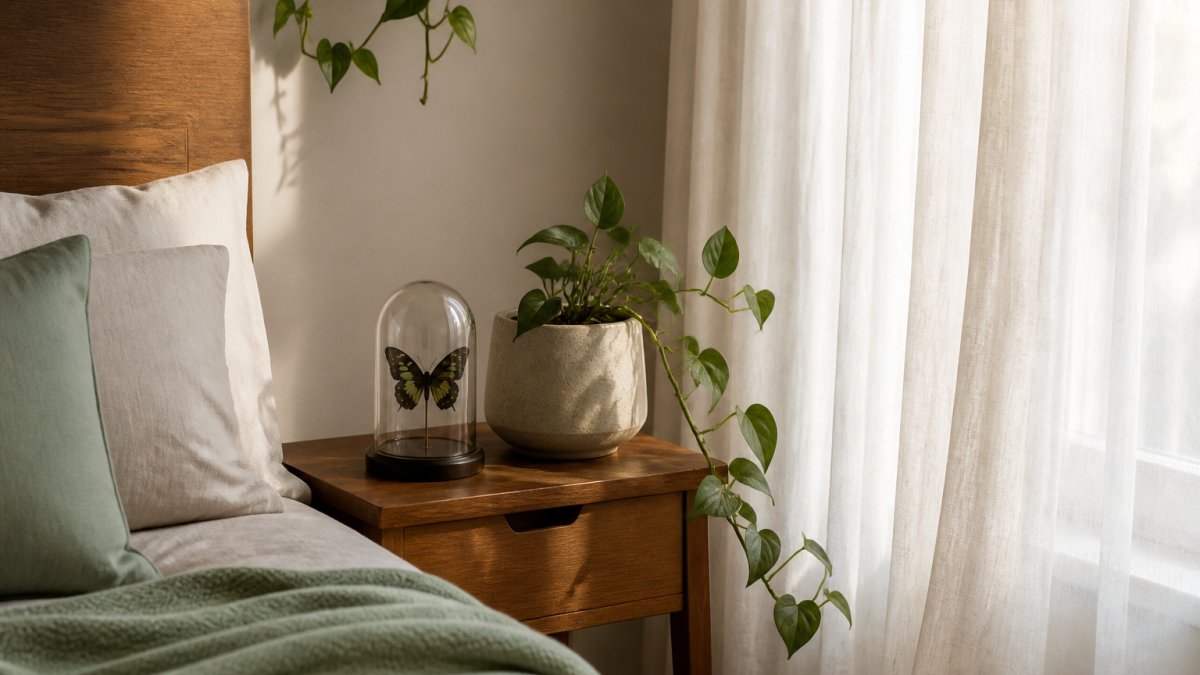
Placement maths that actually matters
Hang height is the single most common mistake. Museum convention places the centre of an artwork at roughly 1450-1500 mm from the floor, standing eye level.
For a bedside table, a dome should occupy no more than about one-third of the surface width: a dome suitable for a 600 mm table would crowd a 400 mm one, so a smaller dome on a timber base is safer for narrow tables.
Grouping and negative space
- Pick one hero piece per sightline. One framed specimen or dome on the wall opposite the bed, and nothing competing with it on that wall.
- Group in odd numbers. Three small natural objects on a shelf, or one large piece alone. Even numbers tend to look arranged rather than collected.
- Keep the palette to three tones. Timber, off-white and one green or ochre is enough.
- Mix living and preserved. A trailing plant next to a preserved specimen gives you the best of both: something growing and something permanent.
- Light it deliberately. A small warm lamp (2700K or lower) near your natural pieces brings out the iridescence on beetle shells and the scale pattern on butterfly wings that cool overhead lighting flattens.
- Leave negative space. A specimen needs room around it to read as a specimen rather than clutter. As a rough guide, leave at least the width of the frame as empty wall on each side.
Why specimens behave differently to prints
A framed print is flat and even. A preserved specimen has depth, shadow and directional sheen, so its appearance changes as you move around the room. That is an advantage in a bedroom, but placement matters more: a dome catching direct morning sun will show glare for part of the day, while one on a side wall with diffused light reads cleanly all day.
Choosing Museum-Grade Specimens for a Biophilic Bedroom
Museum-grade means the specimen has been professionally set, mounted and sealed so it holds its appearance over time. That standard is what separates a piece that lasts from a novelty that fades.

A few things to check before you buy:
| What to Check | Why It Matters | What Good Looks Like |
|---|---|---|
| Mounting method | Determines whether the specimen shifts or sags | Hand-pinned and set on an acid-free backing |
| Enclosure | Protects against dust, humidity and UV | Sealed shadow box frame or glass dome |
| Provenance | Tells you where and how it was sourced | Named species, stated origin, ethical sourcing |
| Construction | Affects how it survives shipping and handling | Solid frame, secure base, protective packaging |
| Scale | Determines whether it suits your space | Small domes for bedside tables, larger pieces for open walls |
Newman Art Designs has been producing preserved specimens since 1996, and the range covers butterflies, beetles, spiders, scorpions and snake skeletons, each displayed in a shadowbox frame or glass dome. Two examples that suit a bedroom well are the Monarch Butterfly in a Frame at $69.95, a compact 4 x 6 inch black shadow box that works on a narrow wall, and the Blue Morpho Butterfly in a Dome at $129.95, a dome on a timber base that suits a bedside table or cabinet.
Danaus plexippus, Monarch Butterfly, in a Dome →

For a smaller space, the Monarch Butterfly in a Dome at $99.95 sits on a wooden base and takes up less room than a lamp. If you have a larger wall to fill, the Multi-butterflies in a XLarge Glass Dome at $189.95 pairs seven colour-matched butterflies in a 10 x 5 inch dome.
Authenticity, Ethics and Long-Term Care of Natural Specimens
Ethical sourcing is the question buyers ask most, and it deserves a direct answer. Reputable suppliers work with reared or sustainably collected specimens and can tell you the scientific name, origin and method behind each piece. If a seller cannot answer those questions, walk away.
How to tell a real specimen from a replica
Most buyers assume a preserved insect is obviously real up close. In practice, high-quality resin casts and printed replicas are convincing in photographs, so it is worth knowing what to check.
- Look for asymmetry. Real specimens are rarely perfectly symmetrical. Wing venation, antennae length and leg positioning vary slightly. A replica is usually mirror-perfect.
- Check the underside of the wings. Real butterfly wings are membranous and slightly translucent when backlit; printed replicas are opaque.
- Inspect the pin and mount. A genuine hand-pinned specimen shows a single entomological pin through the thorax, with the specimen set on acid-free board. A cast or print has no pin.
- Look at the surface under angled light. Real chitin has a subtle sheen and, on species like the Blue Morpho, structural colour that shifts with the viewing angle. Printed colour does not shift.
- Ask for provenance. A named species, a stated origin and a sourcing method are the markers of a legitimate supplier. Vague answers are a red flag.
Ethical sourcing in practice
Ethical sourcing generally means specimens are either captive-reared for the purpose or collected under a permit from wild populations that are not threatened. In Australia, the movement of wildlife specimens, including many insects, is regulated, and suppliers should be able to explain how their stock was obtained. If buying internationally, note that some species require import permits, and unpermitted trade is both a legal and an ethical problem.
Long-term preservation science
A preserved specimen is an archival object, and two forces do most of the damage over time: UV light and pests.
Colour fading. UV exposure breaks down the pigments in wings and the structural colour in beetle shells.
Pest damage. The main risk is dermestid beetles and clothes moths, which feed on dried insect tissue if they can reach it.
Humidity and temperature. Aim for a stable indoor environment.
Routine care
- Keep pieces out of direct sunlight. UV exposure is the main cause of fading, even behind glass.
- Avoid damp rooms. Steamy bathrooms and unventilated laundries are the wrong environment for preserved specimens.
- Dust gently. A soft dry brush or a low-suction vacuum attachment on the frame, never on the specimen.
- Handle the frame, not the specimen. Oils from skin can mark wings and shells.
- Store flat if you take a piece down. Pressure from above can distort a mounted insect.
On longevity, the honest answer is that a properly sealed, museum-preserved specimen kept out of direct sun and away from pests will hold its appearance for many years.
If you are buying as a gift and worried it is too niche, the feedback we see most often suggests the opposite. Buyers describe the pieces as "absolutely stunning" and note the frames are solid and shipping careful.
Conclusion: Small Natural Touches, Better Rest
The challenge with biophilic decor is not enthusiasm, it is restraint. Most bedrooms do not need more objects; they need one natural piece placed where you will actually see it, in a frame built to last.
That is what Newman Art Designs has been doing since 1996: museum-quality preserved specimens, hand-pinned and displayed in shadowbox frames and glass domes, with free shipping across Australia.
CSIRO research on nature and wellbeing (CSIRO research on nature and wellbeing)
Australian Museum entomology collection (Australian Museum entomology collection)
Australian Government Department of Climate Change, Energy, the Environment and Water on wildlife trade and specimen permits (Department of Climate Change, Energy, the Environment and Water)
Frequently Asked Questions
How does biophilic decor improve sleep quality?
Biophilic decor lowers visual and mental stimulation before bed. Natural materials, muted greens and browns, and a single focal piece such as a framed butterfly give the eye somewhere calm to rest instead of a screen or clutter. This supports the wind-down routine that precedes sleep. Keep the room dim, cool and free of bright overhead lighting, and let the natural elements do the calming work rather than adding more objects.
Are framed insect specimens considered biophilic art?
Yes. Biophilic design connects a room to living systems, and preserved entomology art does that directly. A hand-pinned butterfly in a shadow box or glass dome brings real texture, pattern and a scientific story into the space. Museum-grade pieces such as the Monarch Butterfly in a Frame, $69.95, sit comfortably alongside plants and timber because they share the same natural reference point without needing watering or sunlight.
What are the best ways to incorporate nature into a small bedroom?
Work vertically and choose one or two statement pieces rather than filling every surface. A wall-mounted shadow box takes no floor space, and a compact dome on a bedside table adds height without crowding. The Monarch Butterfly in a Dome, $99.95, has a base width that suits a narrow shelf. Pair it with one trailing plant and a natural-fibre textile to complete the effect.
How long do museum-preserved specimens last in a bedroom?
A properly preserved and sealed specimen can last for decades when kept out of direct sunlight. UV exposure is the main cause of fading, so position frames and domes away from windows that receive strong afternoon sun. Stable indoor humidity also helps. Newman Art Designs has been preserving specimens since 1996, and customer feedback describes the frames as solid and the pieces as stunning, which reflects the build quality you can expect over time.
