
Benefits of Displaying Butterfly Specimens in Home Offices
Table of Contents
- Why Butterfly Specimens Belong in the Home Office
- The Biophilic Interior Design Benefits of Nature-Inspired Art
- Psychological Impact: Focus, Stress and Visual Interest
- How to Style Shadowbox Frames for a Professional Yet Personal Workspace
- Choosing the Right Butterfly Specimen for Small Spaces
- Ethical Sourcing of Insect Specimens and Conservation
- Protecting Butterfly Specimens: Lighting, Preservation and Cleaning
- Frequently Asked Questions
Last Updated: October 4, 2026
Why Butterfly Specimens Belong in the Home Office
Butterfly specimens are preserved, mounted butterflies displayed in shadowbox frames or glass domes. They belong in a home office because they add natural texture, colour, and a talking point to a space where you spend hours every day. At Newman Art Designs, we have been crafting museum-quality nature-inspired pieces since 1996, and we have seen how a single framed butterfly can change the feel of a desk or shelf.
The case for displaying butterfly specimens in a home office rests on more than decoration. A preserved insect in a well-made frame brings the outdoors in without demanding sunlight, water, or floor space.
The Biophilic Interior Design Benefits of Nature-Inspired Art
Biophilic interior design is the practice of incorporating natural elements, materials, and patterns into built spaces to support wellbeing. Nature-inspired art, including framed butterfly specimens, delivers those benefits in a desk-friendly format.
The advantages show up in several ways:
- Natural colour without clutter. A butterfly's iridescent scales introduce blues, greens, and warm tones that synthetic prints struggle to match.
- Texture and depth. A shadowbox frame creates a layered, three-dimensional focal point rather than a flat surface.
- A calmer visual anchor. Natural forms give the eye somewhere restful to land between screens and paperwork.
- Zero maintenance demands. Unlike living plants, a preserved specimen needs no watering or pruning.
Psychological Impact: Focus, Stress and Visual Interest
The psychological impact of nature-inspired decor comes from attention restoration: natural imagery gives the brain a soft, undemanding focus point that helps recover from directed concentration. A butterfly specimen fits that role well.
After an hour of concentrated work, your eyes need somewhere to rest that is not another screen. A framed butterfly gives them a small, intricate object to settle on.
Visual interest matters too. A workspace with nothing personal feels transactional; even a small curated collection signals that this is your space.
Position matters as much as the piece itself: get it right, and the specimen works quietly in the background of your day.
How to Style Shadowbox Frames for a Professional Yet Personal Workspace
Styling shadowbox frames comes down to four decisions: where the piece sits, what surrounds it, how much empty space you leave around it, and how it reads on camera. Get those right, and a professional workspace keeps its polish while gaining personality.
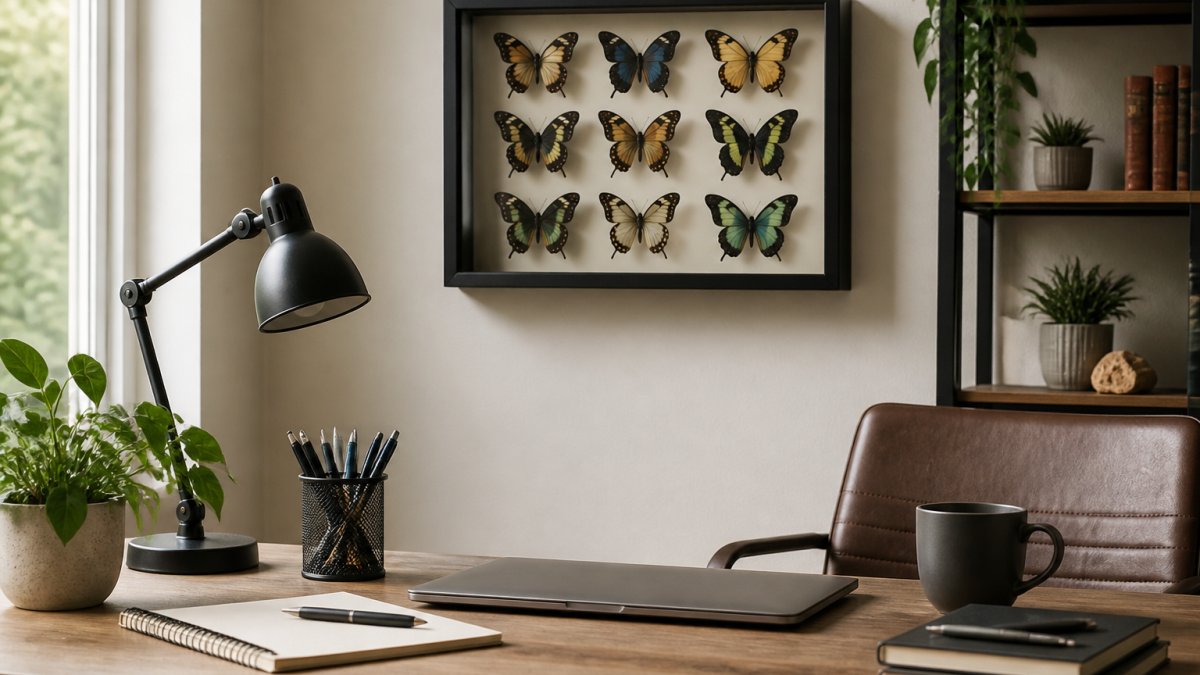
A few styling principles hold up across most desks:
- Anchor, don't scatter. One larger frame reads as intentional. Five small ones read as clutter. If you want more than one piece, group them as a single composition rather than distributing them around the room.
- Match the frame to the furniture. A black shadowbox frame suits dark timber and metal; a wooden specimen box warms up lighter desks. Mismatched frame finishes are the most common reason a curated collection looks accidental.
- Leave breathing room. Aim for at least a hand's width of wall or shelf space on every side of the frame. Crowding a frame against a shelf edge or a monitor bezel flattens the three-dimensional effect the shadowbox is there to create.
- Group by theme, not by size. A butterfly and a beetle in matching frames look curated. Random sizes look accidental.
Placement mechanics that actually matter. For a wall-mounted frame, the centre should sit roughly at eye level when seated, commonly around 1.2 to 1.4 metres from the floor for a standard desk chair. Hanging it higher turns a restful focal point into a strain.
For a compact desk, a floating display case mounted on the wall above the monitor keeps the work surface clear. For a larger office, a glass dome on a side table or cabinet adds a 360-degree view and works as a conversation piece when you take calls.
The video-call test. If you work on camera, your specimen appears in every meeting. Place it off-centre; directly behind your head, it competes with your face; to the side, it frames you. Check how it reads under your actual lighting: iridescent wing scales can flare or go flat depending on the angle of a desk lamp, so look through your webcam preview before committing.
Choosing the Right Butterfly Specimen for Small Spaces
Compact decor works best when the piece is chosen for the space, not the other way around. In a small home office, scale and proportion decide whether a specimen looks considered or accidental.
A 10x15 cm shadowbox frame is a safe starting point for a narrow desk or a short shelf. A 20x25 cm frame suits a wall above a monitor or a larger cabinet. Glass domes work well where you have depth rather than width.
| Space available | Recommended format | Typical piece size | Best placement |
|---|---|---|---|
| Narrow desk or short shelf | Small shadowbox frame | 10x15 cm | Beside monitor, upright |
| Wall above a desk | Medium shadowbox frame | 20x25 cm | Centred above workspace |
| Side table or cabinet | Glass dome | 18 cm diameter | Freestanding, 360-degree view |
| Open shelving | Multi-specimen dome | 25 x 12.5 cm | Statement shelf, low traffic |
The Blue Triangle Butterfly in a Frame is a good example of a compact piece that still carries real presence. The Monarch Butterfly in a Frame offers a similarly small footprint with one of the most recognisable wing patterns in nature.

Scale is not only about size. Colour weight matters too. A vivid blue specimen in a small frame can hold a wall the way a larger, muted print cannot.
Ethical Sourcing of Insect Specimens and Conservation
Ethical sourcing of insect specimens means buying from suppliers who can explain where each specimen came from and how it was obtained. If a seller cannot answer plainly, treat it as a warning sign.
The question we hear most often is simple: how do you know these specimens are ethically sourced? It depends entirely on the supplier, and reputable ones are open about it.
Look for these markers:
- Captive-bred stock. Farmed or captive-bred butterflies reduce pressure on wild populations.
- Natural death. Specimens that died naturally, rather than being collected alive, are the standard for responsible sellers.
- Clear origin records. A seller should be able to name the species and its region.
- No endangered species. Protected or restricted species should never appear in general home decor.
Conservation and collecting are not opposites. Well-run butterfly farms can support habitat protection, and buying from them is more responsible than buying from an unverified source.
Protecting Butterfly Specimens: Lighting, Preservation and Cleaning
Preservation is straightforward once you understand the three main threats: ultraviolet light, moisture, and dust. Handle all three, and a museum-preserved specimen can hold its colour for many years – the one factor that decides whether your piece still looks sharp in five years.
Lighting. Keep specimens out of direct sunlight. UV radiation breaks down the pigments in butterfly wings, and the damage is cumulative; a piece catching a sunbeam for an hour a day will fade faster than one in steady indirect light.
Humidity. Damp conditions encourage mould and can warp mounting boards. Avoid placing specimens near bathrooms, kitchens, laundries, or anywhere with persistent condensation. In humid climates, keep the piece on an interior wall rather than an external one.
Dust, the office-specific problem. Dust is the main enemy of display clarity, and a home office generates more of it than a living room because of paper, fabric chairs, and constant air movement from fans and air conditioning. The protocol is simple but needs to be regular:
- Dust the frame exterior weekly with a soft, dry brush or a microfibre cloth. Work gently around the frame edges and the glazing.
- Never use a wet cloth or spray cleaner on the frame. Moisture can wick into the seal and reach the specimen.
- Never open a sealed frame to clean the specimen itself. Mounted wings are fragile and static-attract dust; once you disturb the mount, you cannot easily restore it.
- For a glass dome, lift it only if the base is designed for it, and dust the interior base with a dry brush rather than a cloth.
- Keep the piece away from high-traffic zones, doorways, printer areas, and anywhere people brush past, to reduce both dust and knock risk.
| Risk | Cause | Prevention |
|---|---|---|
| Colour fading | UV light from direct sun | Keep out of direct sunlight; rotate away from beams |
| Mould growth | High humidity | Avoid damp rooms; use an interior wall |
| Dust build-up | Office air movement, paper, fabric | Dust frame exterior weekly with a dry brush |
| Physical damage | Handling or knocks | Mount securely, avoid high-traffic spots |
Real versus faux, and why it matters for care. A real preserved specimen needs the light, humidity, and dust controls above.
Ethical sourcing is part of preservation. A specimen with a clear origin record is easier to care for because you know its age and how it was mounted. Ask where it originated and whether it was captive bred; reputable sellers answer both without hesitation.
When these pieces are preserved well, the colours hold. Our framed butterflies are real and preserved to last for up to 20 years or more.
Frequently Asked Questions
Are butterfly specimens ethical to display in a home office?
Ethical display depends on where the specimens come from. Look for pieces where butterflies are captive bred and died naturally, rather than wild-caught. Newman Art Designs states its butterflies are captive bred and died naturally, and each piece is preserved and mounted in Australia. Asking a seller directly about sourcing is the simplest way to confirm a specimen was not taken from the wild or from an endangered population.
How do I care for framed butterfly specimens so they last?
Keep framed butterfly specimens out of direct sunlight, since UV exposure fades wing colours over time. Hang them away from humid areas such as bathrooms or kitchens, and dust gently with a soft dry brush rather than a damp cloth. Newman Art Designs notes its preserved butterflies can last 20 years or more with sensible care, so placement matters more than frequent cleaning.
Do butterfly displays help reduce stress in a workspace?
Many people find nature-inspired decor calming, which is part of why biophilic interior design has grown in popularity for home offices. A preserved butterfly specimen gives the eye somewhere restful to land between tasks, and the natural colours and patterns add visual interest without the upkeep of a living plant. The effect is personal, so try one piece first and see how it sits in your space.
What is the best way to display butterfly specimens in a small home office?
Small spaces suit compact pieces such as a 10x15 cm shadowbox frame or a small glass dome on a desk or shelf. Newman Art Designs offers framed specimens from $69.95 and domes from $99.95, so you can add natural history display without needing much wall space. Group two or three small pieces at different heights to create a focal point rather than spreading them across the room.
A home office should feel like yours, not like a generic workstation. If you want nature-inspired art that holds its colour and earns its place on the wall, Newman Art Designs offers museum-quality preservation, ethically sourced specimens, and free shipping across Australia. Our collection includes framed butterflies, glass domes, and multi-specimen pieces, each built to last. Get started with Newman Art Designs and bring a genuine natural history display into your workspace.
