
Best Museum Quality Butterfly Shadow Boxes: 2026 Guide
Table of Contents
- What Makes a Butterfly Shadow Box Museum Quality?
- Quick Comparison: Museum Quality Butterfly Shadow Boxes
- Top Picks: Real Butterfly Specimens in Shadow Box Frames
- Butterfly Display Case Materials: Glass, Plexiglass, and Wooden Frames
- How to Mount Butterfly Specimens for a Clean, Lasting Display
- How to Preserve Butterflies for Display: Colour, Shape, and Long-Term Care
- Protecting Insect Specimens from Light and Dust
- Sourcing, Ethics, and What to Ask Before You Buy
- Frequently Asked Questions
Last Updated: October 18, 2026
What Makes a Butterfly Shadow Box Museum Quality?
Museum quality butterfly shadow boxes are sealed, archival displays built to protect a real specimen from light, dust and humidity for decades, not months. At Newman Art Designs, we build to that standard.
Most cheap framed displays fail on three points. The specimen sits against the glass, the mount is glued rather than pinned, and the backing off-gasses into the wings. Any one of those shortens the life of a piece dramatically.
Museum quality means the specimen can be handled, moved and displayed without damage. It also means the colours stay true.
Below, we break down what separates a genuine archival piece from decorative taxidermy, compare our range side by side, and explain how to care for a specimen so it lasts. The five frames we cover start at $69.95, so there is an entry point for most budgets.
Quick Comparison: Museum Quality Butterfly Shadow Boxes
The table below compares every frame in our range on size and price. Prices are in AUD and include free shipping within Australia.
| Frame | Specimen | Size | Price | Best For |
|---|---|---|---|---|
| Morpho didius | Blue Morpho, Peru | 8" x 10" | $114.95 | Statement wall pieces |
| Double Papilio ulysses | Two Blue Ulysses, Indonesia | 8" x 10" | $119.95 | Symmetry and scale |
| Papilio maackii (Spring) | Black Alpine, Southeast Asia | 4" x 6" | $69.95 | Gifts and small spaces |
| Papilio maackii (Summer) | Black Alpine, Southeast Asia | 6" x 6" | $69.95 | Square shelf displays |
| Monarch, Scarlet Mormon, Red Glider | Various | 4" x 6" to 5" x 7" | $69.95 | Colour contrast |
| Owl Butterfly | Caligo eurilochus, Peru | 5" x 7" | $79.95 | Conversation starters |
| Sea Green Swallowtail | Papilio lorquinianus, Indonesia | 5" x 7" | $89.95 | Turquoise accent pieces |
Every frame is a black shadow box.

Top Picks: Real Butterfly Specimens in Shadow Box Frames
Our range covers a wide spread of species, sizes and price points. Each piece is a real butterfly, preserved and mounted by hand.
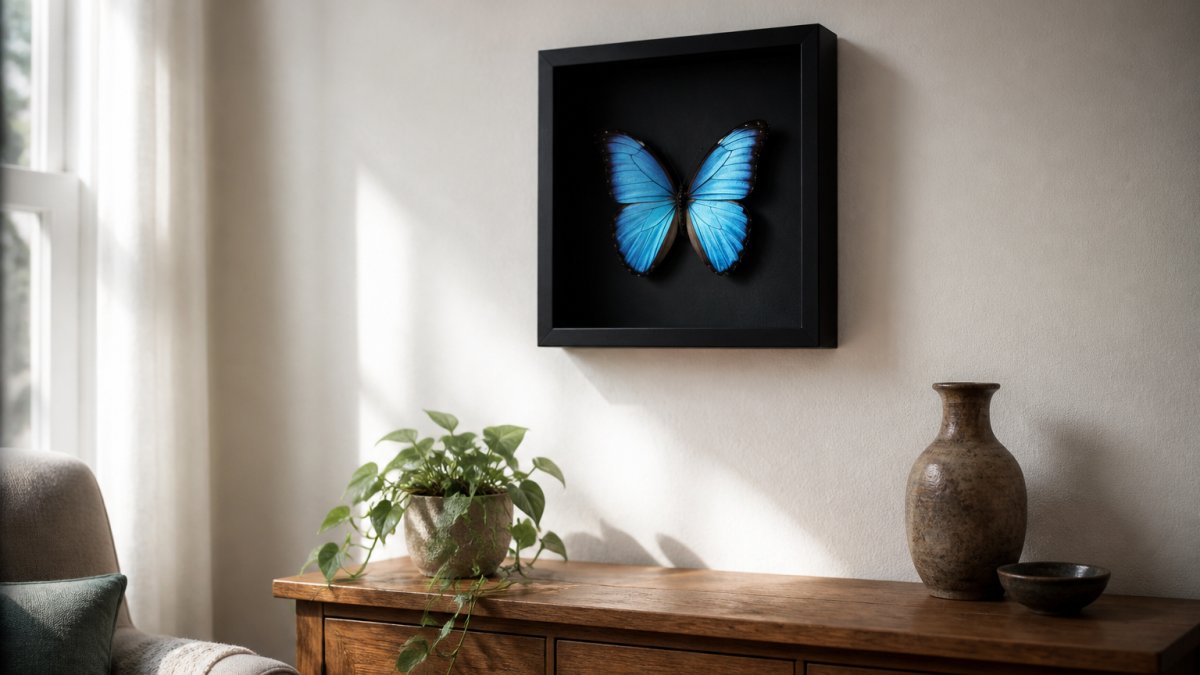
Morpho didius Butterfly in a Frame
Our top pick for impact is the Morpho didius, an 8" x 10" shadow box at $114.95. The blue is not pigment: the wing scales are structured to reflect light, so the colour shifts as you move past it. That is why a Morpho reads as metallic rather than painted.
The 8" x 10" format gives the wings room to breathe inside the frame, which is exactly what a museum mount needs.
Double Papilio ulysses Butterflies in a Frame
Two Blue Ulysses butterflies, mounted as a mirrored pair in an 8" x 10" frame at $119.95. The male's iridescent blue sits hard against the black backing, and the symmetry makes this the strongest option for a hallway or above a bed.
It is one of the most popular Australasian butterflies, and the double mount turns a specimen into a composition.
Papilio maackii in a Frame (Spring and Summer Species)
The Black Alpine butterfly carries thousands of iridescent green and blue scales that form neon-like waves across the wings. We offer two versions at $69.95 each: a 4" x 6" spring specimen and a 6" x 6" summer specimen.
The square summer frame suits a shelf or a stack of books. The smaller spring frame is the better gift size.
Monarch, Scarlet Mormon, and Red Glider Frames
Red is rare in the butterfly world, which makes the Scarlet Mormon and Red Glider stand out in any collection. Both are $69.95. The Scarlet Mormon pairs deep red with black borders, while the Red Glider carries almost fully red wings.
The Monarch at $69.95 is the most recognisable butterfly in the range, and its orange and black pattern suits a warm-toned room. All three are 4" x 6" to 5" x 7", so they work in small apartments.
Owl Butterfly and Sea Green Swallowtail Frames
The Owl Butterfly ($79.95) shows large yellow-ringed eyespots on a 5" x 7" mount, and it is a genuine talking point for guests. The Sea Green Swallowtail ($89.95) brings bright turquoise wings that read almost like a coastal painting.
Both are sealed in a black shadow box.
Butterfly Display Case Materials: Glass, Plexiglass, and Wooden Frames
Butterfly display case materials decide how long a specimen lasts. The three components that matter are the glazing, the frame and the backing board.
Glazing. Glass gives the clearest view and resists scratching, but it is heavy and breaks. Plexiglass is lighter and safer in a home with children, though it scratches more easily. Both can be made with UV-blocking properties, and that matters more than the choice between them.
Frame. The frame itself should be solid wood rather than particleboard. Wood holds its shape, resists warping in humid rooms, and can be repaired if a corner takes a knock. Handmade craftsmanship shows in the joints: tight mitres, no filler, and a back that seats flush.
Backing board. The backing must be acid-free. Standard cardboard off-gasses over time and stains the wings. A reversible mount fixed to an acid-free board with pins, rather than glue, is the archival standard because the specimen can be removed or repositioned without damage.
Seal. A sealed construction blocks dust, moisture and pests. Look for a close-fitting back and a frame that can be opened for inspection without destroying the mount.
A practical test before you buy: ask the seller what the glazing blocks, whether the backing is acid-free, and whether the mount is pinned or glued.
Morpho didius Butterfly in a Frame →
How to Mount Butterfly Specimens for a Clean, Lasting Display
Mounting is where most displays succeed or fail. The specimen must be held firm without adhesive touching the wings.
- Rehydrate the specimen in a sealed container with damp paper for a day so the joints move without cracking.
- Pin the body, not the wings. A single pin through the thorax holds the insect while the wings are positioned.
- Spread the wings on a flat board with strips of paper and pins, then leave them to set in position.
- Fix the mount to an acid-free backing board using pins or a hidden support behind the body.
- Seal the frame so dust and moisture cannot reach the specimen.
The pin-through-thorax method is the archival standard because it is reversible. Glue is not.
How to Preserve Butterflies for Display: Colour, Shape, and Long-Term Care
Preservation comes down to controlling three things: light, humidity and pests. Get those right and a specimen holds its natural colour and shape for decades.
Light. UV exposure bleaches pigments and breaks down scales. Keep frames out of direct sun and away from strong spotlights. UV-blocking glazing slows fading but does not stop it, so position is the first defence.
Humidity. Mould becomes a risk as humidity climbs. A dry room with stable conditions is ideal, and a sealed frame does most of the work. Avoid walls that stay damp, such as bathroom walls, and keep frames away from kettles, stoves and heaters where steam rises.
Pests. Museum beetles and carpet beetles will eat a specimen if they can reach it. A sealed case blocks them entirely.
Cleaning. Dust the outside of the glass with a dry microfibre cloth. Never open the frame. Never spray cleaner onto the glazing, because liquid can track behind the seal.
Repairability. A museum-quality mount is reversible. If a specimen shifts or a frame corner takes a knock, a pinned mount on acid-free board can be opened, corrected and resealed. A glued mount cannot. Ask before you buy whether the frame can be opened without damaging the butterfly.
Protecting Insect Specimens from Light and Dust
Protecting insect specimens from light and dust is a placement decision as much as a materials one. The right wall matters as much as the right frame.
- Hang away from windows that receive direct afternoon sun
- Avoid positioning above heaters, kettles or stoves where steam rises
- Keep frames off walls that stay damp, such as bathroom walls
- Dust the outside only, with a dry cloth
- Check the seal once a year for gaps
UV-blocking glazing slows fading, but it does not stop it. A frame in constant direct sun will still lose colour over years. Position is the first defence.
For collectors building a wall of pieces, rotate them every few months so no single frame takes a full season of light.
Sourcing, Ethics, and What to Ask Before You Buy
Sourcing is the question buyers should ask first, and the one most sellers avoid. A responsible supplier can tell you the species, the country of origin and how the specimen was obtained.
Ask these before you buy:
- Which species is this, and where was it collected?
- Was it farmed, ranched or wild-caught under a permit?
- Can you confirm the specimen is not from a protected population?
- Is the mount reversible, or is it glued?
- What is the return policy if the piece arrives damaged?
At Newman Art Designs, every frame lists the species and origin, and pieces are packed to survive shipping. One customer noted the "frame is pretty solid", and another said "the shipping was impeccable".
A $69.95 frame and a $119.95 frame differ in specimen size and rarity.
Frequently Asked Questions
What makes a butterfly shadow box museum quality?
Museum quality comes down to four things: a real, properly mounted specimen with wings set symmetrically, archival materials that won't yellow or off-gas, and a sealed shadow box that keeps dust and humidity out. Ask the seller how the specimen is mounted and what the glazing blocks before you buy.
How do I preserve butterflies for display once they're in a frame?
Keep the frame out of direct sun, since UV light fades wing scales faster than anything else. Hang it away from kitchens and bathrooms where steam raises humidity, and avoid spots above heaters. Dust the outside of the glass with a dry microfibre cloth rather than spraying cleaner near the frame. If the seal looks loose, have it resealed rather than opening the box yourself.
Is butterfly taxidermy ethical, and how do I check sourcing?
Ethical sourcing means farmed or legally collected specimens, not wild-caught endangered species. Australia regulates wildlife trade under the Environment Protection and Biodiversity Conservation Act 1999, and imports need the right permits. A reputable seller will tell you the species, country of origin, and whether it was farm-raised. If a seller can't answer those questions, walk away.
Can I clean a butterfly shadow box without damaging the specimen?
Clean only the outside. Use a dry microfibre cloth on the glass and a soft brush on the frame edges. Never spray liquid cleaner onto the glass, because mist can seep through gaps and stain wing scales. Never open the box to reach the specimen, as the scales are fragile and static from cloths can lift them. If dust has got inside, take it to a framer for professional cleaning.
What's the difference between glass and plexiglass in a butterfly display case?
Glass is heavier, scratch-resistant, and gives a clearer view, but it shatters if dropped. Plexiglass is lighter and safer for shipping, especially for wall-mounted pieces, but it scratches more easily and can build up static. Both work well when they block UV. For a framed butterfly that will hang in a bright room, UV-blocking glazing matters more than which material you choose.
Choosing a butterfly shadow box comes down to three checks: a sealed wooden frame, UV-filtering glazing, and a reversible mount. Get those right and the piece will outlast the decor around it.
At Newman Art Designs, we have been preserving specimens since 1996, and every frame is handmade in Australia with free shipping. Browse our range of real butterfly specimens in shadow box frames and find the piece that suits your wall.
