
Best Butterfly Specimen Shop Australia: 2026 Guide
Table of Contents
- Quick Comparison: Butterfly Specimens at a Glance
- What Makes a Butterfly Specimen Shop Worth Buying From
- Ethical Butterfly Specimens: How to Verify Responsible Sourcing
- Framed Insect Wall Art: Choosing the Right Display for Your Space
- How to Preserve Butterfly Specimens So They Last for Decades
- Biosecurity and Import Rules for Butterfly Specimens
- Conclusion: Choosing the Best Butterfly Specimen Shop in Australia
- Frequently Asked Questions
Last Updated: September 23, 2026
Quick Comparison: Butterfly Specimens at a Glance
Buying from a butterfly specimen shop sight-unseen comes down to three things: preservation, mounting, and verifiable sourcing. At Newman Art Designs, we have mounted and sold museum-preserved specimens since 1996. A good butterfly specimen shop shows you its preservation method, sourcing paperwork, and frame construction before you pay. Below, we break down what separates a lasting piece from a faded one, plus the biosecurity rules that catch first-time collectors off guard.
| Piece | Size | Price | Best For |
|---|---|---|---|
| Papilio palinurus in a Black Frame | 5" x 7" | $69.95 | First piece, small walls |
| King Swallowtail in a Frame | 5" x 7" | $69.95 | Strong colour contrast |
| Papilio ulysses Butterfly Frame | 8" x 10" | $79.95 | Native species appeal |
| Peacock paris Double in a Frame | 6" x 8" | $94.95 | Symmetry, paired display |
| Papilio ulysses in a Dome | 7" dome | $109.95 | Shelf and sideboard styling |
| Morpho didius Butterfly in a Frame | 8" x 10" | $114.95 | Statement wall pieces |
| Swallowtail Swirl | 8" x 10" | $139.95 | Multi-species collectors |
What Makes a Butterfly Specimen Shop Worth Buying From
A butterfly specimen shop earns its reputation on preservation standards, not listing count. Anyone can photograph a dried butterfly against a white background; far fewer can explain how the wings were set, what the frame is made from, or where the specimen originated.

Preservation Standards and Museum-Quality Mounting
Museum-quality mounting means the specimen was rehydrated, positioned on a spreading board, and pinned with entomological pins before the wings dried in their final pose. Skipping rehydration is the most common shortcut, and it shows: wings sit stiff and slightly cupped instead of flat.
Pricing, Sizing, and What You Get for Your Money
Small framed specimens generally sit in the $70 to $80 range, mid-size paired mounts run closer to $95, and larger statement frames or glass domes start around $110.
Ethical Butterfly Specimens: How to Verify Responsible Sourcing
Ethical butterfly specimens come from licensed butterfly farms and ranching programs, not wild-caught populations.
Here is how to check a seller's claims:
- Ask for the country of origin for each species
- Confirm whether the specimen came from a farm, a ranch, or wild collection
- Check that the species is not CITES-listed or otherwise restricted
- Look for a seller who names the species, not just the common name
- Treat vague "sustainably sourced" claims with no origin detail as a red flag
Framed Insect Wall Art: Choosing the Right Display for Your Space
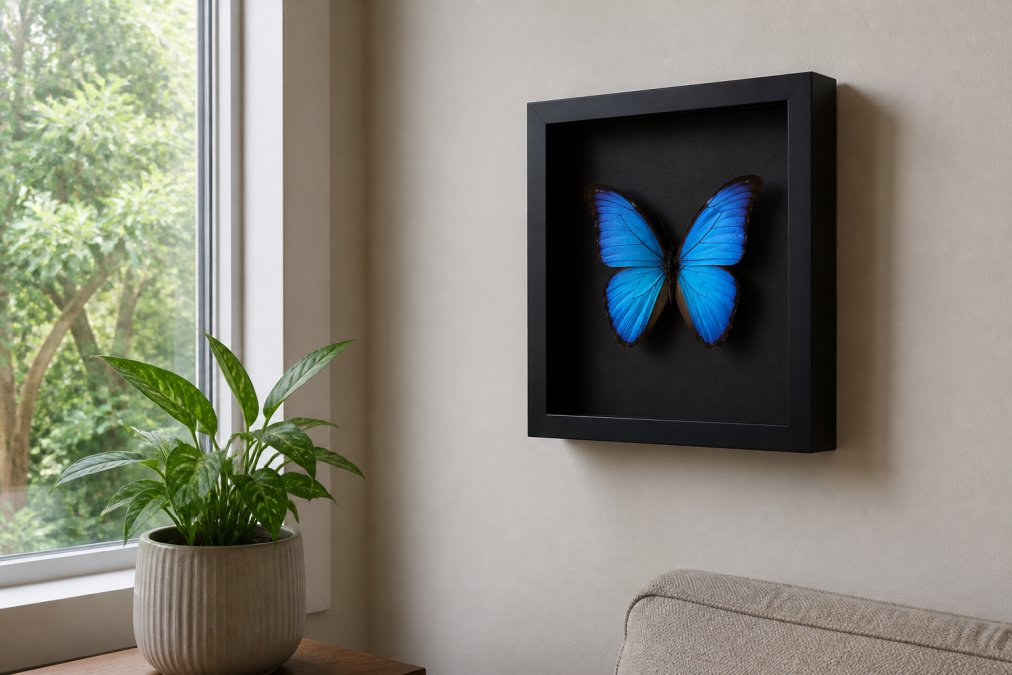
Framed insect wall art works best when the frame format matches the wall. A single 8" x 10" shadow box anchors a narrow hallway; a trio of 5" x 7" frames fills a wider space without crowding it.
How to Preserve Butterfly Specimens So They Last for Decades
Preserving butterfly specimens at home comes down to four variables: light, humidity, pests, and handling. Get them right and a properly mounted specimen holds its colour for decades; get them wrong and even a museum-grade mount degrades within a few years.
Light: The Fastest Killer of Colour
Direct sunlight is the biggest threat to iridescent pigments. The structural blues and greens on a Morpho didius or Papilio ulysses fade fastest under UV because the colour comes from microscopic wing structures, not pigment alone. Keep frames out of direct sun.
Humidity: The Slow, Structural Damage
Damp air encourages mould and warps wings away from the mounting surface. In coastal homes, a sealed shadow box is the difference between a piece that lasts and one that needs replacing. Humidity damage shows as a musty smell when the frame is opened, wings that no longer sit flat, and condensation inside the glass after temperature swings.
Pests: The Specific Threats
Two pests do most of the damage to home collections:
- Dermestid beetles (also called carpet beetles), the larvae feed on dried animal material, including wing scales and the dried body. Look for fine dust beneath a frame, shed larval skins, or small holes in the specimen.
- Clothes moths, the larvae will attack dried insect material stored in dark, undisturbed places, particularly in wardrobes and drawers.
A Practical Care Routine
- Dust frames with a dry microfibre cloth, never a wet one
- Keep pieces at least a metre from heaters and air conditioning vents
- Check sealed frames every few months for condensation
- Store spare specimens with silica gel in an airtight container
- Inspect open displays for pest dust or shed larval skins every two to three months
Rehydrating and Re-Pinning a Dried Specimen
If you buy a dried, unmounted specimen, or want to reposition one that has slipped, the process is straightforward but needs patience. This is the same rehydration step that separates a museum-quality mount from a cheap one.
Morpho didius Butterfly in a Frame →
- Relax the specimen. Place it in a sealed container with a damp (not wet) paper towel or a piece of damp foam. Do not let the specimen touch the water. Leave it for 24 to 48 hours until the wings and body move freely without cracking.
- Set up a spreading board. A spreading board has a central groove for the body and adjustable sides for the wings. Pin the specimen in the groove with an entomological pin through the thorax.
- Position the wings. Use strips of greaseproof paper pinned over each wing to hold it flat against the board. Gently draw the forewing forward until its trailing edge is perpendicular to the body, then bring the hindwing forward so it sits naturally beneath the forewing.
- Pin and dry. Pin the paper strips in place and leave the specimen to dry for one to two weeks in a dry, dust-free spot away from direct sun.
- Mount. Once dry, transfer the specimen to your shadow box or dome, pinning or gluing the thorax only, never the wings.
Storage for Spare Specimens
Unmounted spares belong in an airtight container with silica gel, away from light and heat. Add a pest strip or a few cloves for long-term storage and check every few months. Never store dried specimens in a cardboard box in a garage or shed, that invites dermestids.
Biosecurity and Import Rules for Butterfly Specimens
Importing butterfly specimens into Australia is governed by biosecurity law, and the rules turn on a distinction most overseas sellers never explain: whether the specimen is a preserved, dried, mounted article for display or raw biological material that could carry pests, seeds, or pathogens. The first is often treated as a finished good; the second almost always triggers a permit and inspection. Getting this wrong is why parcels get held.
The framework sits across three layers:
- Biosecurity legislation and the Biosecurity Act 2015 set the baseline that all arriving goods must be free of biosecurity risk, and give officers powers to inspect, treat, hold, or destroy goods that fail.
- The Department of Agriculture, Fisheries and Forestry administers import permits and the conditions attached to biological specimens, including preserved insects.
- The Australian Border Force enforces those conditions at the border and can refer a consignment for assessment.
What Actually Determines Whether Your Parcel Clears
Four things decide the outcome, in this order:
- Species status. Is the species CITES-listed, protected under Australian law, or unrestricted? The seller should be able to name the species, not just the common name, so you can check.
- Permit coverage. Does the shipment carry the export permit from the origin country and, where required, an Australian import permit? Both must match the species and quantity in the box.
- Presentation. Is the specimen fully dried, mounted, and sealed, or is it loose material? Sealed, finished display pieces present a lower biosecurity profile than loose dried insects.
- Declaration. Is the contents accurately declared on the customs documentation? Misdeclaration is the fastest route to a hold, even when the specimen itself is fine.
The Local-Buyer Advantage
This is the strongest practical argument for buying from a local seller who has already cleared the import process. When a shop imports in bulk under its own permits and biosecurity arrangements, the compliance burden moves off you entirely. You are buying a domestic product, not managing an international shipment.
- Can they name the species and the country of origin?
- Can they confirm whether the species is CITES-listed or otherwise restricted?
- For overseas orders, can they supply the export permit reference and confirm import permit coverage?
- Is the specimen fully dried, mounted, and sealed for transit?
- Will the customs declaration match the contents exactly?
Conclusion: Choosing the Best Butterfly Specimen Shop in Australia
The best butterfly specimen shop answers three questions without hesitation: how was this specimen preserved, where did it come from, and is the import paperwork in order? Everything else, from frame size to species choice, is personal taste.
Frequently Asked Questions
Are butterfly specimens sold in shops ethically sourced?
Not all of them, so it pays to check before buying. Ethical butterfly specimens typically come from butterfly farming or ranching programs, where the insects are bred specifically for sale and the surrounding habitat is protected as a result. Ask the seller where their specimens originate. For example, the Papilio ulysses sold by Newman Art Designs comes from an Indonesian breeding program that supports the species' survival. If a shop cannot explain its sourcing, treat that as a warning sign.
How should I display my framed butterfly specimens?
Keep framed insect wall art out of direct sunlight, because UV rays will fade wing colours over time. A hallway, bedroom, or shaded living room wall works well. Avoid hanging pieces above heaters, stoves, or in bathrooms where humidity swings cause condensation inside the frame. Shadowbox frames and glass domes both protect specimens from dust and physical damage, so either display type is a solid choice for long-term protection.
How do I care for preserved butterfly specimens to prevent damage?
Keep them dry, cool, and out of direct sun. Dust the outside of the frame or dome with a soft, dry microfibre cloth rather than spraying liquid cleaner near the glass. If you own unmounted or dried butterflies, store them in a sealed container with silica gel to control moisture. Handled this way, a well-mounted specimen can stay in display condition for many years.
Are there restrictions on importing insect specimens?
Yes. Australia has strict biosecurity rules, and imported insect specimens must meet Department of Agriculture, Fisheries and Forestry requirements. Many sellers already handle this by sourcing from established breeding programs and supplying specimens that comply with import conditions. If you are buying from an overseas seller directly, check what documentation they provide. Buying from a local shop that has already managed the import process removes that burden from you.
What is the difference between mounted and unmounted specimens?
Mounted specimens arrive pinned and positioned in a display frame or dome, ready to hang or place on a shelf. Unmounted specimens, also called dried or papered butterflies, come with folded wings. Mounted pieces suit buyers who want decor they can enjoy immediately. Unmounted specimens appeal to hobbyists who want to practise entomology skills or create their own compositions.
