
Display Insects in Apartments: A Complete Guide
Table of Contents
- Why Display Insects in Your Apartment
- Choosing the Right Display Case: Shadowboxes vs. Glass Domes
- Insect Pinning Techniques for Beginners
- How to Prevent Mould in Insect Collections
- Space-Saving Display Solutions for Small Apartments
- Arranging and Lighting Your Insect Display
- Protecting Your Collection from Pests and Damage
- Frequently Asked Questions
Last Updated: September 24, 2026
Why Display Insects in Your Apartment
Insects are extraordinary; their colours, patterns, and structures rival any painting or sculpture. Once you see a preserved butterfly up close, you understand why.
Displaying insects in your apartment transforms how you see the natural world and sparks conversation. Visitors notice and ask questions. Your home tells a story about curiosity and beauty.
At Newman Art Designs, we've spent decades curating museum-quality specimens for homes and collections.
Choosing the Right Display Case: Shadowboxes vs. Glass Domes
Your choice between a shadowbox frame and a glass dome shapes everything else.
Shadowbox frames are flat, wall-mounted cases with a backing board. They hang like artwork, use vertical wall space, and sit specimens against dark backgrounds that make colours pop. Multiple frames arrange easily in a gallery layout.
Insect Pinning Techniques for Beginners
Proper pinning preserves specimens for decades; bad pinning damages them.
Insect pinning basics:
- Use entomological pins (size 2 or 3 for most butterflies and beetles); they're thinner and sharper than sewing needles.
- Pin through the thorax (middle section between head and abdomen), the only safe place. Pinning through wings or legs damages the specimen.
- Pin straight down using a pin holder to keep it vertical.
- Space the pin about one-third down from the head.
- Let it dry 24-48 hours before moving.
- Mount on archival board inside your frame or dome to prevent degradation.
How to Prevent Mould in Insect Collections
Mould is the silent killer of insect collections. It thrives in humidity from showers, cooking, and breathing. Your display needs to stay dry.
Practical steps:
- Use silica gel packets inside frames or domes; replace every 3-6 months.
- Avoid damp rooms (bathrooms, kitchens); choose bedrooms, living rooms, or offices.
- Ensure air circulation by opening windows regularly.
- Seal cases tightly so no gaps allow moisture in.
- Check monthly for white fuzz on specimens or inside cases.
Space-Saving Display Solutions for Small Apartments
Damage-free mounting for renters:
- Adhesive strips and hooks: Heavy-duty removable strips (3M Command, rated to 5 kg) hold frames without marks. Clean walls with rubbing alcohol, press firmly for 30 seconds, wait 24 hours before hanging.
- Tension rods and wire systems: Mount rods between walls or use picture rails; hang frames with wire or fishing line.
- Leaning frames: Rest shadowboxes on narrow shelves angled slightly forward for a gallery effect.
- Freestanding stands: Metal or wooden easels hold frames upright on shelves or tables.
- Over-the-door hooks: Adhesive hooks hold lightweight frames in hallways.
Vertical space optimisation:
- Gallery clusters: Group 3-5 frames in staggered vertical patterns using adhesive strips. Odd numbers feel more intentional; vary heights for dynamic arrangement.
- Floating shelves: Narrow shelves (15-20 cm) with adhesive brackets hold 2-3 domes. Allow adhesive to cure 24 hours before placing specimens.
- Corner displays: Mount shelves in corners or lean frames against corner walls.
- Over-the-desk displays: Mount frames above desks at eye level for visibility without floor space.
- Under-window ledges: Place domes on windowsills away from direct sunlight to show off colours naturally.
Clustering and visual weight:
Test before committing: hang one frame for a week. If it holds, add more. If it shifts, try different adhesive or mounting methods, as wall surfaces (plaster, drywall, textured paint) respond differently.
Arranging and Lighting Your Insect Display
Arrangement is where your display becomes art. Lighting is what makes it shine.
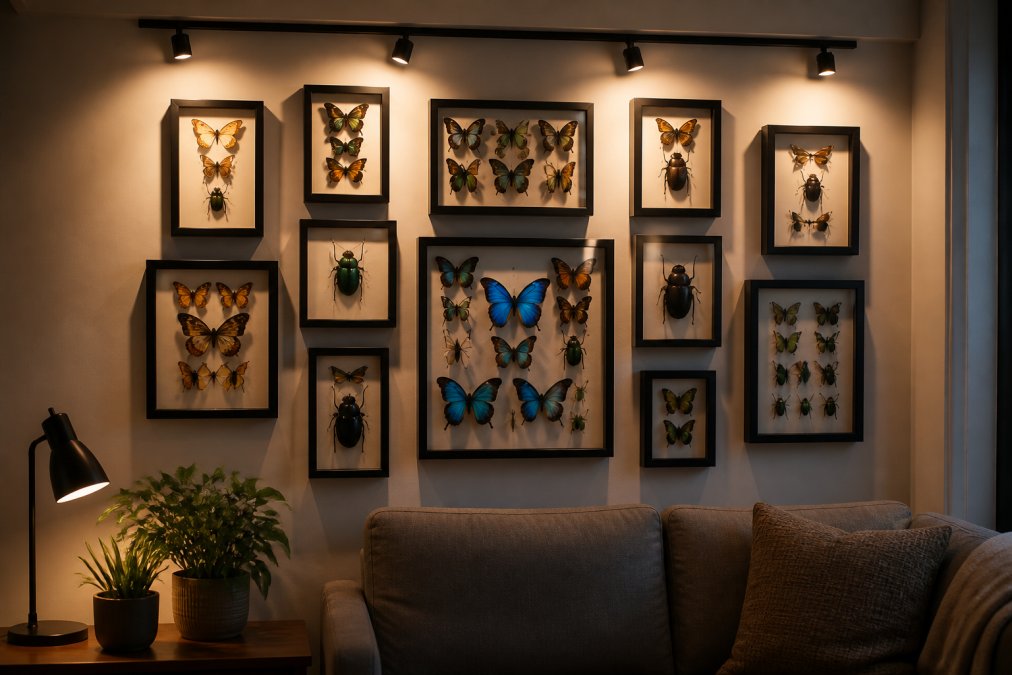
Arrangement principles:
Lighting matters enormously:
- Avoid direct sunlight (UV fades colours); use UV-filtering glass or sheer curtains if needed.
- Use ambient light (soft overhead or wall sconces) without harsh shadows or heat.
- Add accent lighting (picture lights or shelf lights) for drama.
- Consider background: dark walls make colours pop; light walls need stronger lighting.
Protecting Your Collection from Pests and Damage
Preserved insects can attract real insects. Unlike general apartment pest control, collection-specific pest-proofing targets the insects that eat dried specimens. Understanding which pests threaten your collection and how to prevent them is essential for long-term preservation.
Pests that threaten insect collections:
-
Dermestid beetles (carpet beetles). These are the primary threat to dried insect collections. Adult beetles are small (3-5 mm), often black or brown with a mottled pattern. Larvae are hairy and feed on dried organic matter, including preserved insects. They can reduce a specimen to dust in weeks if unchecked.
-
Mites. Dust mites and storage mites thrive in humid conditions and feed on dried insect material. They're invisible to the naked eye but leave a fine dust inside the case. High humidity (above 60%) accelerates mite reproduction.
-
Booklice (psocids). Tiny insects (1-2 mm) that feed on mould and dried organic material. They indicate high humidity and are often a sign that mould is also present.
-
Silverfish and firebrats. Less common in collections, but they feed on dried insects and paper. They prefer warm, humid environments.
How pests enter sealed cases:
Pest prevention inside sealed cases:
-
Seal completely. Shadowboxes must have a backing board that seals the specimen inside with no gaps. Glass domes must sit flush on their base. Even tiny gaps allow pests to enter. Check the seal regularly; if adhesive or rubber gaskets degrade, reseal the case.
-
Use cedar oil or cedar blocks. Cedar is a natural insect repellent. Place a small cedar block (roughly 2 cm × 2 cm) inside your frame or dome. Cedar oil volatilises over time, so replace blocks every 6-12 months. Cedar is safe for specimens and does not damage colours or materials.
-
Add silica gel packets. Beyond humidity control, silica gel creates a dry microclimate that discourages mites and booklice. Replace packets every 3-6 months or when they feel damp. Dry conditions (40-50% relative humidity) are hostile to most collection pests.
-
Avoid naphthalene and mothballs. These are toxic to humans and damage specimen colours. They are ineffective against dermestid beetles and should never be used in sealed cases.
Inspection and early detection:
Regular inspection catches infestations before they spread:
-
Monthly visual checks. Look inside the case for tiny holes in the specimen, fine dust (frass), or movement. Dermestid damage typically starts at the edges of wings or legs and spreads inward. Catch it early.
-
Check for mould. White fuzz or discolouration inside the case often indicates high humidity, which attracts mites and booklice. If you see mould, address humidity immediately (see the "How to Prevent Mould in Insect Collections" section).
-
Inspect the seal. Look for gaps, cracks, or degraded adhesive around the frame or dome edge. Reseal if needed.
-
Rotate specimens. If you have multiple frames, rotate their positions every 6 months. This helps you notice changes and ensures even light exposure.
Treatment if pests are detected:
If you spot pest damage or activity:
-
Remove the specimen immediately. Do not leave it in the case where pests can spread to other specimens.
-
Freeze the specimen. Place it in a sealed plastic bag and freeze at −18 °C for 48 hours. This kills all life stages of most collection pests.
-
Allow slow thawing. Remove the specimen from the freezer and let it thaw at room temperature for 24 hours inside the sealed bag. Rapid temperature changes can damage delicate structures.
-
Clean the case. Wipe the interior with a dry cloth. Vacuum any debris or frass. If mould is present, wipe with a cloth barely dampened with rubbing alcohol, then allow to dry completely.
-
Reseal with fresh materials. Replace silica gel packets and cedar blocks. Reseal the case and monitor closely for 2-4 weeks.
Handling and physical damage prevention:
-
Handle with forceps only. Never touch a specimen with bare hands. Oils and moisture from skin damage delicate wings, fade colours, and create entry points for mites.
-
Dust carefully. Use a soft brush or compressed air to gently clean the glass or acrylic dome exterior. Never wipe or brush the specimen itself; this can dislodge scales or damage wings.
-
Avoid temperature swings. Do not display insects near heating vents, air conditioning units, or windows where temperature fluctuates wildly. Extreme changes cause stress, material expansion and contraction, and can open tiny gaps in seals.
-
Transport carefully. If you move apartments, pack specimens in boxes with padding and bubble wrap. Do not let them shift during transport. Avoid leaving them in hot cars or unheated storage.
Sourcing specimens responsibly:
Frequently Asked Questions
What's the best way to display insects in a small apartment?
Glass domes and shadowbox frames are ideal for apartments because they take up minimal wall or shelf space whilst providing full specimen visibility. Domes work well on side tables or shelves, while shadowbox frames hang vertically on walls, making efficient use of limited space. Choose pieces sized appropriately for your room; compact displays suit tight spaces, whilst larger displays work in living areas with more wall availability.
How do I keep my insect collection safe from mould in humid apartments?
Mould thrives in moisture-rich environments. Use silica gel packets inside sealed display cases to absorb excess humidity, replacing them every 3-6 months depending on your climate. Ensure your shadowbox frames or domes have tight, airtight seals. Position displays away from bathrooms and windows where condensation accumulates.
Are preserved insects ethically sourced, and how can I verify this?
Reputable suppliers like Newman Art Designs source specimens from sustainable, legal channels, never from endangered species. Ask suppliers directly about their sourcing practices and certifications. Specimens are typically sourced from farms, captive breeding programmes, or natural deaths rather than wild collection. Newman Art Designs has been established since 1996 and maintains museum-quality preservation standards, ensuring ethical and legal sourcing throughout their collection.
How long do preserved insect specimens last in home displays?
Museum-quality preservation techniques ensure specimens last decades or longer when properly maintained. Colours remain vibrant if displays are kept away from direct sunlight, which causes fading over time. UV-protective glass in shadowbox frames extends specimen life significantly. Sealed, airtight domes protect against dehydration and pest damage. With proper humidity control and minimal handling, your display will remain stunning for many years.
