
Unique Spider Wall Art: 7 Stunning Framed Specimens
Table of Contents
- Why Choose Framed Spider Wall Art for Your Home
- The Benefits of Biophilic Decor in Bedrooms and Beyond
- What Makes Ethically Sourced Insect Wall Art Worth Investing In
- How to Style Insect Shadow Boxes in Any Room
- Caring for Your Spider Wall Art: Preservation and Placement
- Find Your Unique Spider Wall Art Piece
- Conclusion
- Frequently Asked Questions
Last Updated: September 9, 2026
Why Choose Framed Spider Wall Art for Your Home
Framed spider wall art transforms a creature many of us instinctively fear into a stunning centrepiece that sparks conversation. Unlike mass-produced prints, a real, museum-preserved specimen in a shadowbox frame brings texture, depth, and a genuine sense of wonder to any room. At Newman Art Designs, we specialise in high-quality, museum-preserved specimens, ensuring they remain as vibrant and intricate as the day they were curated.
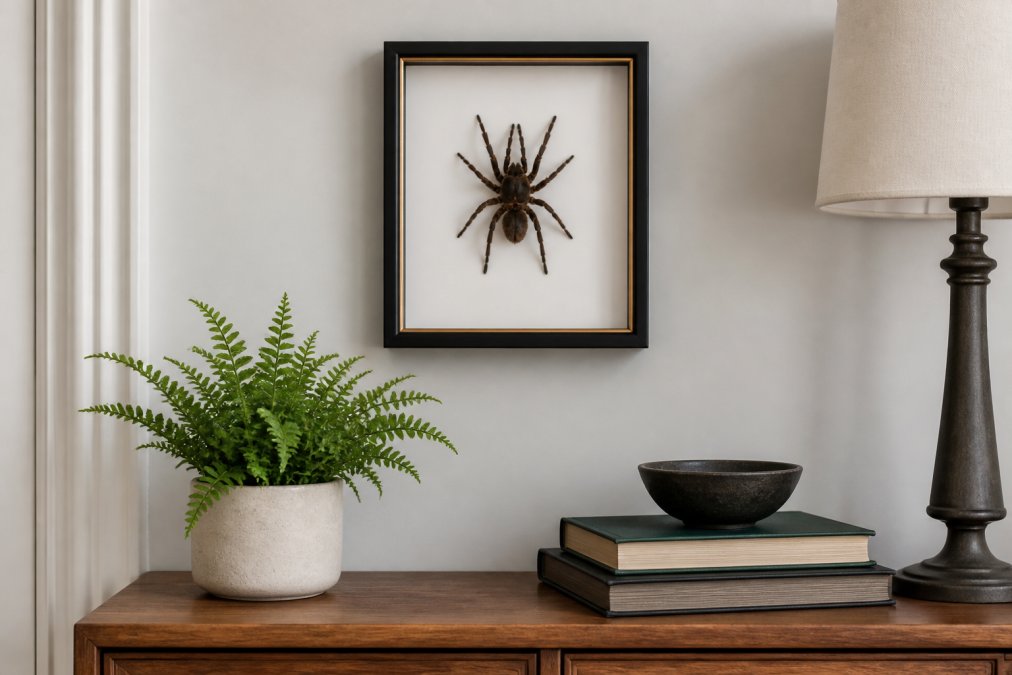
Framed spider wall art is a unique intersection of natural history and interior design, offering a piece that is simultaneously educational, aesthetic, and deeply personal. These pieces work particularly well in spaces where you want to create a focal point: above a reading chair, in a study, or as part of a gallery wall. The intricate anatomy of a spider, from its delicate legs to its often iridescent carapace, becomes a work of abstract art when viewed up close behind glass.
Below, we will show you exactly how to choose, style, and care for these remarkable pieces. But first, here is what most guides get wrong: they treat spider art as a novelty. In reality, it is one of the most versatile and sophisticated additions to a nature-inspired home.
The Benefits of Biophilic Decor in Bedrooms and Beyond
Biophilic decor is the practice of bringing elements of the natural world into your built environment to improve wellbeing and connection to nature. The benefits of biophilic decor in bedrooms and other living spaces extend beyond simple aesthetics, influencing mood, stress levels, and even creativity. A curated specimen offers a permanent, low-maintenance connection to the outdoors, unlike fresh botanicals that wilt or require constant care.
The benefits of biophilic decor in bedrooms are particularly notable, as this is your space for rest and reflection. A single, well-lit shadowbox featuring a striking spider can serve as a calming anchor for the room, drawing the eye away from screens and towards something contemplative. The organic forms and earthy tones of a framed specimen introduce a sense of calm and grounding that is difficult to achieve with synthetic materials.
What Makes Ethically Sourced Insect Wall Art Worth Investing In
The term 'ethically sourced' is thrown around loosely in the decor industry. To make an informed purchase, you need to understand the supply chain mechanics that separate a conservation-positive piece from a potentially harmful one.
The Farming vs. Wild-Caught Distinction
The vast majority of commercially available specimens fall into one of two categories:
-
Captive-Bred (Farmed): These specimens are raised in controlled environments, often in countries like Indonesia, Malaysia, or Papua New Guinea. The insects are bred in large mesh enclosures, fed on host plants, and harvested at the end of their natural lifespan. This is the gold standard for sustainability. When you buy captive-bred specimens, you are supporting a livelihood that gives local communities a financial incentive to preserve their forest habitat rather than clear it for palm oil or logging.
-
Sustainably Harvested Wild-Caught: This is a more nuanced category. In some regions, local collectors are permitted to harvest a limited number of specimens from the wild under government permit. This is only ethical if the harvest quota is scientifically determined to be non-detrimental to the local population. The key indicator here is provenance documentation. A reputable seller should be able to provide you with the export permit number or a certificate of origin.
Red Flags to Look For
- Vague Language: If a listing says 'imported' or 'exotic' without specifying the country of origin or the farming status, walk away.
- Endangered Species: Be aware of the Convention on International Trade in Endangered Species (CITES). If a species is listed under CITES Appendix I or II, it requires specific permits to cross international borders. A reputable seller will never offer a CITES-listed species without clearly stating the permit details. If you are buying within Australia, our strict biosecurity laws (administered by the Department of Agriculture, Fisheries and Forestry) require that all imported specimens be accompanied by a phytosanitary certificate. If a seller cannot provide this, the specimen may have been illegally smuggled, which is both unethical and a legal risk for you.
- Price Anomalies: If a price seems too good to be true for a rare species, it is likely either a low-quality farmed specimen or a wild-caught one that has not gone through proper channels.
Why This Matters for Your Purchase
When you buy from Newman Art Designs, every specimen is sourced exclusively from established breeding farms. We do not purchase wild-caught specimens. This ensures that your purchase actively contributes to habitat conservation by making the living forest more valuable than the cleared land. Furthermore, farmed specimens are often of higher quality because they are raised in optimal conditions, free from parasites and physical damage that wild specimens frequently sustain.
By understanding these mechanisms, you can confidently invest in a piece that is beautiful, legal, and genuinely beneficial to the ecosystems it came from.
How to Style Insect Shadow Boxes in Any Room
Styling insect shadow boxes is easier than you might think, and the key is to treat them as sculptural art rather than scientific curiosities. The benefits of biophilic decor in bedrooms and living areas are maximised when you consider scale, lighting, and grouping. A large specimen, such as a Morpho butterfly with its 8" x 10" frame, can stand alone as a bold statement, while smaller pieces work beautifully in a curated gallery wall.
To create a cohesive look, consider the existing palette of the room. A black shadowbox frame acts as a neutral anchor, complementing both minimalist white walls and darker, moodier interiors. For a dynamic display, mix pieces of varying depths and subjects. A 3D layered shadowbox that gives the specimen a sense of volume looks exceptional when paired with a flat, single-specimen frame. Use a picture light to highlight the iridescent scales of a butterfly or the textured exoskeleton of a spider, as this dramatically enhances the visual impact.
Caring for Your Spider Wall Art: Preservation and Placement
Most guides stop at 'hang it out of the sun,' but the reality of preserving a delicate arachnid specimen is far more involved. The top-ranking articles treat this as an afterthought; we are going to give you the maintenance protocol that museums use, adapted for the home.
The Three Enemies: UV, Humidity, and Pests
Your specimen's primary threats are not dust, but UV radiation, relative humidity (RH) fluctuations, and dermestid beetles.
-
UV Radiation: The exoskeletons of many spiders contain pigments that are highly susceptible to photodegradation. Even indirect sunlight through a window can cause fading over a period of months. A common pattern is that a specimen placed on a north-facing wall (in the Southern Hemisphere) will retain its colour for decades, while the same piece on a west-facing wall will show visible bleaching within two years. The glass in standard frames does not block UV light. You must either position the piece away from windows or use a frame fitted with museum-grade UV-filtering acrylic (not glass), which blocks over 99% of UV rays.
-
Humidity and Temperature: Spiders are largely composed of protein and chitin. In environments with high relative humidity (above 60%), the protein structures can soften, causing legs to droop or the abdomen to distort. In environments that are too dry (below 30%), the exoskeleton can become brittle and prone to cracking. The ideal range for insect preservation is 35% to 55% RH. Do not hang your piece on an exterior wall in an uninsulated home, as temperature differentials can cause condensation to form inside the frame. If you live in a humid climate, consider placing a small silica gel packet behind the backing board (not inside the specimen cavity) to act as a buffer.
-
Pest Infestation: The most insidious threat is the carpet beetle or dermestid beetle. These tiny insects can chew through the backing board and consume the dried tissue of the specimen. A sealed frame is your first defence, but if you notice tiny piles of dust inside the frame or missing setae (hairs) on the legs, you have an infestation. To prevent this, inspect your piece annually. If you see signs of pests, remove the specimen, freeze it in a sealed bag at -20°C for 72 hours to kill larvae, and re-pin it before resealing the frame.
The Annual Maintenance Checklist
To ensure your piece lasts for generations, adopt this simple annual routine:
- Dusting: Use a soft, anti-static brush (like a camera lens brush) to dust the glass and the frame moulding. Never use a wet cloth on the frame, as moisture can wick into the joints.
- Seal Check: Examine the seal between the glass and the frame. If you see any gaps, use a clear, acid-free silicone sealant to close them.
- Position Check: Observe the specimen for any signs of drooping or shifting. If a leg has moved, it is often easier to re-glue it with a tiny drop of water-based PVA glue rather than attempting to re-pin the entire specimen.
The Budget vs. Professional Framing Decision
If you are purchasing a high-value specimen, you have two options: a standard shadowbox or a professional archival frame. A standard shadowbox (typically $50-$150 AUD) uses a foam core backing and standard glass. This is fine for common species. However, for rare or large specimens, you should consider a professional framing service that offers conservation framing. This involves using acid-free mats, UV-filtering glass, and a sealed backing board. This service typically costs between $200 and $400 AUD per piece, but it guarantees that the specimen will not be degraded by the acidity of the backing materials over time. When buying from Newman Art Designs, all our frames are sealed with archival-grade materials, but if you are commissioning a custom piece elsewhere, always ask if the backing is acid-free.
By following this protocol, you move beyond simply 'hanging art' and become the custodian of a natural history artefact.
Find Your Unique Spider Wall Art Piece
Finding the perfect piece involves considering the species, the frame style, and how it will fit into your existing decor narrative. At Newman Art Designs, our collection of unique spider wall art is curated to offer variety, from the imposing presence of larger species to the delicate intricacy of smaller ones. Each specimen is mounted using museum-quality preservation techniques, ensuring its anatomy is displayed in a lifelike and respectful pose.
When selecting your piece, consider the scale of the wall and the surrounding furniture. A larger frame commands attention in a spacious living room, while a smaller, more delicate specimen suits a cosy reading nook or hallway. Our pieces are available in a range of sizes, and we offer free shipping across Australia, so your chosen artwork arrives safely at your door, ready to hang.
For those who appreciate the full spectrum of natural history, we also offer a wide variety of butterflies, beetles, scorpions, and snake skeletons in shadowbox frames or glass domes. This allows you to build a cohesive collection over time, creating a personalised natural history museum within your own home.
Conclusion
Choosing to buy unique spider wall art is an investment in a piece that blends art, science, and conversation. Whether you are drawn to the intricate patterns of a specific species or the bold statement of a larger frame, the key is to select a piece that resonates with you and place it where it can be appreciated daily. A quality, ethically sourced specimen will not only elevate your home decor but also serve as a lasting tribute to the beauty of the natural world.
Finding a trustworthy source is the most important step. Newman Art Designs has been crafting these pieces since 1996, combining museum-quality preservation with a passion for the natural world. Our collection is highly reviewed for its stunning quality and impeccable packaging, ensuring your new artwork arrives in perfect condition. Explore our range of ethically sourced, handcrafted pieces and find the perfect conversation starter for your home.
Frequently Asked Questions
Are museum-preserved spider specimens ethically sourced?
Yes. Our spider wall art uses specimens from sustainable breeding programs and reputable suppliers, never endangered species. We prioritise ethical sourcing for all our insect wall art, so you can enjoy your piece knowing it has not harmed wild populations. Each purchase supports responsible practices in the natural history trade.
How should I arrange spider shadow boxes in a gallery wall?
Group frames of varying sizes with consistent spacing of 5-8 cm. Mix a large statement piece, like an 8x10" frame, with smaller 4x6" pieces. Pair dark frames with botanical prints or neutral art to balance the visual weight. Consider eye level as your starting point and build outward for a cohesive display.
How do I keep my spider wall art looking its best?
Display your framed specimen away from direct sunlight to prevent fading. Avoid areas with high humidity like bathrooms. Dust the glass front gently with a soft, dry cloth. With proper care, your museum-quality piece will maintain its vibrant appearance for many years.
Why is framed spider decor more expensive than regular wall art?
Each piece involves ethically sourcing a real specimen, careful preservation, and professional framing in a shadowbox. The process is labour-intensive and designed to last. You are investing in a unique, museum-quality natural history piece that becomes a genuine conversation starter, unlike mass-produced prints.
Get started with Newman Art Designs and discover how a beautifully preserved specimen can transform your space with a touch of natural wonder.
