
Are Australian Spider Specimens Dangerous to Handle?
Table of Contents
- Are Australian Spider Specimens Dangerous to Handle?
- Live, Dead, and Preserved: Why the Distinction Matters
- Handling Preserved Spider Specimens Safely
- Can Dead Spiders Still Bite?
- Spider Specimen Preservation Methods
- Australian Spider Bite First Aid
- Which Australian Spiders Pose a Real Risk
- Children, Pets, and Allergies: Higher-Risk Situations
- Frequently Asked Questions
Last Updated: October 21, 2026
Are Australian Spider Specimens Dangerous to Handle?
The short answer: preserved spider specimens are not dangerous to handle. A museum-preserved spider has been dried, fixed, and sealed, so there is no venom risk and no bite risk. Live spiders are a different matter entirely.
At Newman Art Designs, we have framed and mounted spider specimens since 1996, and the question we hear most is whether these pieces are safe to touch, move, and display around family. They are, provided you understand what you are handling and how it was prepared. Below, we break down the real risks, the myths, and the practical steps for handling preserved specimens with confidence.
The key insight most guides miss: the danger was never the spider. It is the confusion between a live animal, a dead one, and a preserved display piece. Once you can tell those three apart, the fear drops away fast.
Live, Dead, and Preserved: Why the Distinction Matters
A live spider can bite. A dead spider usually cannot. A preserved specimen cannot bite at all.
That three-way split is the whole safety conversation in one line. Most people lump all spiders together and assume any spider in a frame is a hazard. In practice, the risk sits almost entirely with the first category.
- Live spider: capable of biting if trapped or squeezed. Venom risk depends on species.
- Recently dead spider: fangs may still be stiff enough to jab if you press a finger onto them, but no venom is delivered.
- Preserved specimen: fixed, dried, and mounted. No movement, no venom, no bite.
Preserved specimens are also treated during preparation, which removes any remaining moisture and stops decay. What you handle is essentially a dry, fragile object, closer to a dried flower than a living animal.
Handling Preserved Spider Specimens Safely
Handling preserved spider specimens safely comes down to three things: dry hands, gentle contact, and never squeezing the frame or dome. The specimen itself is fragile, not venomous.
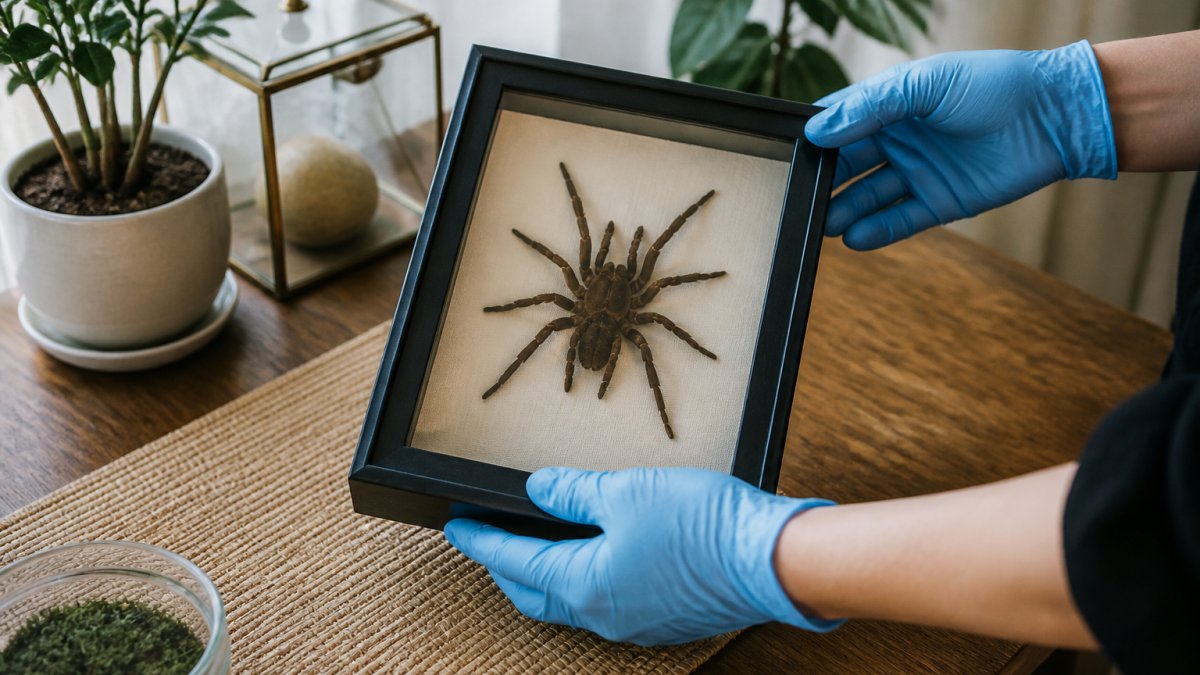
A few habits keep a specimen intact for decades:
- Hold the frame by its outer edges, never the glass or the mount.
- Keep the piece upright when moving it, so nothing shifts inside.
- Store away from direct sun, which fades colours over time.
- Dust the outside of the glass only, with a dry microfibre cloth.
Protective Equipment and Step-by-Step Handling
You do not need protective equipment for a sealed, preserved specimen. A pair of clean cotton or nitrile gloves is enough, and only to protect the piece from oils on your skin.
If you are handling an unsealed or loose specimen, such as one you are rehousing yourself, the steps are straightforward:
- Clear a flat, well-lit surface and lay down a soft cloth.
- Put on clean gloves to keep oils off the specimen.
- Lift the specimen by the mount or pin, never by a leg.
- Support the body from underneath with a small soft brush or card.
- Place it gently into its new frame or dome.
- Seal the enclosure so the specimen stays dry and dust-free.
Expected result: the specimen sits secure, with no loose parts and no contact with your bare skin. That is the whole job.
Assessing and Handling Dead or Unidentified Specimens
A dead spider found in the house is not the same as a preserved display piece. It may be dry and brittle, or recently dead and still limp. Either way, it cannot inject venom, but it can still be a mechanical irritant and a source of allergens.
Use this quick assessment before you pick anything up:
- Is it moving? If yes, it is live, do not handle it. Follow the live-spider guidance below.
- Is it stiff and dry? It is likely long dead. Treat it as fragile and use gloves or a card to move it.
- Is it limp or fresh? It may still have stiff fangs. Do not press the underside; use a tissue or glove.
- Is it unidentified? Assume it could be a species of medical concern and avoid bare-skin contact until identified.
For an unidentified specimen you want identified, do not handle it bare-handed. Use a clean jar with a lid, a soft brush or card to guide the spider in, and a piece of paper to slide under the opening. Photograph it from above and below before sealing, then contact the Australian Museum's spider identification resources or a local museum for advice on submission. Keep the jar out of reach of children and pets until you have an answer.
Can Dead Spiders Still Bite?
A dead spider can technically still pierce skin with its fangs, but it cannot inject venom. So the bite risk from a dead spider is a mechanical prick, not a venom emergency.
This is one of the most common questions we get, and the honest answer is reassuring. The fangs of a recently dead spider can stay stiff for a while. Press your finger hard onto them and you might feel a small jab. There is no venom delivery, because the venom glands are no longer pumping.
In practice, this means:
- Do not press your bare fingers onto the underside of a dead spider.
- Use a tissue, card, or gloves to move it.
- Wash the area if you do get a small prick, as you would any minor scratch.
For a preserved specimen, even this small risk disappears. The fangs are fixed in place and the piece is sealed behind glass or acrylic.
Spider Specimen Preservation Methods
The most common preservation methods for spider specimens are drying, chemical fixing, and resin or dome sealing. Each method locks the specimen in place so it stays intact and safe to display.
We use museum-quality preservation for every piece in our collection, and the method matters for both looks and longevity. Here is how the main approaches compare:
White Striped Tarantula Framed - Acanthoscurria juruenicola →
| Method | How It Works | Best For | Handling Risk |
|---|---|---|---|
| Air drying | Specimen dried slowly, then pinned | Small species, study collections | Low, fragile |
| Chemical fixing | Fluid preserves soft tissue | Scientific collections | Low once sealed |
| Resin casting | Specimen set in clear resin | Paperweights, small displays | Very low, fully sealed |
| Shadowbox framing | Specimen mounted behind glass | Home decor, gifts | Very low, sealed |
A well-preserved specimen in a sealed frame will hold its shape and colour for many years if kept out of direct sunlight. The colours can fade slowly over time, which is normal for any natural specimen.
How Preservation Affects Handling Risk
The method changes what you are actually handling. Air-dried specimens are the most fragile: legs can snap if you grip the body, and the abdomen may be hollow and brittle. Chemical fixing, such as storage in ethanol or formalin, preserves soft tissue but leaves the specimen wet and flammable until fully sealed; once sealed in a display, the chemical risk is contained. Resin casting embeds the specimen in a solid block, so there is no direct contact at all. Shadowbox framing mounts the specimen behind glass or acrylic, which keeps dust and moisture out and hands off.
Australian Spider Bite First Aid
For any suspected bite from a live spider, the first step is to keep the person calm and still, then apply a pressure immobilisation bandage and call emergency services if symptoms are severe. This is standard first aid for a serious bite.
We are not medical professionals, so treat this as general guidance and always follow official advice. The Australian Red Cross first aid guidance covers bite response in detail, and the Poisons Information Centre is the number to call for advice on any suspected envenomation.
The widely taught response for a serious bite is:
- Keep the patient still and calm to slow venom spread.
- Apply a firm pressure bandage over the bite and up the limb.
- Splint the limb to limit movement.
- Call emergency services if the person shows severe symptoms.
Watch for signs that need urgent help: severe pain, sweating, nausea, difficulty breathing, or a widespread rash. An anaphylactic reaction is a medical emergency and needs immediate help.
Which Australian Spiders Pose a Real Risk
Only a small number of Australian spiders pose a serious risk to humans, and the funnel-web spider is the main one. Most others, including the huntsman, are not dangerous.
The Australian Museum's spider identification resources are the best place to check a species. In broad terms:
- Funnel-web spiders: the most serious bite risk. They are mygalomorph spiders, and antivenom exists for the major species.
- Huntsman spiders: large and fast, but the bite is not considered dangerous to humans.
- Redback spiders: painful bite, and worth medical attention, especially for children.
- Jumping spiders and common house spiders: harmless to people.
Most Australian spider species are venomous in the sense that they use venom to subdue insects. That is not the same as being dangerous to humans. Bite severity, not venom presence, is what matters.
Children, Pets, and Allergies: Higher-Risk Situations
Children, pets, and people with allergies face higher risk from any bite, so keep live spiders well away from them. Preserved specimens in sealed frames carry no bite risk at all.
A curious child is far more likely to knock a frame off a shelf than to be harmed by the spider inside. That is the real hazard with a display piece.
For pets, the concern is different. A dog or cat may chew or bat at a framed specimen, which can break the glass. Place pieces on high shelves or wall mounts where pets cannot reach them.
People with known allergies should still treat any live spider bite as a reason to seek advice, since reactions vary. When in doubt, call the Poisons Information Centre rather than wait.
If you want the beauty of these creatures without any live-animal risk, our White Striped Tarantula Framed piece is a sealed, museum-preserved specimen in a black shadow box, ready to hang and safe to display around family.

Handling a preserved spider specimen should feel like handling art, not a hazard. The fear mostly comes from mixing up live spiders with the sealed, preserved pieces you display at home.
Frequently Asked Questions
Are preserved spider specimens dangerous to handle?
Preserved spider specimens are not dangerous to handle in the way a live spider is. The venom has no active delivery method once the specimen is preserved, so a bite cannot occur.
Can dead spiders still bite or inject venom?
A dead spider cannot inject venom. Venom delivery requires muscle contraction and a living reflex arc to drive the fangs into a target. A recently dead spider may have fangs that stay in a fixed position, so a careless press against the chelicerae could scratch skin, but no venom is transferred. Once a spider is preserved, dried, or fixed in resin, the fangs are rigid and harmless. Handle preserved spider specimens by the frame or mount, not the body.
How should you handle a spider specimen safely?
Handle preserved spider specimens by the frame, base, or dome rather than the specimen itself. Wear nitrile gloves if you need to touch the mount, work over a soft surface to avoid drops, and keep the piece away from food preparation areas.
What should you do if a spider bites you while handling it?
Move away from the spider, stay calm, and apply a pressure immobilisation bandage for any suspected funnel-web or mouse spider bite, then call 000. For other bites, wash the area with soap and water, apply a cold pack, and watch for symptoms such as swelling, sweating, nausea, or breathing difficulty. Seek urgent medical help if symptoms worsen. Antivenom is available for funnel-web bites in hospitals, and first aid is most effective when started quickly.
How can you tell whether a spider specimen is properly preserved?
A properly preserved spider specimen has a dry, odour-free body. Look for a clean seal on the frame or dome, and no condensation inside the glass.
