
7 Best Science Gifts for Biology Students
Table of Contents
- Quick Comparison: 7 Science Gifts for Biology Students
- How We Chose These Biology Gifts
- 1. Monarch Butterfly in a Frame: Best Under $70
- 2. Praying Mantis in a Black Frame: Best for Insect Behaviour Study
- 3. Giant Leaf Insect in a Frame: Best for Camouflage and Adaptation Lessons
- 4. Triple Stag Beetles in a Frame: Best for Taxonomy and Classification
- 5. Coiled Snake Skeleton in a Frame: Best for Vertebrate Anatomy
- 6. Asian Bat Skeleton in a Dome: Best for Skeletal Anatomy and Flight
- What to Check Before You Buy Science Gifts
- Frequently Asked Questions
Last Updated: September 28, 2026
Quick Comparison: 7 Science Gifts for Biology Students
Finding science gifts for a biology student usually means choosing between plastic toys that break by semester's end and serious equipment that costs more than the textbook budget. This guide from Newman Art Designs takes a different route: real, museum-preserved specimens, framed and ready to display, that double as study aids and lasting decor.
Every piece is a genuine biological specimen, professionally mounted in Australia. Prices range from $69.95 to $119.95, and each suits a different corner of the biology curriculum, from insect behaviour to vertebrate anatomy.
Here's the short version before we get into detail:
| Gift | Price | Best For | Frame or Dome |
|---|---|---|---|
| Monarch Butterfly | $69.95 | Best overall under $70 | 4 x 6" shadow box |
| Praying Mantis | $79.95 | Insect behaviour study | 5 x 7" shadow box |
| Giant Leaf Insect | $99.95 | Camouflage and adaptation | 5 x 7" shadow box |
| Triple Stag Beetles | $119.95 | Taxonomy and classification | 5 x 7" shadow box |
| Coiled Snake Skeleton | $114.95 | Vertebrate anatomy | 6 x 6" shadow box |
| Asian Bat Skeleton | $119.95 | Skeletal anatomy and flight | 7" acrylic dome |
How We Chose These Biology Gifts
A good biology gift must be scientifically accurate enough to learn from and well-made enough to stay on a shelf for years. We judged each piece on preservation quality, curriculum connection and value.

- Species identification. The exact scientific name must appear on the listing. A specimen labelled only "butterfly" or "beetle" has no study value, since a student cannot cross-reference it against a textbook or dichotomous key.
- Preservation method. Museum-quality mounting seals a specimen against humidity, UV light and pests. Shadow box frames and sealed acrylic domes qualify; open displays and adhesive-only mounts do not.
- Curriculum link. Each gift maps to a topic a student actually encounters: insect behaviour, camouflage and adaptation, taxonomy and classification, vertebrate anatomy or skeletal mechanics.
- Display footprint. A 4 x 6" shadow box suits a crowded dorm desk, while a 7" acrylic dome needs a deeper shelf. We noted each piece's space demands so you can match it to the recipient's room.
- Price band. Every piece sits between $69.95 and $119.95, the range most people spend on a meaningful gift for a student.
Durability matters as much as accuracy. Museum-quality preservation seals specimens against humidity and light damage, so a properly framed piece outlasts any kit. Every item is made in Australia and ships free in Australia, and Newman Art Designs has traded since 1996.
Where preserved specimens fit against other biology gifts
Preserved specimens are not the only option. Most biology students already own or can borrow the basics: a compound microscope, prepared slides, a dissection kit, petri dishes and a lab notebook. Those tools are excellent for hands-on work, but they are consumable or replaceable and rarely stay on display.
1. Monarch Butterfly in a Frame: Best Under $70
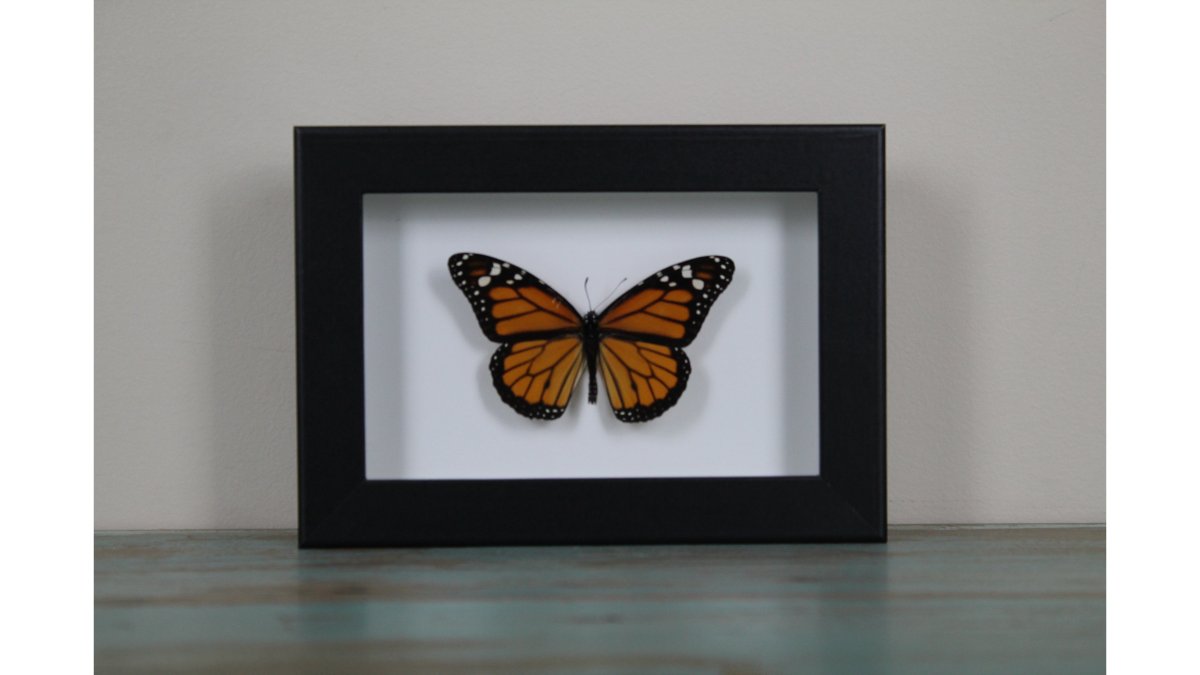
The Monarch Butterfly in a Frame is the best entry point for anyone buying science gifts on a modest budget. At $69.95, it's the lowest-priced piece in the collection, and it still delivers the full museum-quality treatment: a real Danaus plexippus specimen mounted in a 4 x 6" black shadow box.
2. Praying Mantis in a Black Frame: Best for Insect Behaviour Study
For a student drawn to animal behaviour rather than classification, the Praying Mantis in a Black Frame is the sharpest choice. This Hierodula patellifera specimen sits in a 5 x 7" black shadow box at $79.95, and it captures a predator mid-pose.
3. Giant Leaf Insect in a Frame: Best for Camouflage and Adaptation Lessons
Camouflage is one of the hardest biology concepts to appreciate from a photo, and the Giant Leaf Insect in a Frame solves that. The Phyllium giganteum specimen in this 5 x 7" shadow box ($99.95) looks so convincingly like foliage that predators struggle to tell it from a real leaf.

4. Triple Stag Beetles in a Frame: Best for Taxonomy and Classification
Classification gets tedious fast when it's just a dichotomous key on paper. The Triple Stag Beetles in a Frame ($119.95) makes it tangible: three different stag beetle specimens from the family Lucanidae, arranged together in a 5 x 7" shadow box.

5. Coiled Snake Skeleton in a Frame: Best for Vertebrate Anatomy
The Coiled Snake Skeleton in a Frame is the pick for a student heading toward zoology or veterinary study. At $114.95, this 6 x 6" black shadow box holds a real snake skeleton, and it demonstrates vertebrate structure in a way a diagram can't.
Danaus plexippus, Monarch Butterfly, in →
6. Asian Bat Skeleton in a Dome: Best for Skeletal Anatomy and Flight
Flight is biologically expensive, and the Asian Bat Skeleton in a Dome shows why. This real Cynopterus brachyotis skeleton, a non-CITES listed species, sits under a 7" acrylic dome on a wooden base for $119.95.
What to Check Before You Buy Science Gifts
Three checks separate a good purchase from a disappointing one. First, confirm the species is named on the listing, since an unnamed specimen has no study value. Second, check the mounting: shadow box frames and sealed domes protect specimens, while open displays expose them to humidity and pests. Third, verify the size against the recipient's space.
Match the gift to the student's stage and specialism
A first-year undergraduate exploring broad biology gets more from a recognisable, versatile piece such as the Monarch Butterfly in a Frame. A student who has chosen a direction needs something sharper:
- Entomology or ecology focus. A camouflaged species such as the Giant Leaf Insect rewards close observation of adaptation, and the Praying Mantis suits anyone studying predator behaviour.
- Taxonomy or systematics focus. The Triple Stag Beetles lets a student compare variation within a single family, which is exactly the skill a dichotomous key is meant to build.
- Zoology, veterinary or anatomy focus. The Coiled Snake Skeleton and the Asian Bat Skeleton both show vertebrate structure in ways a diagram cannot, and the bat in particular demonstrates the skeletal trade-offs that make powered flight possible.
- Teacher or classroom use. A framed specimen that can be passed around a year group is more practical than a fragile model.
Sustainability and sourcing
Conservation-minded students will ask where a specimen came from, and they are right to. Before buying, confirm three things: the species is named, the listing status is stated (for example, non-CITES), and the seller can describe how the specimen was sourced. If a student is uncomfortable with preserved animal specimens, a botanical or entomological alternative, or a digital resource, may be a better fit.
Digital tools worth considering alongside a physical gift
If you're unsure whether a recipient will appreciate the gift, start with the Monarch Butterfly in a Frame at $69.95. It's the safest introduction to the format, and it's the piece most likely to convert a sceptic once they see the detail up close.
Frequently Asked Questions
What is the best gift for a biology student?
The best science gifts for biology students connect directly to their studies. A museum-preserved specimen in a shadowbox frame works well because it turns textbook theory into something they can examine closely. Consider their specialisation: entomology students appreciate insect displays, while anatomy-focused students may prefer skeletal pieces like a coiled snake skeleton. Practical gifts that double as study aids or display pieces tend to get the most use.
Are preserved specimens appropriate gifts for biology students?
Yes, preserved specimens suit biology students well because they offer a tangible way to study anatomy, taxonomy and morphology. Museum-preserved insect specimens for display let students examine wing venation, exoskeleton structure and species variation up close, which supports coursework in entomology, zoology and comparative anatomy. Choose pieces from reputable sellers who can confirm ethical sourcing and professional preservation methods.
What equipment is essential for a beginner entomology student?
An 8 essential items for beginner entomology equipment list typically includes a sweep net, pitfall traps, a killing jar, spreading board, insect pins, forceps, a hand lens or magnifier, and specimen storage boxes. Add a field notebook for data collection and a reliable identification guide. For display purposes, professionally preserved specimens in frames or domes complement these tools by showing what properly mounted insects should look like.
How do I choose a high-quality science gift for a university student?
Look for accurate species labelling, durable framing or domes, and clear preservation quality. A high-quality piece names the species, states its origin. Size matters too: a 5 x 7-inch shadowbox frame fits most study spaces, while a 7-inch dome makes a stronger statement on a shelf. Check that the seller offers returns and ships items securely.
What are some unique gift ideas for someone studying biology?
Move beyond generic lab supplies. A giant leaf insect in a frame highlights camouflage and adaptation. A triple stag beetle display covers taxonomy and sexual dimorphism. A bat skeleton in a dome teaches skeletal anatomy and flight mechanics. These pieces work as both study references and decor, and they tend to spark conversation in a way a textbook or mug does not.
