
Where to Buy Scorpion Specimens: A Collector's Guide
Table of Contents
- Why Scorpion Specimens Make Striking, Educational Additions
- Ethical Insect Collecting in Australia: What to Look For
- Resin-Preserved vs. Traditional Taxidermy: Which Scorpion Specimen Is Right for You?
- How to Display Insect Specimens in Your Home
- Resin-Preserved Scorpion Care: Keeping Your Piece Looking Museum-Fresh
- What to Expect When Buying Scorpion Specimens Online
- Choosing the Right Scorpion Specimen for Your Space
- Frequently Asked Questions
Last Updated: September 15, 2026
Why Scorpion Specimens Make Striking, Educational Additions
A scorpion specimen is a preserved arachnid body, mounted or embedded for study and display. The appeal is easy to understand once you've held one: an armoured exoskeleton, a curved tail, and two pincers, all frozen mid-pose and detailed enough to reward a close look. At Newman Art Designs, we've spent years building displays around exactly this reaction.
These pieces work as more than decoration. They're an educational tool for students meeting arthropod anatomy up close, and a genuine talking point in a room full of prints and plants. The display formats we cover below range from a $79.95 shadow box frame to a $154.95 predator scene, so there's a price point for most budgets.
But first, here's what most buying guides get wrong: they treat scorpion specimens as a single product. They aren't. Where and how a specimen is preserved changes everything about how it looks, how long it lasts, and where it belongs in your home.
Ethical Insect Collecting in Australia: What to Look For
Ethical insect collecting in Australia starts with one question: was this animal bred in captivity, or taken from the wild? A responsible seller answers that without hesitation.
Captive-bred stock is the standard to insist on. It removes pressure from wild populations and gives you a consistent, well-fed specimen with intact colour and structure. Sellers should also be able to name the species, state its origin, and explain how it was preserved.
Watch for three red flags:
- No species name, only "scorpion" or "assorted insect"
- Vague origin claims like "sourced overseas" with no country
- No answer at all when you ask about breeding
If a listing won't tell you where the animal came from, assume the worst and move on.
Resin-Preserved vs. Traditional Taxidermy: Which Scorpion Specimen Is Right for You?
The choice between resin and traditional taxidermy comes down to handling, not quality. Both preserve real specimens; they simply suit different rooms and different owners.
Resin-preserved pieces are embedded in a solid block of clear Lucite. The arachnid sits suspended inside, fully protected from dust, moisture, and fingers. They're near-indestructible and ideal for high-traffic shelves or desks. A glow-in-the-dark resin hemisphere, for example, doubles as a nightlight-style accent.

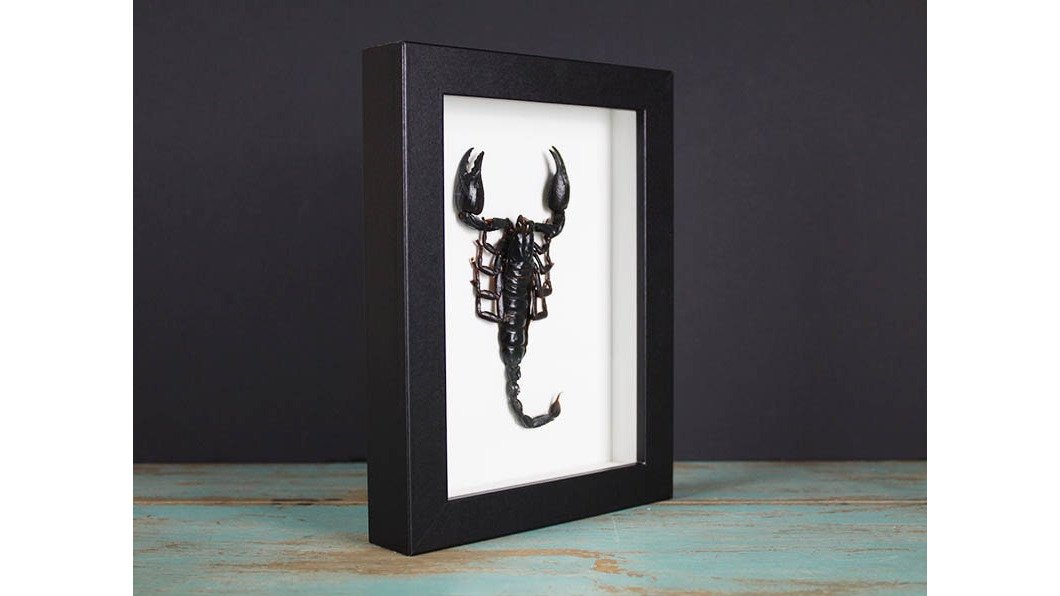
Traditional mounted specimens sit inside a sealed shadow box or glass dome. You see the full three-dimensional form, the natural stance, and the fine hair on the legs. Nothing is flattened or compressed. The trade-off is that the display case is doing the protecting, so it needs to stay sealed and out of direct sun.
| Format | Protection | Best For | Example Price |
|---|---|---|---|
| Resin block | Fully sealed, high durability | Desks, high-traffic areas, gifts | $89.95 |
| Shadow box frame | Sealed case, wall-mounted | Galleries, small apartments | $79.95 |
| Glass dome | Sealed, 3D view | Coffee tables, cabinets | $99.95-$104.95 |
| Predator scene | Sealed, large format | Statement displays | $104.95-$154.95 |
How to Display Insect Specimens in Your Home
The best place to display insect specimens is out of direct sunlight, away from heat sources, and at eye level where the detail can actually be seen. UV light is the enemy: it fades colour and degrades preserved tissue over time. A spot receiving only indirect daylight, or a few hours of gentle morning sun at most, helps keep colours stable for years rather than months.
A few practical placements that work well:
- A shadow box frame on a gallery wall, mixed with prints and mirrors
- A glass dome on a coffee table, side table, or cabinet top
- A resin hemisphere on a desk or bookshelf for a subtle accent
- A large predator scene as a single focal piece on a console
Small apartments aren't a problem. Shadow box frames hang flat against a wall, so they take up no surface space at all. If you're short on room, start with a framed piece and skip the domes.

Long-term display: what actually causes damage
Three mechanisms do almost all the harm to a displayed specimen, and each has a different fix:
- UV exposure. Fades pigment in both resin and mounted specimens and yellows the surface of clear resin over time. Fix: keep pieces off south- and west-facing sills, and rotate anything that sits in a bright room.
- Humidity swings. Mounted and domed specimens are sealed, but the case itself can fog or grow mould if the room stays damp. Fix: avoid bathrooms, laundries, and anywhere near a kettle or stovetop.
- Heat. Sustained warmth softens resin and can warp thin frames. Fix: keep pieces clear of heaters, fireplaces, and the top of a fridge or oven.
Mounting styles and how each one displays
The format you choose changes where the piece can live:
-
Resin-embedded. Fully sealed in a solid block. Near-indestructible, safe on a desk or shelf, and the only format you can hand around. Trade-off: you view it through a layer of resin, so fine surface detail is slightly softened.
-
Framed shadow box. A pinned or mounted specimen set behind glass in a deep frame. Hangs flat, protects the specimen, and reads as wall art. Trade-off: depth of the box limits how three-dimensional the pose can be.
-
Glass dome. A mounted specimen under a sealed dome. Shows the full three-dimensional form and suits a cabinet or table. Trade-off: takes up surface space and the glass shows dust and fingerprints.
Display and preservation tips for the long term
- Keep resin pieces out of direct sun to slow yellowing; a UV-filtering film on a nearby window helps if you can't move the piece.
- Dust domes and frames with a dry microfibre cloth rather than a damp one, so no moisture seeps into the seal.
- If you store a piece rather than display it, use a cool, dark cupboard with stable humidity, and pad it so nothing presses on the specimen.
- Rotate pieces seasonally if you have several, which spreads UV exposure across the collection instead of concentrating it on one.
Resin-Preserved Scorpion Care: Keeping Your Piece Looking Museum-Fresh
Resin-preserved scorpion care takes about a minute a month. Wipe the surface with a soft, dry microfibre cloth. That's it.
Avoid three things:
- Solvents and alcohol-based cleaners, which can cloud the resin surface
- Abrasive cloths or scouring pads
- Prolonged direct sunlight, which dulls the finish over time
For framed and domed pieces, the case is sealed, so you never touch the specimen itself. Keep them out of humid rooms like bathrooms and away from kitchen steam. A quick dust of the outer frame or dome is all that's needed.
What to Expect When Buying Scorpion Specimens Online
Buying scorpion specimens online is safe when the seller packs for the journey and can answer basic questions about what you're actually buying. The risk isn't the specimen; it's the shipping and the listing detail.
Here's what a well-run order looks like:
- Confirm the species name and origin are listed on the product page
How to identify what you're buying
Matching the mounting style to how you'll use it
The format should follow the job, not the photo:
Shipping, inspection, and returns
Choosing the Right Scorpion Specimen for Your Space
Use this quick framework:
Frequently Asked Questions
Is it legal to own a scorpion specimen in Australia?
Yes, owning preserved scorpion specimens is legal in Australia. The key distinction is that you are buying a dead, preserved specimen for display, not a live animal. Live scorpions are subject to strict biosecurity and wildlife regulations, but taxidermy and resin-embedded specimens fall into a different category. Always buy from a seller who can confirm the specimen was legally sourced, and avoid any product that claims to be from a protected or endangered species.
What is the difference between resin-embedded and taxidermy scorpion specimens?
Resin-embedded specimens are cast inside a clear block or hemisphere, which fully protects the scorpion from air, moisture and physical contact. Taxidermy specimens are mounted inside a shadowbox frame or glass dome, giving you a more traditional museum look. Resin pieces tend to be more durable for handling and are ideal for smaller spaces, while framed or domed specimens offer a more classic display aesthetic. Both preserve the scorpion's detail and structure.
How can I ensure my scorpion specimen was sourced ethically?
Ask the seller directly about their sourcing. Reputable sellers will confirm whether specimens were bred in captivity or collected under legal permits. Look for clear species names, country of origin and any statement about sustainable practices. If a listing is vague about where the scorpion came from or refuses to answer questions, treat that as a red flag. Ethical insect collecting in Australia means choosing sellers who prioritise transparency and avoid endangered species.
How should I care for a preserved scorpion specimen to prevent damage?
Keep your specimen out of direct sunlight, which can fade colours over time. For framed or domed pieces, display them away from high-humidity areas like bathrooms or kitchens. Resin-preserved specimens can be wiped with a soft, dry cloth; avoid solvents or abrasive cleaners. If you need to move the piece, handle the frame or base rather than the specimen itself. With basic care, a quality preserved scorpion will last for many years.
Choosing a scorpion specimen is really a question of matching format to space and trusting the seller to be honest about origin. Get those two things right and you'll have a piece that lasts for years. Newman Art Designs hand-builds museum-quality displays in Australia, offers free shipping nationwide, and has been doing it since 1996. Browse the collection and find the piece that fits your room.
