
High End Nature Wall Decor: A 2026 Guide
Table of Contents
- What Makes High End Nature Wall Decor Worth the Investment
- Luxury Nature-Inspired Wall Art: Categories to Know
- Museum-Preserved Specimen Display: The Most Distinctive High End Nature Wall Decor
- Shadowbox Frame Styling Tips for Specimen and Nature Art
- Framed Art Options vs Large-Scale Canvas Art: Choosing the Right Format
- Sustainability and Material Sourcing in Premium Nature Decor
- Interior Design Styling Advice: Biophilic Design at Home
- Conclusion
Last Updated: August 28, 2026
High end nature wall decor is one of the few home decor categories where the gap between cheap and premium is immediately obvious. At Newman Art Designs, we've spent decades working with nature-inspired art pieces that stop people in their tracks. This guide covers every major category of luxury nature wall decor, explains what separates archival-quality work from mass-produced imitations, and gives you practical advice on styling, placement, and sustainability.
The best nature wall decor isn't just decorative. It's a conversation between the natural world and the space you live in.
What Makes High End Nature Wall Decor Worth the Investment
Premium nature wall decor earns its price through material quality, artistic integrity, and longevity that budget alternatives cannot replicate. A mass-produced canvas print fades within a few years. A museum-grade fine art print on archival paper or a properly preserved specimen in a handcrafted shadowbox frame remains vibrant for generations.
Three factors define genuine quality:
- Archival materials: Museum-grade inks, acid-free mounting boards, and UV-resistant glass prevent colour degradation
- Craftsmanship: Hand-stretched canvas, hand-mounted specimens, and custom framing require skilled labour that mass production cannot replicate
- Provenance and sourcing: Ethically sourced specimens and limited-edition prints carry documented origins that add legal certainty and collector value
The cost-per-year calculation favours premium work. A piece lasting 30 years at higher upfront cost outperforms a cheaper alternative replaced every few years, before accounting for aesthetic and emotional value.
According to the Australian Competition and Consumer Commission's guidance on product quality and durability, consumers have the right to expect goods to last a reasonable time relative to their price and the seller's representations.
| Format | Typical Longevity | Key Quality Indicator | Best For |
|---|---|---|---|
| Museum-preserved specimen | Decades with care | Archival mounting, sealed frame | Statement pieces, collectors |
| Fine art photography print | 75-100+ years (archival) | Archival inks, acid-free paper | Landscape and coastal art |
| Gallery-wrapped canvas | 25-50 years (premium) | Hand-stretched, UV-resistant | Large-scale feature walls |
| Botanical giclee print | 50-75 years (archival) | Giclee process, archival paper | Botanical and floral themes |
| Custom metal sculpture | Indefinite (treated) | Powder-coated, weatherproof | Indoor and outdoor display |
Luxury Nature-Inspired Wall Art: Categories to Know
Luxury nature-inspired wall art spans several distinct categories, each suited to different interior aesthetics and collector preferences.
Landscape and Fine Art Photography Prints
Fine art landscape photography sits at the intersection of technical mastery and artistic vision. The best work is produced by photographers who spend years developing a relationship with specific landscapes, capturing images that feel genuinely immersive rather than merely pretty.
High-resolution capture is non-negotiable. Large-scale prints reveal every detail, so images shot with professional-grade equipment on archival-quality paper hold their visual impact where lesser work falls apart. Look for prints produced using archival inks rated for longevity, mounted on acid-free substrates, and optionally behind museum-grade UV-filtering glass.
Australian landscape photography has particular depth as a genre, shaped by unique light conditions, ancient geological formations, and coastal environments found nowhere else. This work carries a specificity of place that imported landscape art rarely achieves.
The National Gallery of Australia's resources on collecting Australian photography offer useful context on what distinguishes fine art photography from decorative reproduction.
Botanical and Floral Art Prints
Botanical art has a longer fine art pedigree than most people realise, dating back centuries as scientific documentation before evolving into a celebrated art form.
Contemporary botanical wall decor ranges from hand-painted illustrations reproduced as high-quality giclee prints to pressed flower artworks and photographic studies of native flora. The best pieces combine scientific accuracy with genuine aesthetic composition, working equally well in a study, bedroom, or formal living room.
Giclee printing on archival paper produces colour accuracy and tonal depth that standard digital printing cannot match. Native Australian botanical subjects feature a distinctive palette: muted ochres, eucalyptus greens, and dusty pinks that create visual warmth complementing both contemporary and traditional interiors.
Wildlife Illustrations and Ocean and Coastal Wall Art
Wildlife illustrations require both artistic skill and biological accuracy. The best examples feel like scientific documents that happen to be beautiful, capturing posture, scale, and anatomical detail with precision that rewards close inspection.
Ocean and coastal wall art brings movement, light on water, and the particular quality of coastal atmospheres. Large-scale coastal photography or painting creates an immersive effect in a room, particularly when the colour palette echoes existing tones.
Both categories benefit enormously from scale. A 30cm coastal print is decorative; the same image at 120cm becomes a focal point that changes the entire room's character.
Museum-Preserved Specimen Display: The Most Distinctive High End Nature Wall Decor
Museum-preserved specimen display is the most distinctive and conversation-generating category in high end nature wall decor. A properly preserved and mounted butterfly, beetle, or spider specimen is simultaneously a scientific artefact, a work of craft, and a genuinely beautiful object.
Newman Art Designs has been creating museum-quality specimen displays since 1996, specialising in butterflies, beetles, spiders, scorpions, and snake skeletons elegantly mounted in shadowbox frames and glass domes. Each piece requires skilled hand-mounting that positions the specimen to reveal its natural form and intricate details.
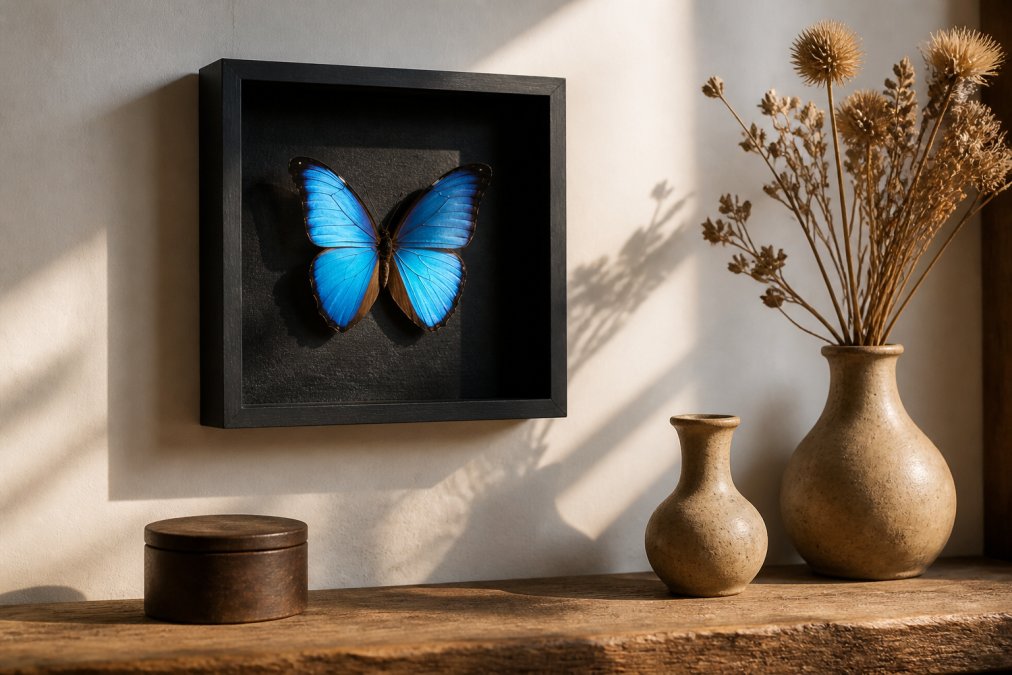
Customers consistently describe these pieces as the single most-commented-on item in their home, noting they are "absolutely amazing" with "impeccable" shipping and "absolutely stunning" presentation.
Ethically Sourced Specimens and Why It Matters
Ethical sourcing is the question every serious buyer should ask before purchasing preserved specimen art. Ethically sourced specimens come from regulated breeding programmes, natural mortality collection, or licensed suppliers operating within the Australian Environment Protection and Biodiversity Conservation Act 1999, which governs the import, export, and trade of wildlife specimens. Reputable sellers can document provenance and demonstrate compliance with relevant regulations.
When you buy from a verified ethical source, you support sustainable practices rather than wild collection from vulnerable populations and protect yourself legally, since possession of improperly sourced specimens can carry penalties under Australian law.
Longevity and Archival Quality
A properly preserved and mounted specimen, kept under appropriate conditions, remains stable for many decades. Museum-grade preservation techniques use methods developed over generations of natural history collection. Specimens are stabilised against biological degradation, mounted on acid-free substrates, and sealed within frames protecting against dust and humidity fluctuation. UV-filtering glass or acrylic prevents colour fading from ambient light.
Keep specimen displays away from direct sunlight and areas of high humidity. A well-ventilated living room or study is ideal; avoid bathrooms and kitchens.
Shadowbox Frame Styling Tips for Specimen and Nature Art
Shadowbox frame styling determines whether specimen and nature art sings or gets lost. The frame is an active part of the composition.
Deep shadowbox frames work best for three-dimensional specimens because the depth creates a shadow separating the specimen from its background, giving it visual presence. Dark backgrounds (black, deep navy, forest green) make colourful specimens appear more vibrant. Light backgrounds (cream, white, pale grey) suit skeletal specimens and work better in minimalist interiors.
Gallery Wall Layouts and Art Curation
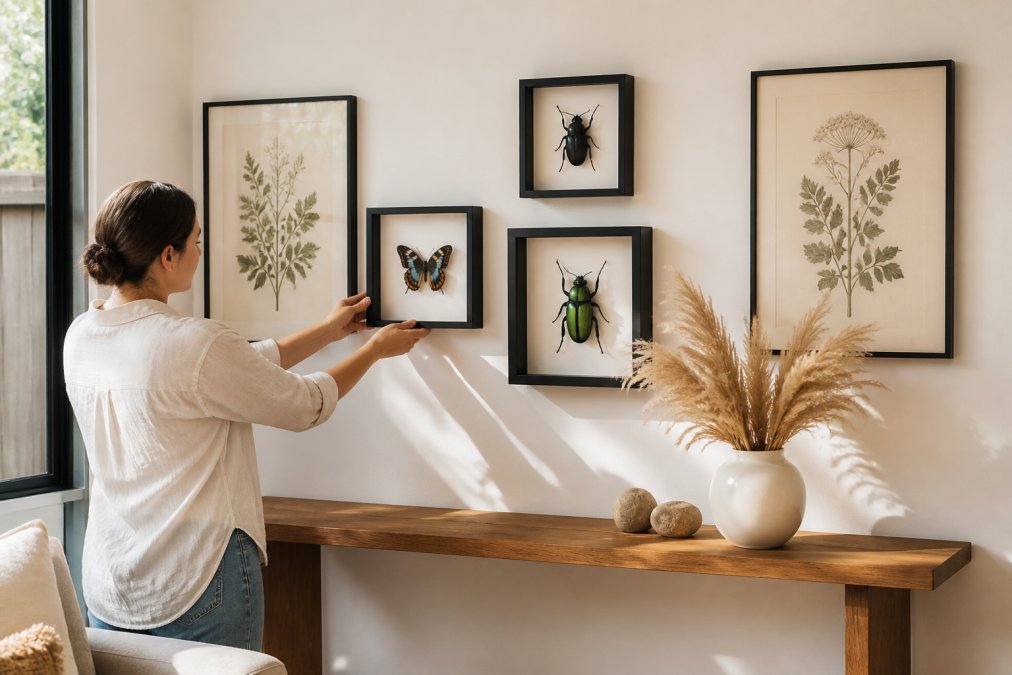
Gallery wall layouts for nature art require more thought than standard print arrangements because pieces have different visual weights. Start with your largest or most visually complex piece as the anchor, then build outward. Mix formats deliberately: a shadowbox specimen alongside a fine art photography print and a botanical giclee creates visual variety. Keep consistent spacing (typically 5-8cm between frames) for a curated effect.
Practical layout principles:
- Centre the arrangement at eye level (approximately 145-150cm from floor to the centre)
- Use paper templates on the floor before committing to wall fixings
- Odd numbers of pieces (3, 5, 7) create more dynamic arrangements than even numbers
- Mix frame depths and finishes deliberately
Lighting and Placement Tips
Lighting transforms nature wall decor from background decoration to focal point. Picture lights, directional spotlights, and adjustable track lighting all work well, but avoid light sources generating heat or UV radiation, which degrade specimens and fine art prints.
LED picture lights are the current standard: they produce minimal heat, have excellent colour rendering, and can be tuned to warm or neutral colour temperature. Warm white (2700-3000K) suits botanical and specimen art. Neutral white (3500-4000K) works better for photography prints requiring accurate colour reproduction.
North-facing walls receive the most consistent indirect light throughout the day and are ideal for displaying fine art and specimen work. South-facing walls receive direct afternoon sun, which is the fastest route to fading.
Framed Art Options vs Large-Scale Canvas Art: Choosing the Right Format
Framed art and large-scale canvas art solve different problems. Choosing between them depends on wall scale, interior style, and specific artwork.
Framed art (including shadowbox frames, glass-fronted fine art prints, and botanical prints in timber or metal frames) suits smaller walls, detailed work rewarding close inspection, and interiors where a precise, finished edge matters aesthetically. Custom framing allows you to match timber tones, metal finishes, and mat colours to your existing palette.
Large-scale gallery-wrapped canvas art suits feature walls, open-plan spaces, and work where the image carries visual impact without needing a frame. Gallery-wrapped canvas has no frame: the image wraps around stretcher bars, creating a clean, contemporary look. Hand-stretched canvas on solid timber stretcher bars is the quality standard; avoid staple-backed canvas on thin MDF, which warps over time.
For specimen and botanical art, framing almost always wins. The detail and three-dimensionality benefit from the depth and protection a quality frame provides. For large-scale landscape and coastal photography, canvas or glass-mounted prints at significant scale create the immersive effect smaller framed versions cannot.
Sustainability and Material Sourcing in Premium Nature Decor
Sustainability in premium nature decor is more complex than it appears. For specimen art, ethical sourcing is primary. For fine art prints and canvas art, sustainability considerations shift to materials: whether inks are water-based and free of harmful solvents, whether papers and substrates are FSC-certified, and whether frames are made from sustainably sourced timber or recycled materials.
Premium producers increasingly document material sourcing because environmentally conscious buyers ask for it. FSC-certified framing timber, water-based archival inks, and acid-free mounting boards are the baseline for genuinely responsible premium production. The Forest Stewardship Council's certification standards provide the global benchmark for responsible timber sourcing, including for picture framing.
Buying less but better is the most sustainable approach to home decor. A single archival-quality piece lasting 50 years has a dramatically lower environmental footprint than five cheap prints replaced every decade.
Interior Design Styling Advice: Biophilic Design at Home
Biophilic design incorporates natural elements, patterns, and references into built environments to support human wellbeing. Nature wall decor is one of the most accessible and impactful biophilic design tools available. Research by RMIT University's research into sustainable and biophilic built environments consistently finds that exposure to natural imagery and materials in interior environments supports reduced stress and improved mood.
Practical biophilic styling for nature wall decor:
- Anchor with a statement piece: A large-scale landscape or prominent specimen display establishes the natural reference point
- Layer textures: Combine flat fine art prints with three-dimensional specimens and organic timber frames for visual richness
- Extend the colour palette: Use colours in your nature wall decor to inform soft furnishing choices
- Avoid overcrowding: A single extraordinary piece in a considered space creates more impact than a wall covered in competing imagery
- Mix the living and the preserved: Combining living plants with preserved specimen art and fine art photography creates the most immersive natural environment
Biophilic design works through restraint as much as abundance, and done well, it doesn't date.
Choosing high end nature wall decor is genuinely difficult when the market mixes archival-quality work with mass-produced imitations that look similar in photographs but feel entirely different in person. Newman Art Designs addresses this directly: museum-quality preservation techniques developed over nearly three decades, ethically sourced specimens documented to meet Australian regulatory standards, and free shipping on every order. Shop the Newman Art Designs collection to find a piece that will anchor your space for years to come.
Frequently Asked Questions
What defines high end nature wall decor?
High end nature wall decor is distinguished by archival-quality materials, expert craftsmanship, and sourcing integrity. This includes museum-grade preservation techniques for specimen displays, archival gicléee or fine art paper for prints, hand-stretched canvas, and custom or gallery-wrapped framing. The visual impact is immediate: pieces carry genuine artistic composition, a considered colour palette, and the kind of texture and detail that mass-produced prints cannot replicate. Premium quality also means longevity, pieces that hold their vibrancy and structural integrity for decades.
How do I style museum-preserved specimens in my home?
Museum-preserved specimen displays work best as statement pieces on a feature wall with plenty of negative space around them. Mount a single large shadowbox frame at eye level against a neutral or deep-toned wall to maximise visual impact. For a gallery wall, group odd numbers of frames in varying sizes, mixing specimen displays with botanical art prints to create a cohesive nature-inspired arrangement. Warm, directional lighting, such as a picture light or adjustable downlight, highlights the texture and detail of the preserved specimen without causing glare.
Are shadowbox frames suitable for luxury interior design?
Shadowbox frames are well suited to luxury interiors precisely because they add depth and dimension that flat prints cannot. The three-dimensional presentation of a preserved butterfly or beetle specimen creates an immersive focal point that draws the eye and invites closer inspection. In minimalist or biophilic design schemes, a single deep-set shadowbox in a dark timber or matte black finish reads as a sophisticated, museum-quality accent rather than a novelty item. The key is choosing frames with clean lines and a premium finish that complements the room's existing aesthetic.
What are the benefits of using ethically sourced natural specimens in decor?
Ethically sourced specimens come from suppliers who work within established wildlife trade regulations, in Australia, this means compliance with the Environment Protection and Biodiversity Conservation Act 1999, ensuring no endangered species are collected. Beyond compliance, ethical sourcing means the specimens are typically farm-raised or collected from natural mortality, which supports conservation rather than undermining it. For the buyer, it means confidence that the piece carries genuine provenance, adding to its value as a collector's item and making it a more meaningful conversation piece in any home.
How do I care for framed insect or skeleton wall art?
Museum-preserved specimen art requires minimal maintenance when displayed correctly. Keep pieces away from direct sunlight to prevent colour fading, and avoid high-humidity areas such as bathrooms or kitchens, which can affect the preservation medium. Dust the frame exterior gently with a soft, dry cloth. The sealed shadowbox or glass dome housing protects the specimen from insects and airborne particles. Properly preserved and displayed, museum-quality pieces can remain in excellent condition for many decades without any specialised treatment.
This article was written using GrandRanker
